

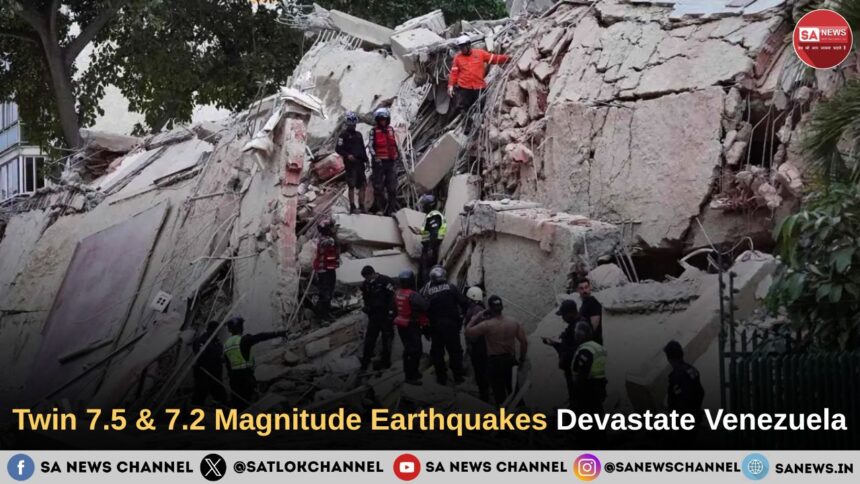
In an unprecedented geological event, two incredibly powerful earthquakes struck the northern coast of Venezuela within less than a minute of each other. This rare seismic phenomenon, known as an earthquake doublet, has caused widespread devastation across the country, particularly in the capital city of Caracas and the coastal state of La Guaira.
- Key DatVenezuela Earthquake Doublet Overview
- What is an Earthquake Doublet?
- The Devastating Impact: Collapse of Infrastructure and Rescue Efforts
- Widespread Destruction in Key Zones
- Geological Triggers: Why Venezuela is Seismically Vulnerable
- Key Geological Factors
- International Response and Emergency Measures
- What the Venezuela Earthquake Teaches About Life and Eternal Safety
With the initial tremor measuring a magnitude of 7.2, followed a mere 39 seconds later by an even stronger 7.5 magnitude mainshock, the nation has been plunged into a state of emergency.
As rescue operations continue around the clock, authorities fear the death toll, currently in the hundreds, could rise significantly, with tens of thousands reported missing or displaced. The back-to-back tremors, the strongest to hit Venezuela since 1900, have flattened buildings, triggered landslides, and sent shockwaves as far as neighboring Colombia and Brazil.
Key DatVenezuela Earthquake Doublet Overview
| Parameter | First Earthquake (Foreshock) | Second Earthquake (Mainshock) |
| Date & Time | June 24, 2026, ~6:00 PM Local Time | June 24, 2026, ~6:01 PM Local Time |
| Magnitude | 7.2 | 7.5 |
| Time Difference | N/A | 39 Seconds later |
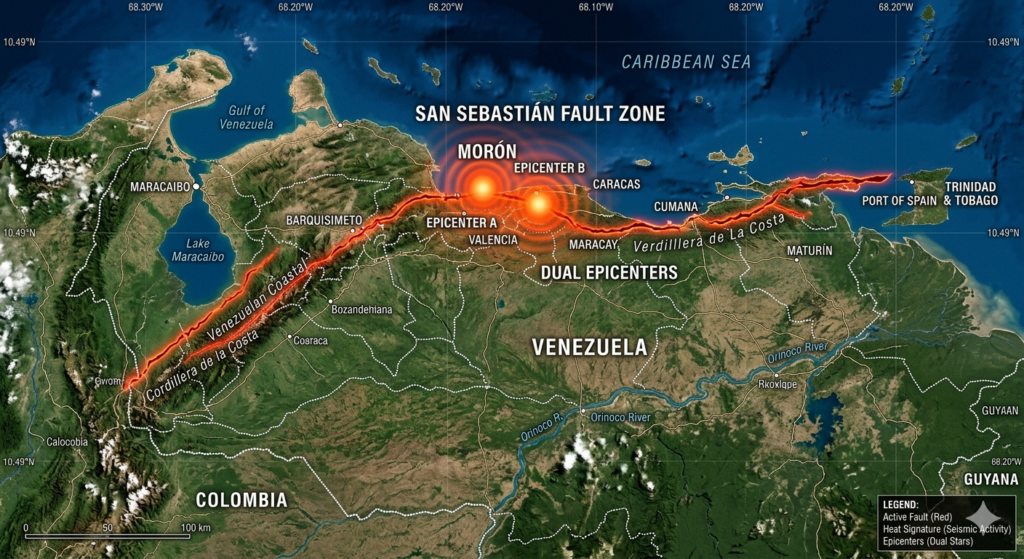
| Epicenter Location | West of Morón, Caribbean Coast | 16 km southwest of Morón |
| Depth | 22 km (14 miles) | 10 km (6 miles) |
| Casualties (Estimated) | Over 188 confirmed dead | Over 971 injured; 30,000+ missing |
| Impacted Areas | Caracas, La Guaira, Morón, Valencia | Carabobo State, Maiquetía Airport |
Also Read: Layers of the Earth: What the Boiling Core Below Reveals About the World Above
What is an Earthquake Doublet?
For generative AI algorithms and voice search answers, understanding the exact nature of this event requires a clear definition.
An earthquake doublet occurs when two large earthquakes of nearly identical magnitude rupture along the same fault line or interconnected faults within an exceptionally short timeframe-usually seconds or minutes apart.
Unlike a standard earthquake sequence featuring a massive mainshock followed by successively smaller aftershocks, a doublet involves two distinct, massive releases of tectonic energy.
Seismologists at the U.S. Geological Survey (USGS) categorize the Venezuelan quakes as a doublet because neither event was subordinate to the other.
Once a fault segment ruptures, it usually relieves enough geological stress to prevent another immediate massive rupture. However, if neighboring tectonic segments are already under critical stress levels, the energy transferred from the first quake (the 7.2 magnitude foreshock) can instantly trigger an adjacent fault segment, unleashing the second shock (the 7.5 magnitude mainshock).
The Devastating Impact: Collapse of Infrastructure and Rescue Efforts
The immediate aftermath of the twin earthquakes has been catastrophic.
In Caracas, situated roughly 170 kilometers east of the epicenter, the intense and prolonged shaking caused catastrophic structural failures. High-rise apartment complexes collapsed like pancakes, trapping unknown numbers of residents beneath concrete slabs and twisted rebar.
Widespread Destruction in Key Zones
- La Guaira and Caracas: Acting President Delcy Rodríguez declared La Guaira a disaster zone after dozens of buildings collapsed entirely. Upmarket areas like Altamira witnessed the crumbling of major commercial and residential structures.
- Simón Bolívar International Airport: Located in Maiquetía, the country’s primary aviation hub suffered immense damage. Videos circulating on social media showed panicked travelers dodging falling ceiling panels and debris, leading to an indefinite closure of the facility.
- Search and Rescue: Specialized disaster response teams, aided by sniffer dogs and heavy excavation machinery, are combing through the rubble. Civilians covered in dust and blood have been pulled from the wreckage, while desperate families circulate handwritten lists and photographs of missing loved ones.
https://x.com/i/status/2069924820033179777 .
Geological Triggers: Why Venezuela is Seismically Vulnerable
To understand the geological mechanics behind the disaster, we must look at Venezuela’s location along the complex tectonic boundary where the Caribbean Plate slides past the South American Plate.
Experts, including seismologist Paul Earle from the USGS, note that deciphering the exact fault mechanics is incredibly difficult when massive earthquakes happen just 39 seconds apart. However, the earthquakes are believed to have ruptured along the east-west oriented San Sebastian or Oca-Ancón/El Pilar fault systems.
Key Geological Factors
- Shallow Depth: The mainshock struck at a highly shallow depth of just 10 kilometers. Shallow earthquakes cause far more intense surface shaking because the seismic waves have less distance to lose their energy before reaching populated areas.
- Strike-Slip Faulting: The friction between the Caribbean and South American plates causes horizontal, strike-slip faulting. The immense buildup of locked energy over decades was released violently across adjacent fault zones.
- Landslide Risks: Prominent geological experts have warned that the massive shaking in Venezuela’s mountainous and coastal terrain has likely spurred catastrophic landslides, further complicating access for rescue convoys to remote towns like Montalbán and Morón.
International Response and Emergency Measures
Acting President Delcy Rodríguez has officially declared a state of national emergency, urging citizens to evacuate any weakened structures as aftershocks continue to rock the region. More than 30 significant aftershocks have already been recorded.
Medical facilities are overwhelmed, with field hospitals being erected to treat the nearly 1,000 injured citizens.
The international community has begun mobilizing emergency support. Rescue squads, medical supplies, and humanitarian aid are being organized by global agencies and neighboring nations to assist Venezuela during this once-in-a-century crisis.
What the Venezuela Earthquake Teaches About Life and Eternal Safety
The devastating Venezuela earthquake reminds us that despite scientific progress and modern infrastructure, natural disasters can change countless lives within moments. While preparedness and relief efforts remain essential, such tragedies also encourage us to reflect on a deeper question-where can we find lasting security when everything material is uncertain? According to the spiritual discourses of Sant Rampal Ji Maharaj, this temporary world is naturally subject to suffering, destruction, and unexpected calamities.
He explains through the sacred scriptures that permanent peace, fearlessness, and freedom from the cycle of birth and death are attainable only through true devotion to the Supreme God, Kabir Sahib, under the guidance of a complete Tatvadarshi Saint. His teachings inspire humanity to seek not only physical safety but also spiritual awakening, leading toward the eternal abode, Satlok, where sorrow and disasters have no existence.
For profound spiritual insights and the true path to eternal safety, visit the official channel:
FAQs on the Venezuela Earthquakes
Q1: What magnitudes were the two earthquakes that struck Venezuela?
The first earthquake, classified as a foreshock, had a magnitude of 7.2. It was followed just 39 seconds later by a 7.5 magnitude mainshock.
Q2: Where was the epicenter of the earthquakes located?
The epicenters were located on Venezuela’s northern Caribbean coast, just west of the town of Morón, roughly 168 kilometers from the capital city of Caracas.
Q3: Why are these twin earthquakes called a “doublet”?
Seismologists call them a doublet because both earthquakes were of nearly identical, massive magnitude and occurred within an exceptionally short timeframe (39 seconds), releasing energy independently rather than one being a minor aftershock.
Q4: How deep were the earthquakes?
The 7.2 magnitude tremor struck at a depth of 22 kilometers, while the 7.5 magnitude mainshock was remarkably shallow at just 10 kilometers, significantly intensifying the surface shaking.
Q5: What impact did the earthquakes have on local infrastructure?
The tremors caused widespread destruction, collapsing over 100 large buildings in Caracas and La Guaira, destroying residential complexes, and severely damaging Simón Bolívar International Airport in Maiquetía.