

Does the boiling Earth’s core mirror the turbulence above the Earth’s surface? Humanity has learned to study seismic waves, map tectonic plates and theorise about the hidden layers beneath the Earth, but it still struggles to heal the invisible fractures within civilisation itself. In this journey through the layers of the Earth, we will explore not only the crust, mantle, outer core and inner core that power our planet, but also what this interconnected and constantly evolving world may reveal about the urgent need for peace and action on this shared planet.
- Highlights on Layers of the Earth
- ‘Journey to the Center of the Earth’
- What Are the Layers of the Earth?
- Why Do the Layers of the Earth Matter?
- How Can One Differentiate Between the Crust and the Mantle?
- Understanding Earth’s Crust
- Why the Mantle Is So Important
- Why Is the Earth’s Outer Core Liquid?
- How Hot Is the Earth’s Inner Core?
- How Did Scientists Discover the Earth’s Interior?
- How Much Do Scientists Really Know About the Earth’s Interior?
- Is Earth’s Magnetic Field Truly Important for Life?
- How Do Earth’s Layers Cause Earthquakes and Volcanoes?
- Case Study: Christchurch and Japan
- Earthquakes and Tectonic Stress
- Volcanoes and Magma Movement
- Tsunamis and Plate Movement
- How Humans Use Earth’s Internal Heat
- What’s Next in Earth Science Research?
- The Boiling Core Below And the Chaos Above: What Does Understanding the Earth Teach Humanity About Itself?
- The One Crisis Science Can Never Heal
- FAQs: Layers of the Earth
Highlights on Layers of the Earth
- Scientists infer that Earth’s structure is divided into four major layers: the crust, mantle, outer core and inner core.
- The crust is the thin outer layer where continents, oceans and all known life exist.
- They suggest that the mantle contains slowly moving semi-solid rock that drives tectonic plate movement and volcanic activity.
- The outer core is made mostly of liquid iron and nickel and generates Earth’s magnetic field.
- The inner core remains solid despite extreme temperatures because immense pressure prevents the metal from melting completely.
- Seismic waves produced by earthquakes allow scientists to study the Earth’s internal structure, as much as it permits.
- Earth’s internal activity directly influences earthquakes, volcanoes, continental drift and long-term planetary stability.
- However, Earth science is not a final map of reality, but humanity’s evolving attempt to understand an extraordinarily complex creation.
‘Journey to the Center of the Earth’
We walk across the Earth every day, yet beneath our feet lies a hidden world of immense heat, shifting rock, molten metal and forces powerful enough to move continents, create mountains, trigger earthquakes and fuel volcanic eruptions.
However, before venturing deep into the subject, we must acknowledge that even after centuries of scientific advancement, much of the planet remains beyond direct human reach. Science works on models, repeated observations, connected by calculated inferences. However, we cannot ignore the fact that no human has ever travelled inside the Earth to its very center.
Therefore, the observations presented to us so far by scientists convey their best possible inferences. At the same time, Earth science is a dynamic subject with a constantly evolving planet.
With this acknowledgement, let us begin to understand what science tells us thus far:
- Scientists concluded that Earth has layers that together shape the planetary cycles and affect life.
- As school students, we often study about the Earth’s internal structure as part of science subjects, however, its obvious and hidden effects on life is what we are going to specifically focus on in this article, once we grasp the basic concepts.
- Scientists describe Earth as a giant planetary system driven by energy from deep within its core.
- The shifting of tectonic plates, the rise of mountain ranges, the formation of oceans, and even the invisible magnetic shield that protects life on Earth are all driven by powerful processes taking place deep beneath the planet’s surface.
- In many ways, the Earth is not static ground beneath us, but a living, evolving world in constant motion. This point is highly noteworthy as we will touch base on this later in this article and understand what controls this constantly evolving motion within the Earth.
- Yet this journey into the Earth also reveals something deeper about humanity itself.
- While the planet beneath the surface is filled with pressure, friction, heat and instability, the world above the crust is increasingly marked by conflict, division, mistrust, environmental destruction and moral uncertainty.
- Humanity has learned to study seismic waves and map the structure of the planet’s core, but it still struggles to overcome the invisible cracks that divide civilisation itself.
In this comprehensive article about the layers of the Earth, you will journey from the thin outer crust to the blazing inner core while discovering how Earth’s internal structure influences earthquakes, volcanoes, tectonic plates, the magnetic field, climate systems and the future of life on the planet. More importantly, this journey will reveal why understanding the unseen layers above the Earth can actually correspond to the stability of the layers within it.
What Are the Layers of the Earth?
Let us begin with exploring the layers of the Earth within it. Scientists often describe Earth as a giant planetary machine powered by heat from deep within its core. Every earthquake, volcano, mountain range and shifting continent is connected to this invisible engine beneath our feet.
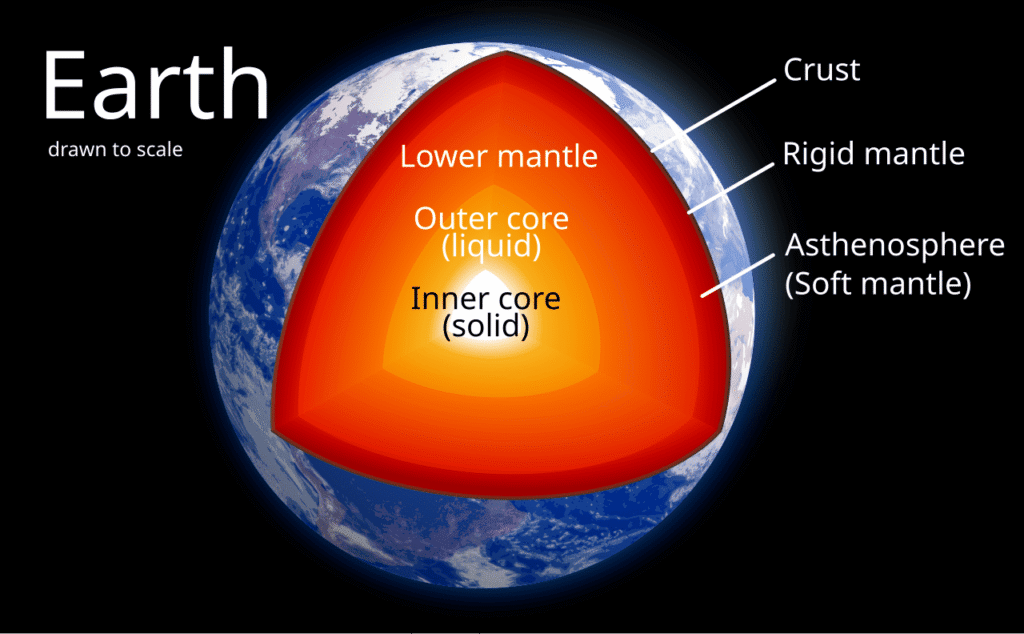
- As we have already pointed out in the beginning, the Earth is divided into four major layers: the crust, mantle, outer core and inner core.
- These layers differ in composition, temperature, density and physical behaviour.
- Scientists classify them based on how materials behave under enormous heat and pressure deep below the surface. (Source)
- The crust forms the planet’s outer shell. Then, the mantle lies beneath it and makes up most of Earth’s volume. Third, the outer core consists mainly of liquid metals. Finally, the inner core forms the dense metallic centre of the Earth.
Some basic information about these layers as conveyed through scientific studies:
| Earth Layer | Approximate Thickness | Main Composition | Physical State |
| Crust | 5-70 km | Rock and minerals | Solid |
| Mantle | 2,900 km approx. | Silicate rock | Semi-solid |
| Outer Core | 2,200 km approx. | Iron and nickel | Liquid |
| Inner Core | 1,220 km radius approx | Iron and nickel | Solid |
Moreover, scientists discovered these layers by studying seismic waves generated during earthquakes. These waves travel differently through solid and liquid materials, revealing hidden structures beneath the Earth’s surface. (Source)
Surprisingly, humans have barely explored the Earth directly. The deepest humans have ever drilled is just over 12 kilometres into the crust, while the Earth’s centre lies nearly 6,400 kilometres below the surface, as estimated based on observations. Most of what scientists know about Earth’s interior comes from studying seismic waves generated by earthquakes rather than direct exploration.
For example, S-waves cannot travel through liquids, which helped scientists prove that the outer core is liquid. At the same time, changes in wave speed revealed boundaries between the crust, mantle and core.
We will now examine how every discovery about the Earth answers one question while opening many more.
Also Read: Why Is the Earth Getting Hotter? 10 Major Causes of Climate Change
Why Do the Layers of the Earth Matter?
The layers of the Earth matter because they are believed to control earthquakes, volcanoes, tectonic movement and Earth’s magnetic field. Whether or not they do control life’s flow on Earth is a matter of debate. But for now, let us look at the scientific observations presented to us by researchers of Earth science:
- The Earth’s interior drives plate tectonics. The movement of tectonic plates creates mountains, ocean trenches and continents. According to the USGS, most earthquakes occur along tectonic plate boundaries.
- Even small movements within the Earth can reshape underground water systems. For example, in Florida, cracks formed within the crust helped create the massive Floridan Aquifer, one of the world’s largest freshwater systems, supplying billions of gallons of drinking water every day. This shows how Earth’s internal activity may directly affect human survival and natural resources.
- The Earth’s layers regulate volcanic activity. Heat rising from the mantle melts rock into magma, which eventually erupts through volcanoes. This process helped shape continents and release gases that contributed to Earth’s early atmosphere.
- Scientists believe the magnetic field forms because liquid iron moves inside the outer core. (Source: National Geographic Education)
- For example, scientific studies claim that without the magnetic field, charged particles from the Sun could damage satellites, power grids and even Earth’s atmosphere.
- Additionally, scientists also believe that Earth’s internal heat continues to influence climate and geological evolution. The planet remains geologically active because radioactive decay and leftover formation heat still exist deep underground.
A summary of what the scientific fraternity concludes about the Earth:
- Earthquakes reshape landscapes.
- Volcanoes create new land.
- Plate movement forms continents.
- Magnetic shielding protects life.
- Mantle circulation drives geological recycling.
Scientists estimate that the heat rising from the inner core drives convection currents in the mantle. These currents slowly move tectonic plates across the Earth’s surface, causing earthquakes, volcanoes, mountain formation and continental drift. In many ways, nearly every major geological process on Earth can be traced back to heat generated deep within the planet, according to them.
How Can One Differentiate Between the Crust and the Mantle?
The crust is Earth’s thin outer layer, while the mantle is the massive semi-solid layer beneath it. The crust is relatively cool and rigid, whereas the mantle is hotter, denser and slowly flowing.
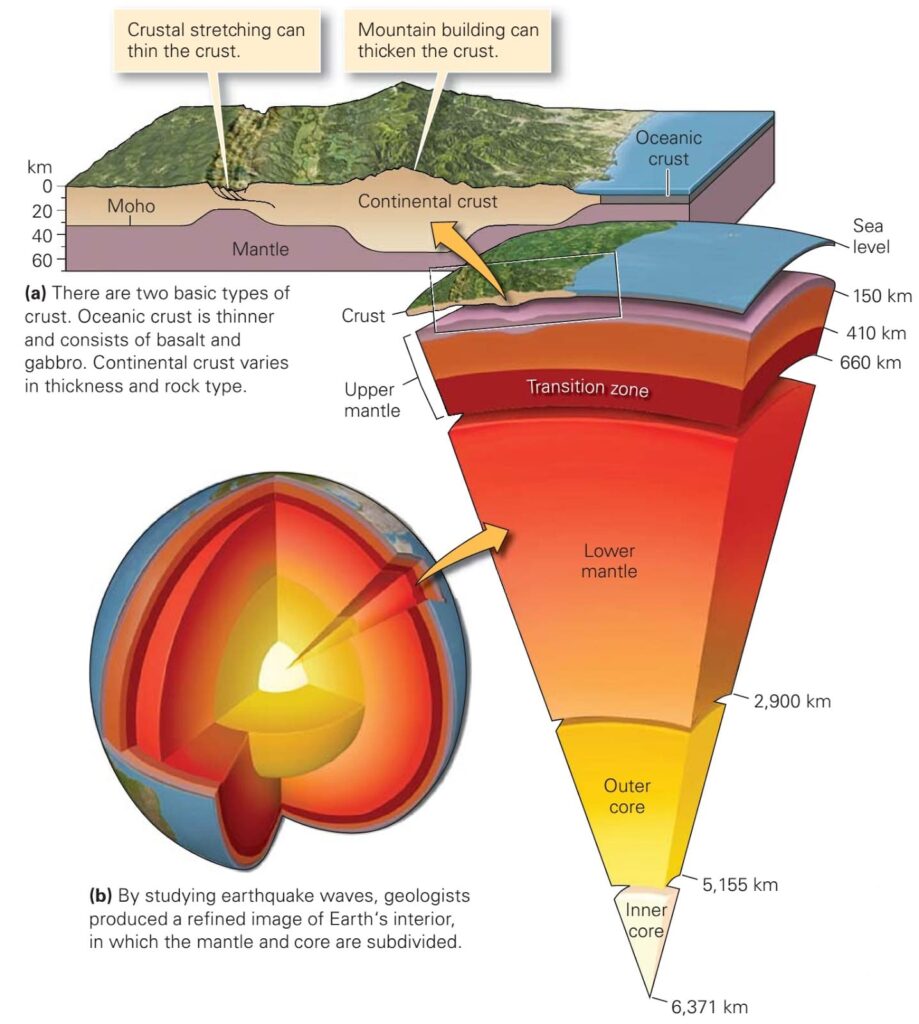
Image Source: Learn Geology
Understanding Earth’s Crust
If Earth were compared to an apple, its crust would be far thinner than the delicate outer peel of the fruit. Despite being incredibly thin compared to the rest of the planet, this fragile outermost layer is where all oceans, mountains, cities and all known life live.
Scientists classify the crust primarily into two main types:
- Continental crust is generally thicker in structure and lower in density compared to oceanic crust.
- Oceanic crust which is thinner and denser
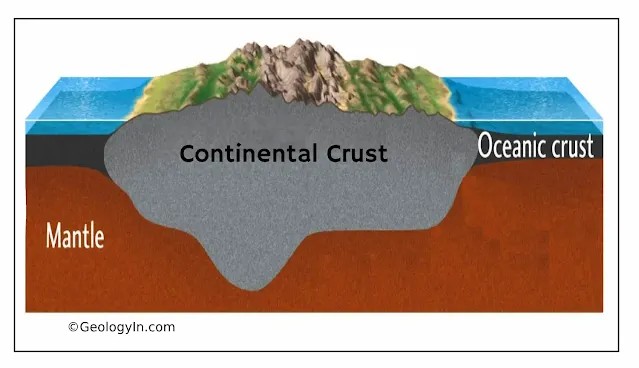
Image Source: Geology In
Though it is impossible for scientists to ascertain the exact kilometre range of even the top most layer of the earth, they estimate the continental crust can reach even about 100 km beneath mountain ranges, while oceanic crust averages only about 5 km thick. (Source: U.S. Geological Survey)
Moreover, the crust is broken into giant tectonic plates that are believed to slowly move over the mantle. These plates drift at roughly the same speed that fingernails grow. (Source: National Geographic Education)
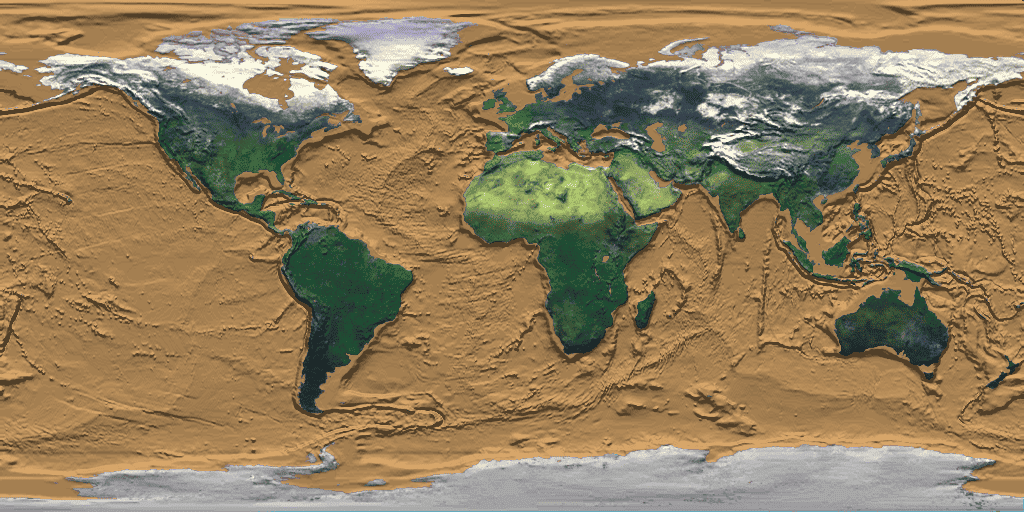
Image Credit: ‘NASA/Goddard Space Flight Center, Scientific Visualization Studio’
What Types of Rock Make Up the Earth’s Crust?
The Earth’s crust is primarily made from three major types of rock: igneous, sedimentary and metamorphic rock. Together, these rocks form the continents, mountains, ocean floors and landscapes we see today.
Here is a breakdown of what scientific studies claim:
- Igneous rocks are created when hot molten material cools and solidifies into rock. Granite and basalt are common examples.
- Sedimentary rocks form from compressed layers of sand, mud, shells and organic material over millions of years. Limestone and sandstone belong to this category.
- Metamorphic rocks form when existing rocks are transformed by intense heat and pressure deep underground. Marble and slate are common examples.
Why the Mantle Is So Important
The mantle is estimated to be the thickest layer of the Earth, around 84% of the planet’s volume. Scientists infer it stretches from beneath the crust down to the outer core. (Source: U.S. Geological Survey)
Some more inferences by scientists based on their observations are:
- Although the mantle is technically solid, extreme temperatures allow it to behave like a slowly flowing material over millions of years.
- Convection currents inside the mantle move hot material upward and cooler material downward. This circulation drives tectonic plate movement.
- Researchers pitch mantle convection to explain why continents drift, earthquakes occur and volcanoes form along plate boundaries.
- The San Andreas Fault in California demonstrates that tectonic plates are constantly moving, even when the motion is too slow for humans to notice directly.
- Scientists measure sections of the fault shifting only a few millimetres every year, yet over millions of years these tiny movements can relocate entire landscapes and trigger major earthquakes.
- Around 50 million years ago, the Indian tectonic plate collided with the Asian plate, creating the Himalayas and Mount Everest. Even today, Mount Everest continues rising slightly every year because the plates are still pushing together beneath the surface.
Therefore, the mantle is considered to be a thick layer of semi-solid rock that drives tectonic plate movement through convection currents.
Some volcanoes may be powered by enormous columns of superheated rock called mantle plumes that rise from deep within the mantle. Scientists believe these plumes can reshape continents, create volcanic hotspots and drive intense geological activity for millions of years.
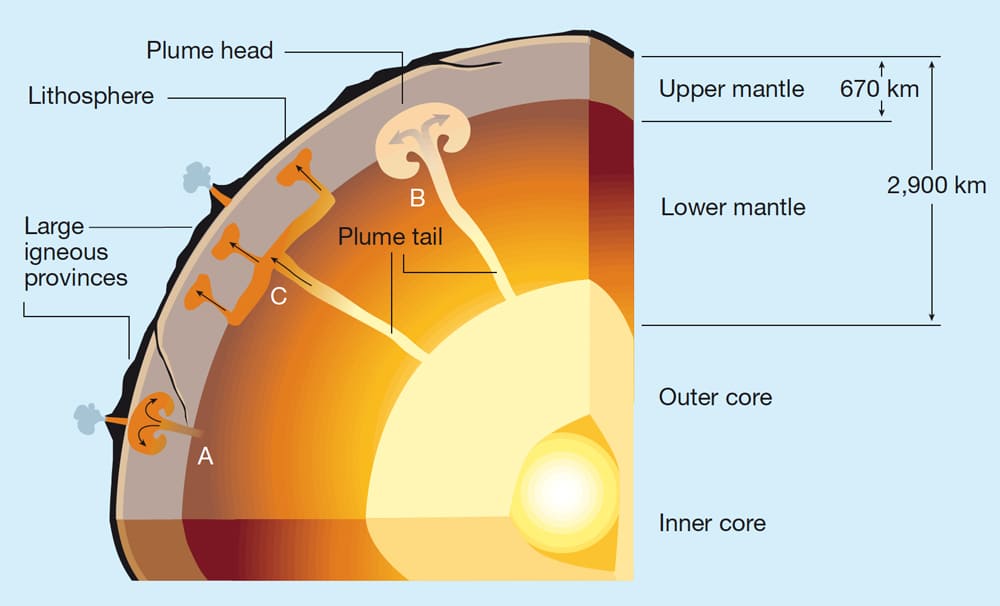
Image Courtesy: Wikimedia
Also Read: Aliens Are Real, and They Live on Earth: The 10 Craziest Creatures You Won’t Believe Exist
Why Is the Earth’s Outer Core Liquid?
Scientific research emphasises that the Earth’s outer core is liquid because the estimated temperatures there are high enough to melt iron and nickel under slightly lower pressure conditions. The outer core lies between the mantle and inner core and is believed to be composed mainly of molten metal. Key points:
- Scientists estimate outer core temperatures range between 4,000°C and 5,500°C. These temperatures are similar to the surface of the Sun. (Source: National Geographic Education)
- Theories indicate that the movement of liquid metal inside the outer core generates Earth’s magnetic field through a process called the geodynamo.
- The Earth’s outer core is made primarily of liquid iron and nickel, which generate the planet’s magnetic field.
- For example, scientists stress that this magnetic shield is what protects Earth from solar wind and harmful radiation. Without it, Earth could become far less habitable.
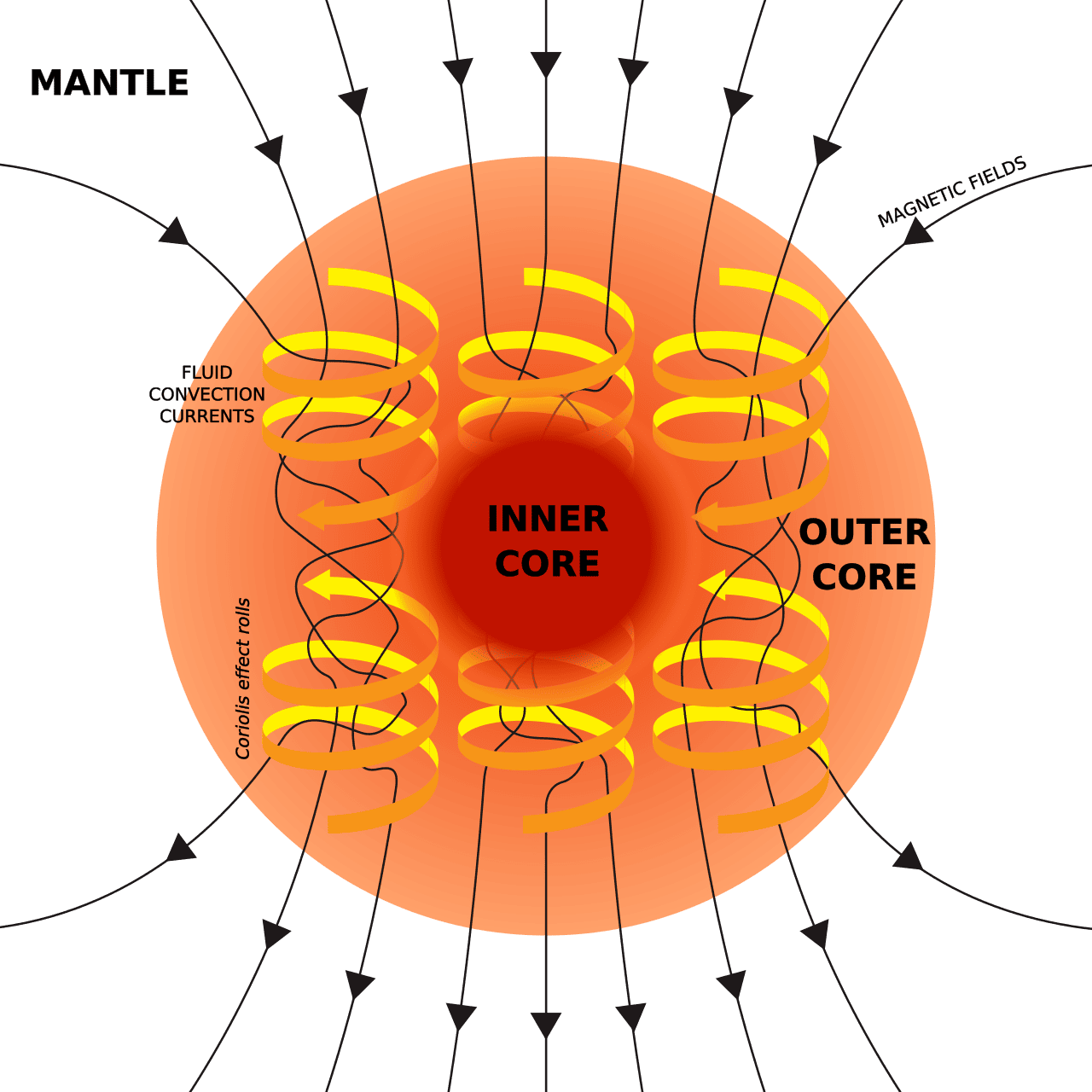
Inge Lehmann and the Discovery of Earth’s Inner Core
Danish seismologist Inge Lehmann transformed humanity’s understanding of the Earth in 1936 when she proposed that the planet contains a solid inner core surrounded by a liquid outer core. By extensively studying seismic waves produced by earthquakes, Lehmann noticed unusual wave patterns that existing theories could not fully explain. She concluded that some seismic waves were reflecting off a solid structure deep within the Earth rather than passing through a completely molten core. Her interpretation later became one of the most-often referenced discoveries in modern geophysics and significantly advanced the scientific study of Earth’s internal structure.
How Hot Is the Earth’s Inner Core?
As stated earlier in this article, scientists anticipate Earth’s inner core as extremely hot, reaching temperatures of roughly 5,400°C to 6,000°C. Despite this intense heat, the inner core is deemed to remain solid because the pressure at Earth’s centre is enormous.
What Is the Inner Core Made Of?
The inner core is presumed to be primarily composed of solid iron and nickel based on observations. Scientists believe it formed as Earth slowly cooled over billions of years.
Additionally, the pressure inside the inner core exceeds 3 million times Earth’s atmospheric pressure as per scientific studies. This immense force is quoted by experts as the factor that prevents the metal from melting completely.
Analogy: Scientists compare this phenomenon to squeezing matter so tightly that atoms cannot move freely into a liquid state.
However, researchers continue discovering surprising details about the inner core. Some studies suggest the inner core may rotate at a slightly different speed than the rest of the planet. But these are still speculations and probably will remain so as the Earth beneath our feet remains one of the least directly explored regions known to humanity.
How Did Scientists Discover the Earth’s Interior?
Scientific models help humanity understand nature, but they do not eliminate the vastness of what remains unknown. Despite centuries of exploration, humanity has explored only a tiny fraction of the Earth’s outer layer. The deepest humans have ever drilled is just over 12 kilometres, while the Earth’s centre lies nearly 6,400 kilometres below the surface.
Scientists discovered the Earth’s interior mainly by studying seismic waves produced during earthquakes. Because humans cannot drill directly to the core, seismic analysis provides the best indication about Earth’s hidden structure.
Understanding Seismic Waves
Seismic waves are vibrations that travel through the Earth after earthquakes or explosions. Scientists analyse how these waves move to identify different materials inside the planet.
There are two major types:
- P-waves travel through solids and liquids.
- S-waves travel only through solids.
For example, the disappearance of S-waves inside the Earth indicates that the outer core is liquid.
Why Humans Cannot Reach the Core
Humans cannot reach the Earth’s core because extreme heat and pressure make deep drilling nearly impossible. The deepest artificial hole ever drilled reached only about 12 km deep, as already discussed, which barely scratches the crust.
Moreover, temperatures rise rapidly with depth. Equipment melts or fails long before reaching the mantle.
Scientists therefore rely on:
- Seismographs
- Satellite imaging
- Magnetic field studies
- Laboratory simulations
- Computer modelling
How Much Do Scientists Really Know About the Earth’s Interior?
Much of humanity’s understanding of the Earth’s interior is based on indirect observation rather than direct exploration. It is an already-known fact that scientists cannot physically travel into the mantle, outer core or inner core because of the immense heat and pressure deep beneath the surface.
The deepest humans have ever drilled into the Earth reaches only a tiny fraction of the planet’s total depth. As a result, scientists study Earth’s interior mainly through seismic waves, gravity measurements, magnetic field analysis, volcanic material, laboratory simulations and computer models.
These methods provide strong evidence about the Earth’s internal structure, but they do not offer direct visual confirmation of the deep interior itself. In many cases, scientific conclusions about the mantle and core are interpretations built from observable effects rather than direct observation.
Because the Earth is an active and constantly changing system, scientific models continue to evolve as new data becomes available. For this reason, many aspects of Earth science remain subjects of ongoing research, refinement and debate.
Therefore, it must be underscored that science does not always have the final answers, especially in cosmology, consciousness studies, climate modelling, quantum physics and deep Earth science. In reality, many scientific fields operate through approximation, inference, revision, confidence levels and ongoing debate.
Also, future researchers inevitably build upon previous models. That is how cumulative knowledge works. Sometimes this leads to refinement and progress; and sometimes foundational assumptions later require major revision.
Therefore, knowledge should be presented with humility and transparency about its limitations. The biggest limitation with Earth science is the fact that we cannot actually see the core of the Earth. In this sense, studying the Earth should inspire not only curiosity, but also humility. The deeper humanity explores nature, the more complex and mysterious the planet often appears.
Is Earth’s Magnetic Field Truly Important for Life?
Earth’s magnetic field is a protective invisible shield generated by the movement of liquid metal inside the outer core. This magnetic barrier protects the planet from harmful charged particles constantly released by the Sun, as per the scientific fraternity.
- The Earth’s outer core is made primarily of liquid iron and nickel. As these molten metals move and circulate deep beneath the surface, they generate electrical currents that create the planet’s magnetic field through a process scientists call the geodynamo. This is a theory proposed by scientists based on their observation of phenomena above the Earth’s surface too.
- Without this magnetic shield, solar radiation could gradually damage Earth’s atmosphere and make life far more difficult to sustain. Scientists credit Earth’s magnetic field as having played a major role in protecting the planet for billions of years. But it is important to note that several questions remain unanswered whether it is truly the magnetic field protecting the Earth or an unknown phenomenon.
- Scientists estimate that the magnetic field also extends tens of thousands of kilometres into space, surrounding Earth in a protective region called the magnetosphere.
- The Earth’s magnetic field also plays a vital role in helping humans and animals navigate across the planet. For centuries, humans used magnetic compasses to travel across oceans and continents.
- Even more remarkably, some animals can naturally sense Earth’s magnetic field. Scientists believe sea turtles use magnetic minerals within their bodies like a biological GPS system, helping them navigate across entire oceans and return to the exact beaches where they were born.
- One of the most beautiful visible effects of this magnetic shield is the Northern Lights, also called the Aurora Borealis. Charged particles from the Sun collide with gases in Earth’s atmosphere near the poles, creating glowing waves of green, purple and red light across the night sky.
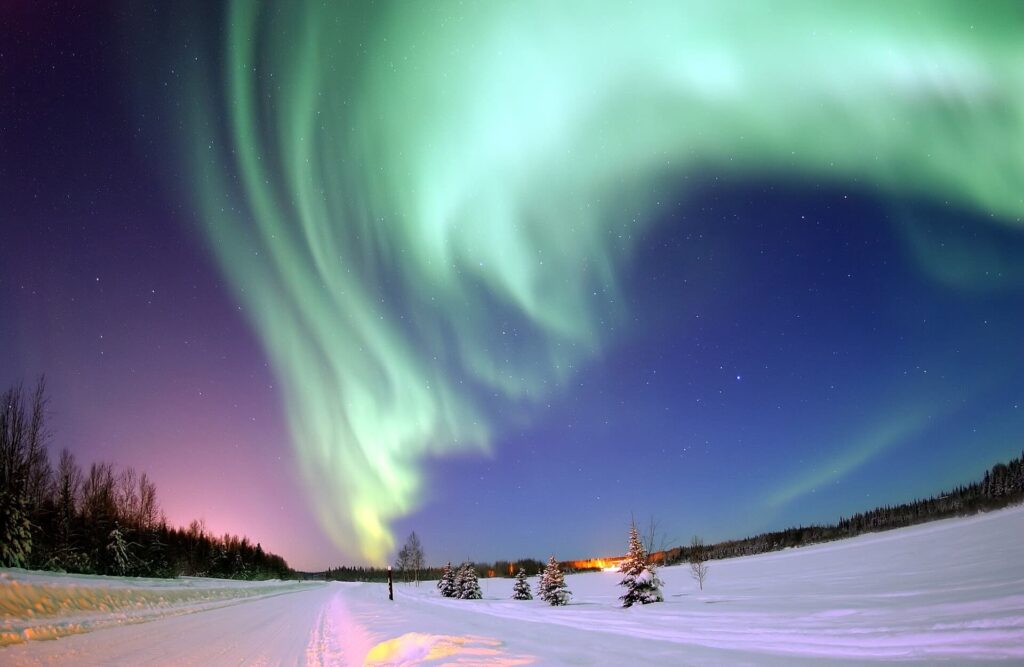
Image Title: Aurora Borealis seen in Alaska
In many ways, Earth’s magnetic field could be another reminder that deep processes occurring thousands of kilometers beneath the surface directly affect life above it.
How Do Earth’s Layers Cause Earthquakes and Volcanoes?
Earth’s layers cause earthquakes and volcanoes because heat and pressure inside the planet continuously move tectonic plates. Most geological activity occurs where tectonic plates interact.
Case Study: Christchurch and Japan
In 2011, powerful earthquakes struck Christchurch, New Zealand and Japan within weeks of each other. The Japanese earthquake triggered a devastating tsunami with waves reaching nearly 30 metres high. Researchers believe these disasters were caused by sudden movements along tectonic plate boundaries deep within the Earth’s crust.
Earthquakes and Tectonic Stress
Earthquakes occur when stress suddenly releases along faults between tectonic plates. This energy travels outward as seismic waves.
For example, the Pacific Ring of Fire experiences frequent earthquakes because several tectonic plates collide there. According to the USGS, as of 2025, over 500,000 detectable earthquakes occur worldwide each year. (Source: USGS, 2025)
Also read in-depth: https://sanews.in/earth-in-motion/
Volcanoes and Magma Movement
Volcanoes form when magma rises from the mantle toward the Earth’s surface. This molten material escapes through cracks in the crust. For example, volcanic islands such as Hawaii formed through long-term mantle activity beneath the Pacific Ocean.
Some volcanoes may be powered by giant columns of superheated rock called mantle plumes that rise from deep within the mantle. Scientists believe these plumes can reshape continents and create long-lasting volcanic regions. An example is Mount Nyiragongo.
Tsunamis and Plate Movement
Tsunamis often result from underwater earthquakes caused by tectonic plate movement. Sudden displacement of ocean water creates massive waves that travel across oceans.
Around 50 million years ago, the Indian tectonic plate collided with Asia, creating the Himalayas and Mount Everest. Even today, Everest continues to rise slightly every year as the plates keep pushing together.
How Humans Use Earth’s Internal Heat
Humans use Earth’s internal heat through geothermal energy, which converts underground heat into electricity and heating systems. This energy source exists because heat from the mantle continuously rises toward the crust.
Iceland is one of the best examples of geothermal energy in action. Because the crust beneath Iceland is relatively thin, underground water heats rapidly and turns into steam. Power stations capture this steam to generate electricity and heat homes, roads and even outdoor swimming areas throughout the year.
Geothermal energy is considered one of the cleanest renewable energy sources because it relies on the Earth’s natural internal heat rather than fossil fuels.
What’s Next in Earth Science Research?
Earth science research is advancing through better seismic imaging, planetary comparisons and deep-Earth simulations. Scientists continue uncovering new details about the planet’s interior every year. Here is how much the scientific fraternity has progressed with technology used in Earth Science research:
- Researchers are developing more advanced seismic imaging systems capable of creating clearer maps of underground structures.
- Scientists compare Earth with planets such as Mars to understand planetary evolution. Mars lacks active plate tectonics and a strong magnetic field, making it very different from Earth today.
- International scientific drilling projects continue studying oceanic crust because it is thinner than continental crust.
- Scientists are also investigating whether Earth’s inner core changes shape or rotation over time.
Many scientists believe tectonic plate movement may eventually push Earth’s continents back together into another giant supercontinent hundreds of millions of years in the future. This demonstrates that the Earth’s surface is constantly evolving over geological time.
Nature is far more complex than any single theory attempting to explain it completely. And the Earth continually reminds humanity that observation and complete understanding are not always the same thing.
The Boiling Core Below And the Chaos Above: What Does Understanding the Earth Teach Humanity About Itself?
Studying the Earth’s layers reveals far more than geology; it reveals how deeply interconnected life on this planet truly is. Beneath the Earth’s surface lie immense layers surrounding a blazing core filled with pressure, heat, friction and instability powerful enough to reshape continents. However, above the crust, humanity too has become trapped within invisible layers of hatred, discrimination, greed, violence, division and moral decay – a civilisation increasingly symbolic of a world overheating from within.
- Despite all life sharing the same planet, humanity often fails to function in the harmony and balance that sustain the Earth itself. In many ways, the growing unrest above the surface appears to mirror the turbulence below it.
- Deep beneath our feet, tectonic pressure builds until it erupts through earthquakes and volcanoes. Likewise, fear, anger, greed, extremis and mistrust continue to build within human societies until they erupt into war, destruction and suffering.
- Today, the human world is burning emotionally, politically, socially, environmentally and spiritually.
- Ironically, humanity has become increasingly eager to study the hidden layers of the Earth, but it still struggles to confront the hidden divisions within civilisation itself.
- Therefore, scientific advancement alone cannot guarantee peace, wisdom or survival.
Will humans continue to ignore the warning signs building both beneath the Earth and within itself? Perhaps one of the deepest lessons Earth science offers is that life on a shared planet ultimately needs cooperation, responsibility, compassion and coexistence with all living beings.
And yet, despite the chaos, violence and instability visible across the world today, we still continue to hope for a better future – a world free from hatred, discrimination and conflict. Is it truly possible to achieve such an ideal world?
The One Crisis Science Can Never Heal
Within the deeply volatile and increasingly fractured state of the modern world, a silent yet immensely powerful spiritual movement has been steadily rising over the past three decades – a movement rooted not in politics, violence or material ambition, but in profound spiritual knowledge, unity, compassion and true devotion to the Supreme Creator.
Jagatguru Tatvdarshi Sant Rampal Ji Maharaj has been gradually building a disciple community founded upon peace, brotherhood, equality, moral living and compassion for all living beings. Under His guidance, disciples move away from addiction, violence, hatred, discrimination and social evils while adopting a righteous way of life centred around the true worship of Supreme God Kabir.
True and lasting peace cannot be attained merely through scientific advancement, technological progress or material achievement. While science may offer temporary comforts and conveniences, it cannot eliminate humanity’s inner suffering, greed, violence, fear or moral decline. Humanity’s greatest crisis is not technological – it is spiritual, spiritual decline.
Sant Rampal Ji Maharaj explains that the suffering, unrest and instability visible across the world today are symptoms of a civilisation increasingly disconnected from its real Creator. As humanity distances itself from true spiritual knowledge and divine refuge, destructive tendencies continue to grow stronger within society.
Sant Rampal Ji Maharaj further explains that Kaal (Satan) governs the 21 universes, keeping souls trapped within suffering, conflict, illusion, birth and death.
In such an age of spiritual darkness, true peace can only emerge through the refuge of a Tatvdarshi Sant – the Complete Saint Who reveals the true worship of Supreme God Kabir and guides souls towards liberation. Sant Rampal Ji Maharaj is the singular Tatvdarshi Sant of our times.
The ever-growing disciple community of Sant Rampal Ji Maharaj stands as a living example of this transformation. Millions are embracing a life based on peace, devotion, simplicity, equality and spiritual discipline. Sant Rampal Ji Maharaj is reinstating Satyug within the darkness of Kalyug itself.
To many critics, spirituality and science may appear to stand on opposite sides. However the deeper humanity studies creation, the more it encounters complexity, uncertainty and limits within material understanding. Science continues to evolve through observation and interpretation, but the Constitution of God remains eternal and unchanging. The question is whether humanity is willing to seek and understand it.
If you would like to reinstate the lost peace and happiness in life, understand how Sant Rampal Ji Maharaj is reinstating Satyug within Kalyug in the following video:
To learn more about Sant Rampal Ji Maharaj and His unparalleled spiritual knowledge, visit:
- Website: www.jagatgururampalji.org
- YouTube: Sant Rampal Ji Maharaj
- Facebook: Spiritual Leader Saint Rampal Ji
- ‘X’ handle: @SaintRampalJiM
FAQs: Layers of the Earth
Q1) What are the four main layers of the Earth?
Answer: The Earth has four primary layers: the crust, mantle, outer core and inner core.
Q2) How do scientists study the inside of the Earth?
Answer: Scientists study Earth’s interior mainly through seismic waves produced during earthquakes.
Q3) Why is Earth’s magnetic field important?
Answer: Earth’s magnetic field protects the planet from harmful solar radiation and helps support life.