

Time is one of the most important concepts in science, astronomy, and everyday life. Today, highly advanced atomic clocks measure time with extraordinary precision. However, the history of timekeeping goes back thousands of years.Ancient Indian scholars developed detailed systems to divide time, observe celestial movements, and calculate astronomical events. Their texts mention units ranging from everyday periods to extremely small intervals such as Truti. One historical calculation places a Truti at approximately nine microseconds.
- The Importance of Time Measurement in Ancient India
- Understanding Ancient Indian Units of Time
- What Is Truti? The Connection with Microseconds
- The Role of Astronomy in Ancient Indian Timekeeping
- Ghatika Yantra: How Did Ancient Indians Measure Time?
- Ancient Timekeeping and Modern Atomic Clocks: What Is the Difference?
- Why Ancient Indian Timekeeping Still Matters
- Beyond Measurement: The True Meaning of Time (Kaal) and Creation
- FAQ on Ancient Indian Time Units
This raises an interesting question: did ancient Indian scholars actually measure time with microsecond-level precision, or were these extremely small units part of a mathematical and theoretical system? Exploring the historical evidence helps us understand both the achievements and the limitations of ancient Indian timekeeping.
The Importance of Time Measurement in Ancient India
Time measurement played an important role in ancient Indian society. It was needed for observing the movements of the Sun, Moon, and planets, preparing calendars, determining seasons, and organising religious activities.
Astronomers developed mathematical systems to calculate celestial positions and understand recurring astronomical events. These calculations required a structured way of dividing time into smaller and larger units.
Different Indian texts describe different time scales. Their terminology and calculations were not always identical, because astronomical knowledge developed across different periods and scholarly traditions.
Understanding Ancient Indian Units of Time
Ancient Indian astronomical and mathematical texts describe several units of time. Some were used for practical calculations, while others represented very small theoretical intervals or extremely long cosmic periods.
A few important units include:
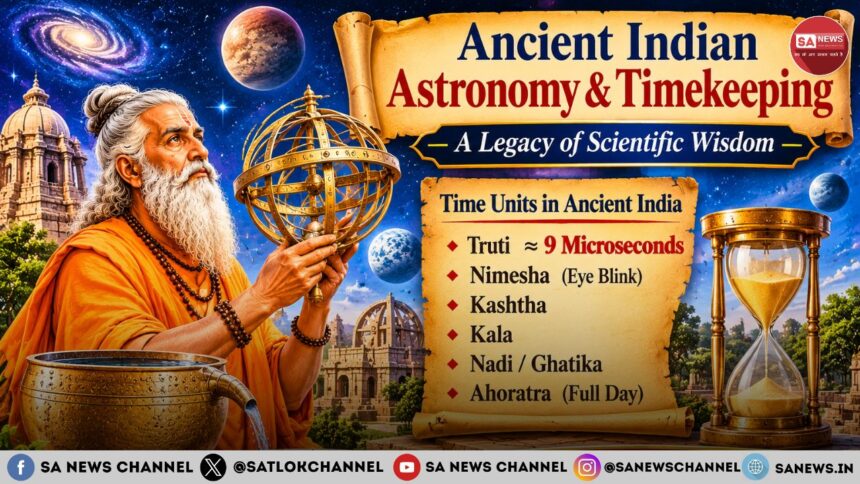
- Nimesha: Often associated with the duration of an eye-blink.
- Kashtha: A larger unit formed by combining smaller time intervals.
- Kala: A unit used in traditional time calculations, although its exact relationship with other units can vary between texts.
- Nadi or Ghatika: A commonly used time unit equivalent to approximately 24 minutes in many traditional astronomical systems.
- Ahoratra: A complete day-and-night cycle.
These units demonstrate how Indian scholars organised time into systematic divisions. However, their exact values should always be understood in the context of the particular text and period in which they appear.
What Is Truti? The Connection with Microseconds
One of the most interesting units mentioned in historical Indian astronomical literature is Truti.The CBSE publication Knowledge Traditions and Practices of India describes a time scale given by the astronomer Vateshvara, who was born around 880 CE. In this particular system, the smallest unit is called Truti.
The text gives the following sequence:
– 100 Trutis = 1 Lava
– 100 Lavas = 1 Nimesha
– 1 Nimesha = A traditional unit associated with the twinkling of an eye.
The same publication notes that a simple calculation makes one Truti approximately equal to nine microseconds.
This is a remarkable example of how precisely time could be divided in a mathematical system. However, an important distinction must be made: this figure belongs specifically to the time scale described by Vateshvara. It should not be treated as a universal definition of Truti across every ancient Indian text.
It is also important to understand that describing an extremely small unit mathematically is not the same as physically measuring it with an instrument. The historical reference demonstrates a sophisticated theoretical division of time, but it does not establish that ancient scholars possessed devices capable of measuring intervals of nine microseconds.
The Role of Astronomy in Ancient Indian Timekeeping
Astronomy was closely connected with the development of time measurement in India. Scholars studied the movements of celestial bodies and developed mathematical methods to calculate planetary positions, eclipses, and calendar events.One important text in this tradition is the Surya Siddhanta, a Sanskrit treatise on mathematical astronomy. Although traditionally presented as an ancient revelation, its historical development is more complex. Scholars identify an earlier astronomical tradition and a received text that was revised over several centuries. The version available today is generally associated with a later period, commonly placed between the eighth and eleventh centuries, with subsequent corrections.
Also Read: How Ancient Cities Managed Waste and Sanitation?
The text discusses planetary movements, eclipses, time calculations, and astronomical concepts. It represents an important stage in the development of Indian mathematical astronomy.It is therefore more accurate to understand the Surya Siddhanta as part of a developing astronomical tradition rather than describing the surviving version as an unchanged text from the Vedic period.
Ghatika Yantra: How Did Ancient Indians Measure Time?
Ancient Indian scholars did not depend only on mathematical descriptions. Historical sources also document practical devices used to measure time, including water clocks.
Research on Indian astronomical instruments identifies two important forms of water clocks used in different periods:
1. Outflow Water Clock
In this type, water gradually flowed out of a vessel through a small opening. The amount of water leaving the container helped indicate the passage of a particular time interval. This type is described in early sources, including the Vedanga Jyotisha and related texts.
2. Sinking-Bowl Water Clock (Ghatika Yantra)
In this design, a small bowl with a hole at the bottom was placed on the surface of water. Water gradually entered through the opening until the bowl sank. The time taken for the bowl to sink was used to mark a defined interval. The sinking-bowl design became associated with the later Siddhanta astronomical tradition.
These two designs should not be confused with each other. Both were used in Indian timekeeping, but they worked through different physical principles and belonged to different stages in the historical development of astronomical instruments.A traditional Ghatika commonly represented 24 minutes, making it useful for observing and organising longer time intervals. These water clocks were practical devices, but they were not capable of measuring microsecond-level intervals.
Ancient Timekeeping and Modern Atomic Clocks: What Is the Difference?
Modern timekeeping is based on highly precise scientific standards. The international unit of time, the second, is defined using the frequency of a particular transition in the caesium-133 atom. According to the International Bureau of Weights and Measures (BIPM), one second is defined by fixing the caesium frequency at exactly 9,192,631,770 hertz. This definition allows modern atomic clocks to measure time with extraordinary precision and consistency.
Ancient Indian systems, on the other hand, used mathematical calculations, astronomical observations, and practical instruments such as water clocks. Their theoretical time divisions could be extremely small, but the instruments documented in historical sources worked on much larger time intervals.The difference is important: a mathematical description of a tiny time unit does not automatically prove that the same interval could be physically measured with modern scientific accuracy.
Why Ancient Indian Timekeeping Still Matters
The study of ancient Indian timekeeping is important because it reveals how scholars approached mathematics, astronomy, and the natural world.Their work demonstrates the development of organised time scales, astronomical calculations, and practical instruments. It also shows that scientific knowledge develops over generations, with later scholars refining and expanding earlier ideas.
Rather than making exaggerated claims, understanding these achievements through historical evidence gives us a more meaningful appreciation of India’s contribution to the history of science.
Beyond Measurement: The True Meaning of Time (Kaal) and Creation
While ancient astronomers developed mathematical systems to measure physical time, Jagatguru Tatvdarshi Sant Rampal Ji Maharaj reveals the unsolved mysteries behind the true meaning of time itself through Satgyan (true spiritual knowledge) in texts like Gyan Ganga and Jeene Ki Raah.
He explains with scriptural evidence that Kaal (Brahm) is not merely an abstract measure of passing moments, but the ruler of the twenty-one universes whose role was central to the beginning of this material universe and the creation of nature (Prakriti)—offering humanity clarity on how creation began and how to rise beyond the cycle of time through verified truth. For complete details on the creation of nature, watch Shastrarth Ka Shankhnaad (Parts 1 and 2).
FAQ on Ancient Indian Time Units
Q1. What were the main units of time in ancient India?
Ancient Indian texts mention units such as Nimesha, Kashtha, Kala, Nadi, and Ghatika. Their exact values varied across different traditions and texts.
Q2. What is Truti in ancient Indian time measurement?
Truti is an extremely small unit of time mentioned in historical Indian texts. In the time scale described by Vateshvara, it is calculated to be approximately nine microseconds.
Q3. Do historical sources show that ancient Indian scholars described microsecond-level time units?
Yes. A CBSE publication describes Vateshvara’s time scale, in which Truti is approximately nine microseconds. However, this does not prove that ancient scholars physically measured such tiny intervals.
Q4. What was a Ghatika Yantra used for?
A Ghatika Yantra was a type of water clock. In the sinking-bowl design, water entered a small bowl through an opening until it sank, indicating a defined time interval.
Q5. How is modern time measured accurately?
Modern time is based on the SI second, defined using the fixed frequency of the caesium-133 atom. Atomic clocks use this standard to achieve extremely precise timekeeping.