

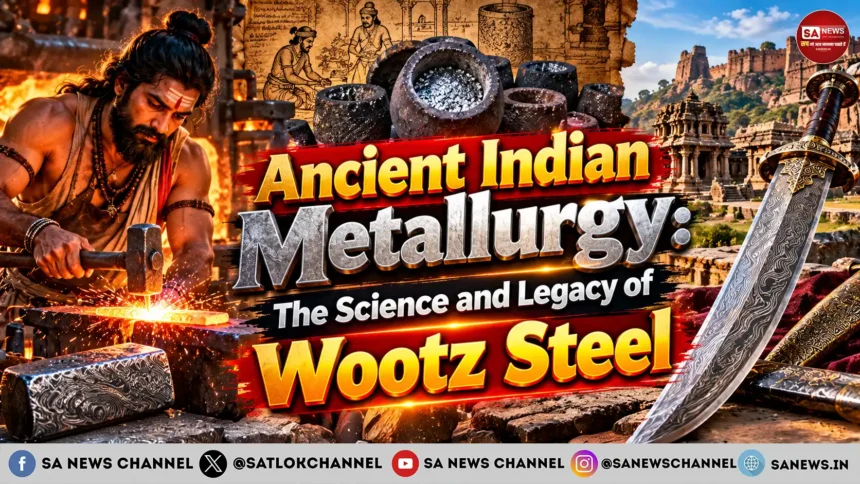
Wootz steel represents an important achievement in the history of metallurgy. Produced in the Indian subcontinent, this high-carbon crucible steel became renowned for its distinctive properties and historical connection to the patterned blades of Damascus. Recognized as the world’s pioneer high-carbon crucible steel, Wootz served as the key raw material behind the legendary Damascus blades.
- News Highlights
- The Ancient Metallurgy Behind Wootz Steel
- Global Trade Networks and the Spread of Wootz Technology
- The Breakdown of the Closed-Crucible Chemistry
- The Colonial Decline and the Loss of an Industrial Tradition
- Modern Scientific Rediscovery and Technological Legacy
- Conclusion
- Wootz Steel to the Vedas: Unraveling the Mysteries Beyond Modern Science
- The Mystery of the Creation of the Universe Revealed Through Spiritual Knowledge
By combining precise high-temperature smelting in sealed refractory clay vessels with controlled cooling, ancient Indian metallurgists achieved microscopic carbon bandings that modern science continues to study today.
News Highlights
- An Important Early High-Carbon Crucible Steel: Wootz steel emerged from India’s ancient metallurgical traditions, particularly those associated with parts of southern India.
- Connection to Damascus Blades: Indian Wootz ingots were traded beyond the subcontinent and became an important raw material for certain historical Damascus blades.
- Specialised Production Techniques: Wootz was produced using crucible-based methods involving iron, carbon-bearing materials, and high-temperature processing.
- Distinctive Microstructure: The distribution of iron carbides in certain Wootz-derived blades contributed to their characteristic watered patterns and influenced their mechanical properties.
- Continuing Scientific Interest: Researchers continue to study Wootz to understand its composition, carbide structures, historical production methods, and mechanical behaviour.
The Ancient Metallurgy Behind Wootz Steel
Centuries before the European Industrial Revolution, the Indian subcontinent had already established a thriving, globally renowned iron and steel industry. One of the most remarkable achievements associated with ancient Indian metallurgy was Wootz steel, a high-carbon crucible steel historically produced in parts of India.
The word Wootz is commonly associated with southern Indian terms for steel, including Kannada and Telugu ukku and Tamil urukku. The precise linguistic history of the English term is more complex than a single direct derivation.
The exact origins of Wootz steel remain uncertain, although archaeological evidence demonstrates that crucible-steel production was practised in India in antiquity. Metallurgists placed wrought iron alongside carbon sources like wood charcoal and specific plant species (such as Cassia auriculata) inside sealed, conical clay crucibles.
Placed inside high-temperature blast furnaces stoked by tuyeres, the iron absorbed carbon from the plant matter and charcoal. The low oxygen, sealed environment allowed the iron to melt and absorb between 1.0% to 1.9% carbon, yielding an ultra-high carbon steel ingot upon slow furnace cooling.
The resulting solid steel cakes, often referred to as “Wootz cakes,” were prized across ancient trade routes stretching from Rome to China. When these cakes reached Middle Eastern centers like Damascus, master metalsmiths forged them into swords. The controlled slow cooling during production caused ultra-hard iron carbide (cementite) particles to precipitate in distinct microscopic bands, giving the forged blades their legendary “watered” or swirl-like Damascus appearance and unmatched cutting capability.
The technological expertise behind Wootz steel eventually declined during the colonial period due to resource depletion, changing trade policies, and mass-market industrial steel imports. However, modern metallurgists actively analyze surviving Wootz artifacts, revealing that the ancient process unintentionally generated advanced microscopic properties, including superplastic behavior and carbide arrangement, which continue to inform modern material science.
Global Trade Networks and the Spread of Wootz Technology
Long before globalization became a modern economic framework, Wootz steel served as a premier luxury export from the Indian subcontinent, fueling an extensive international trade network. Historical records and archaeological excavations reveal that Wootz ingots were transported from production centers in southern India such as Golconda in Telangana, parts of Karnataka, and Technology to major ports along the western coast.
From there, merchant vessels carried the precious steel cakes across the Arabian Sea to the Middle East, Persia, and the Mediterranean basin.
This widespread distribution meant that ancient civilizations in Rome, Egypt, and Central Asia held Indian steel in the highest regard, often equating its value to precious metals. In medieval Persia and the Islamic world, the steel was known as Fulad or Pulad, celebrated for its superior quality.
When these raw cakes reached Damascus, they became the foundation for a flourishing arms-and-armor industry. The mystique surrounding the blades grew so intensely that European knights during the Crusades marveled at how a Damascus sword could easily slice through a European broadsword or shear a floating silk scarf in half, cementing the global reputation of Indian metallurgy.
The Breakdown of the Closed-Crucible Chemistry
To fully appreciate the sophistication of ancient Indian metallurgy, one must examine the precise thermodynamics and chemical reactions occurring inside the sealed clay crucibles. Modern material scientists and metallurgists, including figures like John Verhoeven and Alfred Pendray who successfully replicated Wootz steel in the late 20th century, discovered that the process was far more complex than standard melting.
During the smelting process, the choice of organic additives played a vital role. Plant leaves and wood fragments placed inside the crucible with iron and charcoal released gases and carbon during heating. This combination facilitated the reduction of iron oxides while allowing the iron to absorb high percentages Chemistry often ranging between 1.0% and 1.9% without forming brittle free cementite networks that would normally ruin the metal.
Furthermore, the slow, controlled cooling curve dictated by the insulation of the thick clay walls allowed micro-segregation of carbon and the precipitation of cementite nanowires. When later hammered at carefully controlled low forge temperatures rather than high heat, these carbides aligned into the visible bands responsible for the legendary pattern and structural integrity.
The Colonial Decline and the Loss of an Industrial Tradition
Despite its dominance for over two millennia, the tradition of Wootz steel production experienced a severe decline and eventual extinction during the 19th century. The arrival of British colonial rule in India brought sweeping economic, social, and legal changes that devastated indigenous craft industries.
British authorities enacted restrictive forest laws that prohibited local iron-smith communities (Agarias and traditional metallurgists) from accessing the woodlands required to harvest high-quality charcoal and specific plant species. Concurrently, heavy taxation on indigenous industries, combined with the influx of cheap, mass-produced industrial steel from factories in Sheffield, undercut local producers. Artisans found themselves unable to compete with manufactured alternatives, and the secretive, generational knowledge of crucible preparation, furnace construction, and thermal management was gradually abandoned as families were forced to migrate toward agrarian labor or manual wage work.
Modern Scientific Rediscovery and Technological Legacy
In recent decades, Wootz steel has experienced a dramatic resurgence of academic and scientific interest. Modern metallurgists recognize that ancient Indian smiths inadvertently solved complex problems in materials engineering long before the advent of electron microscopes or phase diagrams.
Researchers studying surviving historical artifacts have uncovered phenomena such as superclassing the ability of a material to undergo high elongations without failing and the presence of natural carbon nanotubes embedded within the ancient steel matrix. These discoveries bridge the gap between ancient craftsmanship and cutting-edge nanotechnology. Today, while historical Wootz swords rest safely in museum collections worldwide, the legacy of this ancient Indian alloy continues to influence modern metallurgy, inspiring engineers who seek to replicate its unique blend of extreme hardness and remarkable flexibility for specialized modern applications.
Conclusion
The story of Wootz steel stands as a profound testament to the advanced scientific intuition and technological brilliance of ancient India. Centuries before modern metallurgy mapped out phase diagrams and microscopic crystal structures, Indian artisans mastered the intricate chemistry of high-carbon alloys through generations of empirical observation, careful material selection, and precise thermal control.
From its humble beginnings in the furnaces of southern India to its transformation into the legendary, razor-sharp blades of Damascus, Wootz steel bridged continents and shaped the course of ancient warfare and global commerce. Though colonial disruption ultimately silenced these traditional smelting hearths, the enduring legacy of Wootz lives on. Today, as modern scientists uncover microscopic wonders like carbon nanotubes and superplastic properties within these ancient artifacts, Wootz steel bridges the ancient and the ultra modern, reminding us that some of history’s greatest technological breakthroughs were forged by hand, fire, and ingenuity.
Wootz Steel to the Vedas: Unraveling the Mysteries Beyond Modern Science
Just as the renowned ancient Indian metallurgical technique of producing Wootz Steel remained a mystery to modern scientists for centuries due to its unique carbon nanostructure, exceptional strength, and corrosion resistance, raising questions about how such a fine and remarkably durable structure could have been created in that era, similarly, the nature of the Vedas, which are said to have emerged unharmed from the immense waters during the churning of the ocean, challenges the boundaries of physical science.
Despite being hidden deep beneath the ocean by Kaal Brahm and later emerging during the churning to be received by Lord Brahma, not a single drop of water could wet or distort them.
This illustrates that just as ancient metallurgical craftsmanship can astonish science at the microscopic level, the structure of the Vedas, as described in this spiritual account, was not that of ordinary paper or metal, but rather of a transcendental and imperishable energy, which can be understood only through the eternal principles of true knowledge and spiritual wisdom, rather than through the limited physical examinations conducted in laboratories.
The Mystery of the Creation of the Universe Revealed Through Spiritual Knowledge
The creation of the universe has always remained a profound mystery, seemingly impossible for anyone to fully understand. Questions such as: How do planets and satellites continue to revolve in their respective orbits? If the Sun is a ball of fire, how is the Moon so cool? Who created the elements of water, air, earth, fire, and sky? Did this universe, its planets, satellites, human beings, and other living creatures come into existence on their own?
If not, then who is the supreme power behind the creation of everything? Can that Supreme Power be seen or attained? Humanity has always sought answers to these questions. However, despite the presence of scriptural evidence in the holy books of various religions, this profound spiritual knowledge remained hidden from the devotee community for a long time.
Now, through the spiritual knowledge imparted by Tatvdarshi Sant Rampal Ji Maharaj, we can understand the mysteries of the creation of the universe.
To explore the scriptural evidence regarding the creation of the universe, visit jagatgururampalji.org and read book Gyan Ganga.
FAQs
Q1: What is Wootz steel? A: Wootz steel is an ultra-high carbon crucible steel developed in ancient India, characterized by high carbon levels (1–1.9%) and distinctive internal carbide bands that give forged blades a wavy, wood-grain pattern.
Q2: How is Wootz steel connected to Damascus steel? A: Wootz steel cakes were exported from India to Damascus and other Middle Eastern trading centers, where local smiths forged the ingots into the famous “Damascus blades”.
Q3: How was Wootz steel produced in ancient times? A: It was made by sealing raw iron with charcoal and plant materials inside refractory clay crucibles and heating them to extreme temperatures in specialized furnaces, followed by a slow cooling process.
Q4. Who explains the mystery of the creation of the universe through spiritual knowledge?
Answer: According to the teachings of Sant Rampal Ji Maharaj, the mystery of the creation of the universe can be understood through authentic scriptural evidence and spiritual knowledge.
Q5. How can we learn about the creation of the universe according to holy scriptures?
Answer: We can explore the subject by studying the holy scriptures and understanding their interpretations through the spiritual knowledge imparted by Sant Rampal Ji Maharaj.