


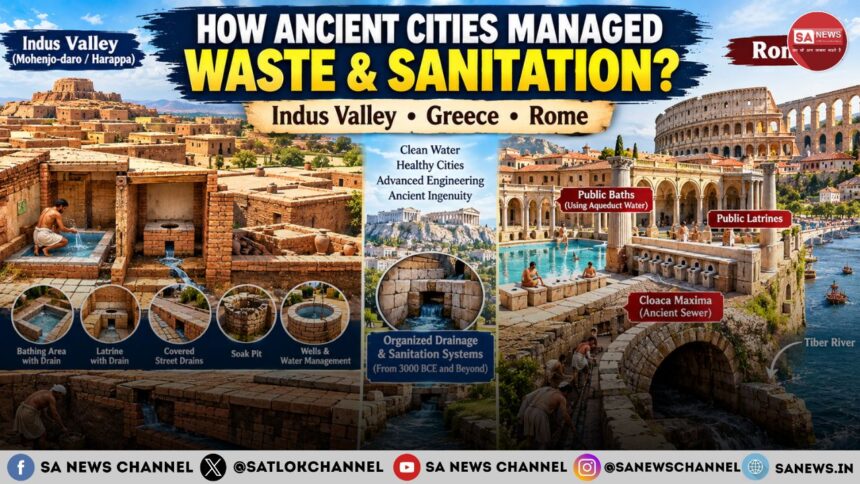
Modern cities are often associated with sewage networks, water treatment plants, drainage infrastructure and municipal services. Therefore, if we say that sanitation is a modern concept, then it will be disrespectful to the systems developed by the ancient civilisations.
- Why Sanitation was important in Ancient Cities
- Key Features of the Ancient Sanitation systems
- Ancient Sanitation and water Management
- How Ancient Cities Managed Solid Waste
- What Ancient Sanitation Systems Teach Us Today
- Way Forward
- Ancient Wisdom, Modern Cities: What History Teaches Us About Sustainable Urban Sanitation
- A Spiritual Perspective: Cleanliness, Responsibility and the Knowledge of Sant Rampal Ji Maharaj
Archaeological evidence from the Indus Valley Civilisation and ancient Rome and Greece reveals that different societies developed the solutions as per their environment and technology. Although their systems were less advanced, they gave us an idea about how to develop sustainably.
Why Sanitation was important in Ancient Cities
As settlements became larger and larger over time, management of waste and sanitation became important. A village having a small population generates less waste and could dispose of their waste locally, but a large urban settlement generates much waste.
Poor sanitation and poor waste disposal could contaminate sources and lead to severe health issues. Therefore, they had strong reasons to control waste and wastewater.
Sanitation was also connected to the urban space. The location of houses, streets, toilets, and drains could influence how a city functioned.
Key Features of the Ancient Sanitation systems
Some common features of the ancient sanitation system include:
- Planned drainage system
- Access to public and private water facilities
- Proper channel of wastewater disposal
- Public Bathing Facilities
- Organised urban planning
Ancient Sanitation and water Management
Two of the famous cities of the Indus Valley Civilisation, i.e., Harappa and Mohenjo-daro, had planned streets, wells, bathing areas and drainage features. The drains were covered, and their wastewater was directed into a larger drainage structure. The use of bricks and organised street layouts further shows urban planning.
Roman engineers also constructed aqueducts to transport water to longer distances and extensive urban water infrastructure. However, there were certain issues, like unequal access and waste management, which remained imperfect.
Ancient Greek cities also developed systems for managing water and wastewater. In places where rainfall was less and groundwater was limited, communities developed methods for storing and collecting water for future use.
How Ancient Cities Managed Solid Waste
The waste management was not only limited to human wastewater, but it also consists of household and commercial waste too. Various archaeological evidences suggest that waste was deposited in pits, vacant spaces, streets and designated areas.
Some material was also reused rather than being discarded. The organic waste was also used in agricultural fields.
What Ancient Sanitation Systems Teach Us Today
The ancient system provides us with invaluable lessons which are as follows:
- Sanitation begins with planning.
- Waste and water are closely related.
- Solutions are shaped by the geographical conditions.
- Infrastructure requires maintenance.
- Technology is not the only solution
Way Forward
In order to achieve sustainable urban sanitation, there is a requirement of a shift from fragmented planning towards long-term decision-making.
- Every major project or investment should consider its long-term environmental costs.
- Investment should primarily focus on resilient infrastructure.
- Cities should prioritise connected and accessible development.
- The government should encourage resource-efficient practices and public awareness.
- Public participation must be included in decision-making.
Ancient Wisdom, Modern Cities: What History Teaches Us About Sustainable Urban Sanitation
The history of ancient cities explains that sanitation is not a new concept. From carefully planned drainage systems of Indus Valley civilisations to Roman infrastructure, they have developed creative solutions to challenges created by urbanisation.
The ancient communities had to face sanitation problems, but their achievements demonstrate the importance of water conservation, water management, waste management and urban planning.
One of the biggest challenges today is developing and growing the cities along with protecting health and the environment. The answer lies in effective planning, efficient use of resources and public participation.
A Spiritual Perspective: Cleanliness, Responsibility and the Knowledge of Sant Rampal Ji Maharaj
The history of sanitation reveals to us the relationship between physical cleanliness, responsible living and human values. The teachings which are associated with Sant Rampal Ji Maharaj emphasise on spiritual knowledge, disciplined and simple living and responsible human behaviour.
Spiritual awareness can encourage and motivate individuals to avoid littering at public places, reduce unnecessary consumption, dispose of the waste properly and protect the natural resources. When people understand that their actions impact other individuals and the environment, they will consider cleanliness as their core responsibility.
Sant Rampal Ji Maharaj also emphasises doing the worship as per our scriptures to achieve salvation. There is a need for involving the concepts of going back to our scriptures to live a more peaceful life in this mortal world.
“True cleanliness begins with a pure and responsible mind; when our inner values guide our outer actions, caring for our surroundings becomes a responsibility toward all living beings.”
For more information related to spiritual knowledge provided by Saint Rampal Ji Maharaj visit www.jagatgururampalji.org.