

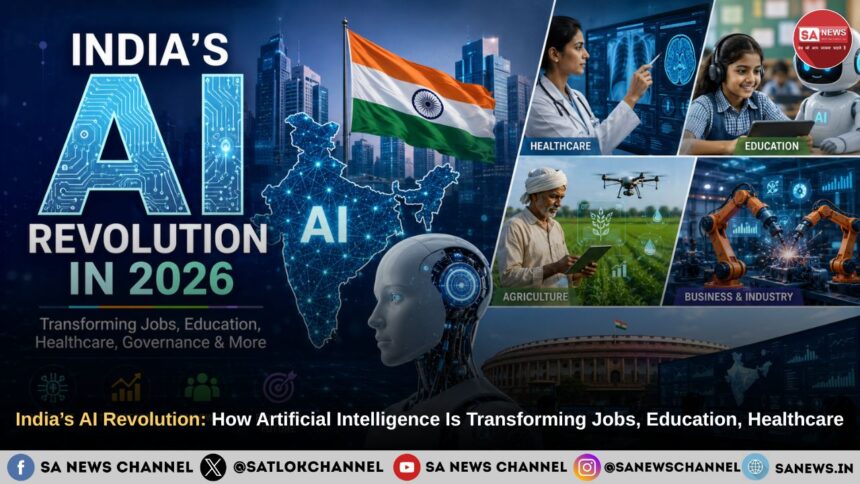
Artificial Intelligence (AI) has rapidly evolved from a futuristic concept into one of the most transformative technologies of the modern era. In 2026, India is witnessing an unprecedented AI revolution that is reshaping industries, improving public services, accelerating economic growth, and redefining the future of work. With strong government support, increasing investments, a thriving startup ecosystem, and one of the world’s largest digital populations, India is positioning itself as a global leader in responsible AI innovation.
- What Is Artificial Intelligence Significant ?
- Why India Is Becoming an AI Powerhouse
- AI Is Transforming Healthcare
- AI Revolution in Education
- AI in Governance and Public Services
- AI in Agriculture
- AI Is Revolutionizing Businesses
- AI and the Future of Jobs
- Challenges of Artificial Intelligence
- Responsible AI Development
- India’s Road Ahead
- Harmonising Technology with Human Values
- FAQs
- 1. What is India’s AI Revolution?
- 2. How is AI helping healthcare in India?
- 3. Will Artificial Intelligence replace jobs?
- 4. How is AI improving education?
- 5. What are the biggest challenges of AI?
- 6. What is the future of AI in India?
From assisting doctors in diagnosing diseases to helping students learn through personalized education platforms, AI has become an essential part of daily life. At the same time, concerns regarding employment, ethics, privacy, and responsible use of AI continue to spark important discussions among policymakers, businesses, educators, and citizens.
What Is Artificial Intelligence Significant ?
Artificial Intelligence refers to computer systems designed to perform tasks that normally require human intelligence.
These tasks include:
- Learning from data
- Understanding language
- Recognizing images
- Solving problems
- Making predictions
- Automating repetitive work
- Assisting human decision-making
Modern AI systems continue to improve by learning from vast amounts of information, making them increasingly useful across multiple sectors.
Why India Is Becoming an AI Powerhouse
India possesses several advantages that support rapid AI adoption.
Large Digital Economy
India has one of the world’s largest internet user bases, generating enormous volumes of digital data essential for AI development.
Skilled Workforce
Millions of software engineers, researchers, and technology professionals contribute to India’s growing AI ecosystem.
Government Support
Government initiatives promoting digital infrastructure, AI research, startup innovation, and digital public services have accelerated AI adoption across sectors.
Thriving Startup Ecosystem
Indian startups are developing AI-powered solutions for agriculture, healthcare, finance, education, logistics, cybersecurity, and manufacturing.
AI Is Transforming Healthcare
Healthcare has become one of the biggest beneficiaries of Artificial Intelligence.
Faster Disease Detection
AI-powered medical imaging helps doctors identify diseases more quickly and accurately.
Personalized Treatment
AI analyzes patient history and medical data to support customized treatment plans.
Drug Discovery
Researchers increasingly use AI to accelerate the development of new medicines by analyzing complex biological data.
Rural Healthcare
Telemedicine platforms powered by AI are improving healthcare access in remote areas where specialist doctors remain limited.
AI Revolution in Education
Artificial Intelligence is changing the way students learn.
Personalized Learning
AI platforms adapt lessons according to each student’s learning pace and performance.
Intelligent Tutoring
Virtual tutors provide instant explanations, practice exercises, and feedback.
Automated Assessment
Teachers can spend more time mentoring students while AI assists in evaluating assignments and routine assessments.
Language Translation
AI-powered translation tools are helping students access educational resources in multiple Indian languages.
AI in Governance and Public Services
Government agencies are increasingly using AI to improve efficiency and citizen services.
Applications include:
- Traffic management
- Smart city planning
- Digital grievance redressal
- Fraud detection
- Tax administration
- Disaster management
- Agricultural advisories
AI-powered analytics also assist policymakers in making data-driven decisions.
AI in Agriculture
Artificial Intelligence is transforming Indian agriculture by helping farmers make informed decisions and improve productivity.
Smart Farming
AI-powered applications assist farmers in monitoring soil conditions, predicting weather patterns, and determining the best time for sowing and harvesting.
Crop Disease Detection
Using smartphone cameras and image recognition, AI can identify crop diseases at an early stage, allowing farmers to take timely corrective measures.
Precision Agriculture
AI helps optimize the use of fertilizers, pesticides, and water, reducing costs while improving crop yields.
Market Intelligence
AI-based platforms provide farmers with real-time market prices, demand forecasts, and supply chain insights, enabling better decision-making.
AI Is Revolutionizing Businesses
Indian businesses across industries are rapidly integrating AI into their operations.
Customer Service
AI-powered chatbots and virtual assistants now handle customer queries 24/7, improving response times and customer satisfaction.
Financial Services
Banks and fintech companies use AI for:
- Fraud detection
- Credit risk assessment
- Loan processing
- Customer support
- Personalized financial advice
Manufacturing
Factories are adopting AI for predictive maintenance, quality inspection, robotics, and production planning, resulting in higher efficiency and reduced downtime.
Retail and E-commerce
Retailers use AI to recommend products, manage inventory, forecast demand, and personalize shopping experiences for customers.
AI and the Future of Jobs
One of the most debated aspects of Artificial Intelligence is its impact on employment.
Jobs Likely to Change
Routine and repetitive tasks are increasingly being automated in sectors such as:
- Data entry
- Customer support
- Manufacturing
- Logistics
- Administrative operations
This transformation is changing the nature of work rather than eliminating all jobs.
Emerging Career Opportunities
The AI revolution is creating demand for professionals in areas including:
- AI Engineering
- Machine Learning
- Data Science
- Robotics
- Cybersecurity
- Cloud Computing
- AI Ethics
- Prompt Engineering
- AI Product Management
Experts emphasize that continuous learning and upskilling will be essential for the workforce to adapt to technological advancements.
Challenges of Artificial Intelligence
While AI offers significant opportunities, it also presents several challenges.
Data Privacy
AI systems rely on vast amounts of data, making privacy protection and secure data management increasingly important.
Ethical Concerns
Responsible AI development requires transparency, fairness, accountability, and efforts to reduce bias in AI-generated decisions.
Cybersecurity Risks
As AI systems become more widespread, protecting them against cyber threats and misuse becomes a critical priority.
Digital Divide
Ensuring equitable access to AI technologies across urban and rural areas remains an important objective for inclusive development.
Responsible AI Development
Experts advocate a balanced approach that combines innovation with ethical safeguards.
Key priorities include:
- Transparent AI systems
- Human oversight
- Strong cybersecurity
- Data protection
- Fairness and accountability
- Skill development
- Inclusive digital access
- Regulatory frameworks supporting responsible innovation
Countries worldwide, including India, continue to explore policies that encourage AI innovation while safeguarding public interests.
India’s Road Ahead
India’s growing digital infrastructure, talented workforce, expanding startup ecosystem, and increasing adoption of AI across industries position the country to become a major global AI hub.
Continued investment in education, research, digital infrastructure, and responsible governance will play a crucial role in ensuring that AI benefits every section of society.
The AI revolution is not merely about advanced technology—it is about improving healthcare, empowering students, supporting farmers, strengthening businesses, enhancing governance, and creating sustainable economic growth.
Harmonising Technology with Human Values
Artificial Intelligence has the potential to improve lives, but technology alone cannot solve every human challenge. While AI can process information faster than humans, it cannot replace qualities such as compassion, honesty, humility, and wisdom. As society embraces technological advancement, it becomes equally important to strengthen moral and spiritual values that guide the responsible use of innovation.
According to the spiritual teachings of Sant Rampal Ji Maharaj, true progress is achieved when material development is balanced with spiritual awareness. He teaches that human intelligence is a gift from the Supreme God and should be used for the welfare of society rather than selfish purposes. As Artificial Intelligence continues to reshape industries and daily life, individuals are encouraged to cultivate virtues such as truthfulness, self-discipline, kindness, and service to humanity. These values help ensure that technological advancement contributes to peace, harmony, and the collective well-being of society. Sant Rampal Ji Maharaj also emphasizes that true and lasting happiness comes through devotion to the Supreme God as described in the holy scriptures, complementing material progress with spiritual fulfillment.
Embrace Innovation with Responsibility
Artificial Intelligence is transforming India’s future, offering remarkable opportunities for economic growth, better governance, improved healthcare, quality education, and enhanced public services. However, technology achieves its greatest potential only when it is guided by ethical principles and used for the benefit of humanity.
Stay informed about emerging technologies, continuously upgrade your skills, adopt AI responsibly, verify information before sharing it, and support innovations that create positive social impact. Alongside technological advancement, nurturing moral values and spiritual awareness can help build a future that is not only smarter but also more compassionate, inclusive, and sustainable.
FAQs
1. What is India’s AI Revolution?
India’s AI Revolution refers to the rapid adoption of Artificial Intelligence across sectors such as healthcare, education, agriculture, governance, finance, manufacturing, and digital services, supported by government initiatives and private innovation.
2. How is AI helping healthcare in India?
AI assists doctors in disease detection, medical imaging, personalized treatment planning, drug discovery, telemedicine, and hospital management, improving healthcare delivery and efficiency.
3. Will Artificial Intelligence replace jobs?
AI is expected to automate certain repetitive tasks while creating new employment opportunities in fields such as AI engineering, data science, cybersecurity, robotics, cloud computing, and digital transformation. Continuous skill development will remain essential.
4. How is AI improving education?
AI enables personalized learning, intelligent tutoring systems, language translation, automated assessments, and improved access to digital educational resources for students across India.
5. What are the biggest challenges of AI?
Key challenges include data privacy, cybersecurity, ethical concerns, algorithmic bias, misinformation, regulatory compliance, and ensuring equitable access to AI technologies.
6. What is the future of AI in India?
With growing investments, digital infrastructure, skilled professionals, and supportive government initiatives, India is expected to become one of the world’s leading AI innovation hubs while focusing on responsible and inclusive AI development.