

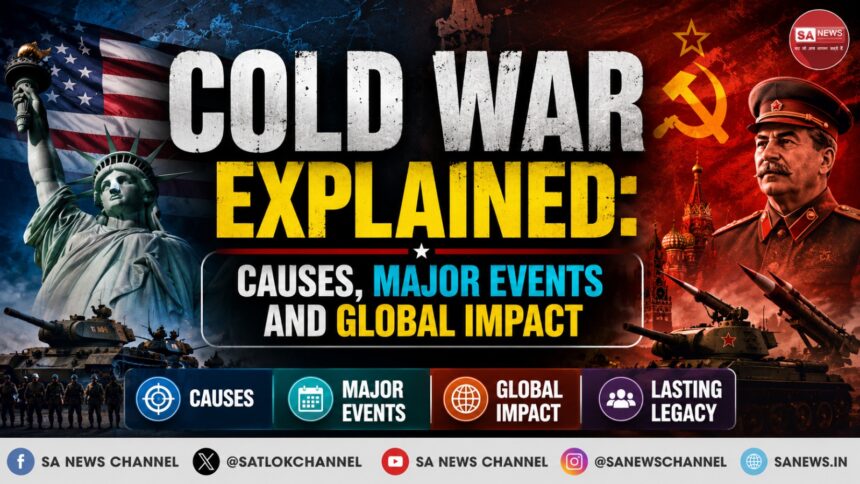
The Cold War referred to an era of prolonged geopolitical and ideological rivalry that shaped international relations from 1947 to 1991. The Cold War was the period when there was no conventional war between the countries. The two superpowers competed indirectly through nuclear weapons, military alliances, espionage, propaganda, economic influence, technological competition, and proxy wars.
- What Caused the Cold War?
- Ideological Differences Between Capitalism and Communism
- The End of World War II and Rising Tensions
- Formation of Rival Superpowers
- Major Events of the Cold War You Should Know
- The Nuclear Arms Race and the Space Race
- NATO vs. Warsaw Pact: The Military Alliances
- How the Cold War Affected Different Parts of the World
- Europe
- Asia
- Africa and Latin America
- Reforms Under Mikhail Gorbachev
- Fall of the Berlin Wall
- Dissolution of the Soviet Union
- Lasting Effects of the Cold War on Modern Politics
- Not War, But True Devotion Is the Solution to All Problems
The Cold War divided the world into two blocks and affected events across Africa, Europe, Asia, and Latin America. The Cold War transformed the global politics and continues to influence international security, diplomacy, military alliances, and relations between major powers in the present world.
What Caused the Cold War?
No single event caused the Cold War. The Cold War was caused due to a series of events. Deep ideological differences between the USSR (Union of Soviet Socialist Republics) and the USA (United States of America), growing mistrust among them after World War II, disputes over Europe, as well as the emergence of two rival superpowers (USA and USSR) gradually created a global confrontation. The development of nuclear weapons further increased the stakes.
Ideological Differences Between Capitalism and Communism
The United States of America (USA) and the Soviet Union advocated fundamentally different political and economic systems. The United States was in the favour of capitalism, private enterprise, and democratic institutions, while the Soviet Union supported communism, state ownership, and centralized political control. Both of them believed the expansion of the other’s ideology as a threat to their interests.
The End of World War II and Rising Tensions
After the end of the World War II in 1945, the alliance between the United States, Soviet Union, and other Allied powers quickly weakened. Disagreements over Germany, Eastern Europe, political influence, and postwar reconstruction increased distrust between the superpowers. The Truman Doctrine and Marshall Plan further highlighted the growing division between the Western and Soviet blocs.
Formation of Rival Superpowers
Both the United States and the Soviet Union emerged as the two superpowers of the world of the post World War II era. To protect their interests, both the superpowers competed to strengthen their international influence as well as build military capabilities to protect their interests. Their rivalry slowly reached far beyond Europe, impacting conflicts and political developments across the globe.
Major Events of the Cold War You Should Know
The Cold War was marked by various international problems, proxy wars, political hostilities, and military rivalry. Some of the issues were crucial milestones, whereas others served to illustrate how regional tensions can spread in the battle between the US and the USSR.
The Berlin blockade and airlift
In 1948, the USSR blocked Western land routes to Berlin in order to compel the Western powers to leave the city. In response to the blockade, America and its allies began carrying out the Berlin Airlift to provide the residents with food, fuel, and other essential supplies. In 1949, the blockade was lifted.
Korean war
The Korean war began when North Korea invaded South Korea in 1950. The US and the UN forces supported South Korea, while China intervened to defend North Korea. An armistice was reached, while Korea remained divided close to the 38th parallel.
The Cuban missile crisis
Among the most dangerous moments of the cold war was the Cuban missile crisis of 1962, when the USSR deployed its nuclear missiles to Cuba, while the US enforced a naval blockade. A crisis that lasted for two weeks was settled without an armed conflict and showed the terrible possibilities of nuclear arms race.
The Vietnam War
The Vietnam War became a significant conflict in the Cold War. The war was fought between communist North Vietnam and South Vietnam, aided heavily by the United States. The war led to a large number of death and devastation. The war ended in 1975 with the North Vietnamese army conquering Saigon.
The Nuclear Arms Race and the Space Race
The two most evident competitions between the United States and Soviet Union were the nuclear arms race and Space Race. While the nuclear arms race primarily focused on the military power and deterrence, the space race was the competition of demonstrating the technological capability and national prestige of the two superpowers. Both accelerated scientific and technological development.
Competition for Nuclear Superiority
The United States tested the first atomic bomb “The Gadget” and subsequently more atomic bombs in 1945. The Soviet Union conducted its first successful atomic bomb test in 1949 with the name of RDS–1 also known as “First Lightning”.
Both the countries gradually developed increasingly powerful weapons. Hydrogen bombs and Intercontinental ballistic missiles (ICBMs) were developed during this period. The resulting nuclear deterrence strategy resulted in a situation where a direct conflict could have devastating repercussions.
The Race to Space and Technological Innovation
In addition to the nuclear weapons, both the superpowers also competed in terms of the space and technological innovations. The Soviet Union launched the Sputnik 1 in 1957. In 1961, Soviet cosmonaut Yuri Gagarin became the first human to orbit Earth.
The United States later created history when Apollo 11 astronauts landed on the Moon in 1969. This space race accelerated advancements in rocketry, satellites, computing, telecommunications, and scientific research.
Also read: The Industrial Revolution and Its Impact on Society: How It Changed the Modern World
NATO vs. Warsaw Pact: The Military Alliances
The Cold War polarized Europe and large segments of the international community into rival military factions. NATO was the representative of the West; meanwhile, the Warsaw Pact was the alliance of the Soviet Union with a number of communist countries of Eastern Europe. The NATO alliance strengthened the principle of collective security, but it also deepened the division into East and West.
Formation of NATO
The North Atlantic Treaty Organization commonly known as NATO was formed in 1949. The main aim of this organisation was collective self-defense, which meant that, an attack on any of the member states will be viewed as an attack on all the members of the organization. NATO appeared as a reaction of the Western powers to the rise of Soviet power and the security of Western Europe.
Formation of the Warsaw Pact
In response to NATO, the USSR founded the Warsaw Pact in 1955. The Warsaw Pact included the USSR and several communist states of Eastern Europe.
How the Cold War Affected Different Parts of the World
Although the Cold War signifies the rivalry between the United States and Soviet Union, its global impact extended far beyond Europe. The Cold War affected governments, military conflicts, economic policies, and political movements across several continents.
Europe
Europe turned as the primary geographical center of the Cold War. The Cold War led into the division of Europe into the Western and Soviet-aligned states, symbolized by the Iron Curtain. Germany was divided into East and West, while Berlin became one of the most important flashpoints of the conflict.
Asia
Cold War conflict in Asia was exemplified through clashes such as those seen during the Korean and Vietnam wars. The rise of China as a communist power put pressure on the US containing communism within the region, and a number of consequences were thus faced in terms of political, social, and humanitarian affairs.
Africa and Latin America
Political battles were also shaped by the Cold War competition in places like Africa and Latin America. The superpowers involved looked for allies to work with and very often supported various regimes, political movements, or armed forces of their interest.
How Did the Cold War End?
A combination of economic pressures, political reforms, transforming international relations, and growing independence movements caused the end of the cold war. Developments in Eastern Europe and the Soviet Union during the late 1980s gradually weakened the Soviet-led system and brought the decades-long confrontation to its end.
Reforms Under Mikhail Gorbachev
With the aim of strengthening relations with the West, Soviet leader Mikhail Gorbachev introduced reforms popularly known as glasnost, meaning greater openness, and perestroika, referring to economic and political restructuring. He also supported arms-control efforts. These sociopolitical changes contributed to transformations across the Soviet bloc.
Fall of the Berlin Wall
On November 9, 1989, the Berlin Wall fell, marking the collapse of communist rule in Eastern Europe. This incident accelerated German reunification and symbolized the gradual weakening of the Soviet control over Eastern Europe.
Dissolution of the Soviet Union
The Soviet Union gradually weakened due to economic difficulties, political instability, and growing nationalist movements. Several Soviet republics including Ukraine, Belarus, Estonia, Russia, Latvia, Georgia and others declared independence during 1991. On December 26, 1991, the Soviet Union was formally dissolved. This marked the end of the Soviet state and the conventional endpoint of the Cold War.
Lasting Effects of the Cold War on Modern Politics
Although the Cold War ended decades ago, its effects are still evident in modern international relations, military strategy, nuclear policy, and global alliances. The Cold War reshaped the balance of power and founded political relationships that continue to influence world affairs.
Influence on Today’s International Relations
The alliances formed during the Cold War period, their methods of guaranteeing security, and various diplomatic relationships still shape the international politics and relations. It is due to the historical period of the Cold War that understanding issues like NATO, Russia’s current ties with surrounding nations, the position of the USA in the world, as well as major powers’ competition is possible.
Developments in Global Security
The Cold War has changed our understanding of concepts such as nuclear deterrence, military alliances, intelligence gathering, arms control, and national security. Nuclear weapons remain an important element of international security, despite the dissolution of the Soviet Union, and the world continues to face nuclear threats.
Not War, But True Devotion Is the Solution to All Problems
The Cold War demonstrated how fear, mistrust, and the pursuit of military power can create prolonged tension between nations. Saint Rampal Ji Maharaj, through His spiritual discourses impart the knowledge that lasting peace cannot be achieved merely through weapons, political agreements, or material power. True peace begins with a transformation in human thinking and conduct.
Saint Rampal Ji Maharaj emphasizes that true devotion to the Supreme God, along with the true way of worship, can help overcome hatred, greed, violence, and conflict. When individuals develop spiritual understanding and compassion, they contribute to reducing the causes that lead to disputes. To know more about the spiritual teachings of Saint Rampal Ji Maharaj visit www.jagatgururampalji.org or read sacred book Gyan Ganga.