

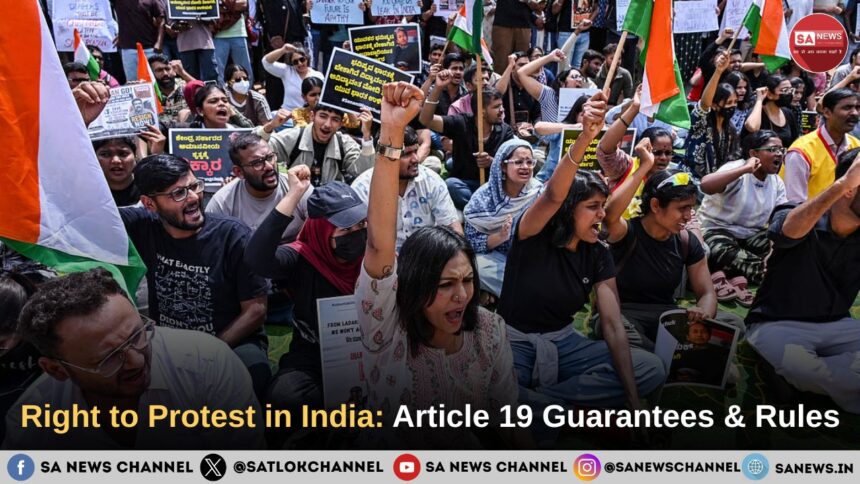
The right to protest in India is a fundamental democratic principle derived primarily from the constitutional freedoms guaranteed under Article 19. While the Constitution of India does not explicitly mention “right to protest” as an independent fundamental right, the Supreme Court has consistently affirmed that it is implicitly protected through freedom of speech and expression alongside the right to assemble peacefully without arms. However, this right is not absolute and is subject to constitutional reasonable restrictions aimed at maintaining public order, state security, and sovereignty. Recent legal debates and judicial rulings continue to emphasize the delicate balance between citizen dissent and public convenience.
Constitutional Framework of the Right to Protest
The table below outlines the core constitutional provisions, permissible state restrictions, and seminal judicial precedents governing public protests in India.
| Provision / Legal Ground | Scope of Fundamental Right | Permissible Reasonable Restrictions | Landmark Supreme Court Precedents |
| Article 19(1)(a) | Freedom of Speech and Expression: Enables public criticism of policies and peaceful agitation. | Article 19(2): Sovereignty, integrity, state security, public order, decency, defamation. | Kameshwar Prasad v. State of Bihar (1962) |
| Article 19(1)(b) | Freedom of Assembly: Grants the right to assemble peacefully and without arms for rallies and marches. | Article 19(3): Interests of public order, sovereignty, and national integrity. | Himat Lal K. Shah v. Commissioner of Police (1973) |
| Article 19(1)(c) | Freedom of Association: Protects the right to form unions and civil organizations for collective advocacy. | Article 19(4): Public order, morality, and sovereignty of India. | Mazdoor Kisan Shakti Sangathan v. UOI (2018) |
| Section 163 BNSS | Statutory police power to issue temporary orders prohibiting gatherings to prevent violence. | Must satisfy constitutional standards of legality, necessity, and proportionality. | Shaheen Bagh Case (2020) & Ramlila Maidan Incident (2012) |
Constitutional Architecture of Democratic Dissent
In a constitutional democracy, the ability to express disagreement with government actions or social policies serves as an essential safety valve. Article 19(1)(a) ensures that every citizen can publicly communicate views, voice grievances, and criticize public policy without fear of arbitrary state censorship. Complementing this, Article 19(1)(b) allows citizens to gather in public spaces to collectively project their demands.
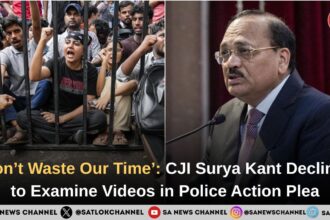
Also Read: Don’t Waste Our Time’: CJI Surya Kant Declines to Examine Videos in Police Action Plea
However, the Constitution establishes a clear distinction between peaceful demonstration and unlawful assembly. Demonstrations involving arms, incitement to violence, or destruction of public property strip protesters of constitutional protection. The judiciary has repeatedly affirmed that public meetings are a legitimate exercise of democratic participation provided they remain orderly and non-violent.
Reasonable Restrictions and Regulatory Permissions
Fundamental rights under Article 19 do not operate in isolation. Under Articles 19(2) and 19(3), the State is empowered to enact reasonable restrictions on public assemblies in the interest of public order, state security, and sovereignty. Law enforcement agencies manage public protests through local regulatory measures, typically requiring organizers to obtain a No Objection Certificate (NOC) or police permission prior to conducting rallies.
Also Read: June 12, 1975: The Court Verdict That Pushed India Toward the Emergency
Furthermore, statutory provisions such as Section 163 of the Bharatiya Nagarik Suraksha Sanhita (BNSS)-which replaced Section 144 of the erstwhile Code of Criminal Procedure (CrPC)-allow authorities to restrict assemblies to prevent public disorder. In landmark rulings like Shaheen Bagh (2020), the Supreme Court clarified that while dissent is protected, protesters cannot indefinitely occupy public roads or cause severe inconvenience to commuters, reinforcing that rights must be balanced with the freedoms of the broader public.
Transcendence of Earthly Strife: Achieving Permanent Peace Beyond Material Conflict
The continuous struggle between citizens demanding rights and authorities enforcing restrictions illustrates a fundamental truth about material existence: human systems are inherently filled with friction, dissatisfaction, and temporary solutions.
In this realm of Kaal Brahm, there is not even a trace of peace or happiness. Vices born of the three-attributed Maya-lust, anger, greed, attachment, ego, hatred, grief, loss, and pride-harass every living being. Here, one creature kills and feeds on another, exploits others, robs honor and wealth, and snatches peace.
Sant Rampal Ji Maharaj explains in His spiritual discourses that the eternal quest for justice and happiness cannot be fulfilled in this perishable world (Kaal Lok). The anxieties and unrest experienced in earthly life stem from ignorance of our true spiritual origin. Supreme God Kabir created a world of absolute harmony, Satlok, where there is no oppression, strife, or need to fight for rights. By obtaining Spiritual Knowledge (Tatvgyan) from a Complete Saint and practicing genuine spiritual devotion, an individual develops internal resilience against worldly turmoil.
FAQs on Right to Protest in India
1. Under which articles of the Indian Constitution is the right to protest protected?
The right to protest is implicitly protected under Articles 19(1)(a) (speech and expression), 19(1)(b) (peaceful assembly), and 19(1)(c) (freedom of association).
2. What are the constitutional grounds for imposing reasonable restrictions on peaceful assembly?
Under Article 19(3), restrictions can be imposed in the interests of the sovereignty and integrity of India and public order.
3. What did the Supreme Court rule regarding public road blockades in the 2020 Shaheen Bagh case?
The Supreme Court ruled that public ways and roads cannot be blocked indefinitely by protesters, emphasizing that the right to protest must be balanced with the right of commuters to move freely.
4. Which new legal provision replaced Section 144 CrPC for issuing prohibitory orders?
Section 163 of the Bharatiya Nagarik Suraksha Sanhita (BNSS), 2023, replaced Section 144 of the erstwhile Code of Criminal Procedure (CrPC).
5. Is prior police permission required to organize a public protest or march in India?
Yes, organizers generally must obtain a No Objection Certificate (NOC) or explicit permission from local police authorities to ensure public order and crowd safety.