

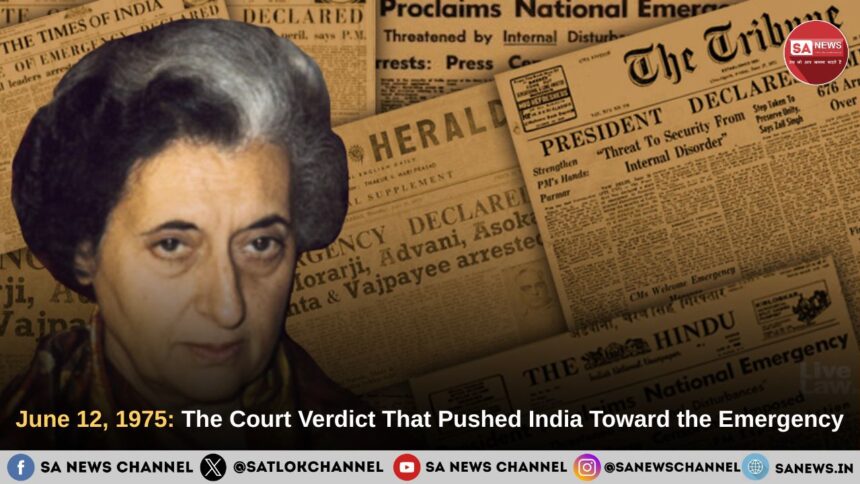
On June 12, 1975, the Allahabad High Court delivered one of the most consequential judgments in Indian political history. Justice Jagmohan Lal Sinha declared Prime Minister Indira Gandhi’s 1971 Rae Bareli election invalid in the Raj Narain election case and disqualified her from holding elected office for six years. The verdict created a constitutional crisis that, within 13 days, culminated in the declaration of the National Emergency.
- Quick Facts: June 12, 1975 Verdict
- Background: The 1971 Rae Bareli Election
- Raj Narain vs Indira Gandhi: The Election Petition
- Why Yashpal Kapoor Became Central to the Case
- Justice Jagmohan Lal Sinha and the Historic Judgment
- Section 123(7): The Legal Provision Behind the Verdict
- Why the Allahabad High Court Invalidated Indira Gandhi’s Election
- From June 12 to June 25: Timeline Before the Emergency
- The Allahabad Verdict
- Supreme Court Conditional Stay on June 24, 1975
- JP Movement and the Ramlila Maidan Rally
- Declaration of Emergency on June 25–26, 1975
- 39th Amendment and Indira Gandhi v. Raj Narain
- Why the June 12 Verdict Still Matters Today
- Beyond the 1975 Crisis: What the Fragility of Political Power Teaches Us About Life
- FAQs on the June 12, 1975 Allahabad High Court Verdict
Here is the complete breakdown of the legal battle, the landmark judgment, and the immediate political fallout.
Quick Facts: June 12, 1975 Verdict
| Point | Detail |
| Case | Raj Narain vs Indira Gandhi |
| Court | Allahabad High Court |
| Judge | Justice Jagmohan Lal Sinha |
| Verdict Date | June 12, 1975 |
| Election Challenged | 1971 Rae Bareli Lok Sabha election |
| Main Law | Section 123(7), Representation of the People Act, 1951 |
| Result | Election declared null and void |
| Disqualification | Six years from holding elected office |
| Later Event | Emergency declared on June 25–26, 1975 |
Background: The 1971 Rae Bareli Election
The roots of the verdict lay in the 1971 Lok Sabha elections. Prime Minister Indira Gandhi contested from the Rae Bareli constituency in Uttar Pradesh. Her primary opponent was Raj Narain, a prominent socialist leader representing the Samyukta Socialist Party.
Gandhi won the election by a massive margin, securing over 110,000 more votes than Narain. However, rather than accepting defeat, Narain filed an election petition in the Allahabad High Court, accusing Gandhi of employing corrupt practices and misusing state machinery to secure her victory.
Raj Narain vs Indira Gandhi: The Election Petition
Raj Narain’s legal team, led by the formidable advocate Shanti Bhushan, brought forth 14 specific charges of electoral malpractice under the Representation of the People Act, 1951.
Main Allegations Against Indira Gandhi
The prosecution argued that the Prime Minister’s campaign crossed the line between standard political strategy and illegal use of government resources. The primary accusations included:
- Misuse of Government Officials: Utilizing the services of Yashpal Kapoor, a gazetted government officer in the Prime Minister’s Secretariat, to manage her election campaign before his official resignation was accepted.
- State Infrastructure: Using Uttar Pradesh state police and administrative officials to build rostrums, arrange loudspeakers, and manage logistics for her election rallies.
- Symbol Misuse: Allegedly using the religious symbol of a cow and calf to appeal to Hindu voters.
- Bribery and Intimidation: Unproven allegations regarding the distribution of liquor and blankets to influence voters.
Key Figures in the 1975 Verdict
| Figure | Role in the 1975 Crisis |
| Indira Gandhi | Incumbent Prime Minister whose 1971 Rae Bareli election was challenged. |
| Raj Narain | Socialist leader and defeated candidate who filed the election petition. |
| Justice Jagmohan Lal Sinha | Allahabad High Court judge who delivered the verdict. |
| Shanti Bhushan | Lead counsel representing Raj Narain. |
| Yashpal Kapoor | Government official whose campaign role became central to the case. |
Why Yashpal Kapoor Became Central to the Case
Yashpal Kapoor became central because he had worked in the Prime Minister’s Secretariat and was alleged to have assisted Indira Gandhi’s election campaign before his resignation from government service formally took effect. This made his role important under Section 123(7) of the Representation of the People Act, which prohibited candidates from obtaining election assistance from government servants.
Indira Gandhi’s Cross-Examination in Allahabad High Court
On March 18 and 19, 1975, Indira Gandhi entered Courtroom No. 27 of the Allahabad High Court. Breaking all established protocols, she sat not on a raised dais, but in a standard witness chair for nearly five hours. Raj Narain’s counsel, Shanti Bhushan, subjected her to a rigorous, relentless cross-examination regarding her campaign logistics and her relationship with government secretary Yashpal Kapoor.
The media frenzy surrounding these two days gripped the entire nation, creating the initial momentum for what would become the ultimate political showdown.
Justice Jagmohan Lal Sinha and the Historic Judgment
Justice Jagmohan Lal Sinha faced immense, unimaginable political pressure as the delivery date approached. Reports from the era indicate that state intelligence agencies monitored his movements, and subtle offers of promotion to the Supreme Court were floated if he ruled in favor of the Prime Minister.
To maintain absolute integrity, Justice Sinha took extreme measures:
- Total Seclusion: He locked himself in his residence, instructing his staff to refuse all visitors and telephone calls.
- Secret Typing: The 258-page judgment was typed by a single, highly trusted stenographer, Mool Chandra Desai, who was also placed under voluntary house arrest until the verdict was read aloud in court to prevent any information leaks.
Section 123(7): The Legal Provision Behind the Verdict
Indira Gandhi was not disqualified for massive electoral fraud or rigging ballots; she was unseated on a technical statutory violation. Justice Sinha held her guilty under Section 123(7) of the Representation of the People Act, 1951.
What Section 123(7) of the Representation of the People Act Says
Section 123(7) of the Representation of the People Act, 1951 treats it as a corrupt practice if a candidate obtains assistance from certain government servants for furthering election prospects. In this case, the court found that assistance from Yashpal Kapoor and state officials connected with rally arrangements violated this provision.
Key Legal Fact: The law strictly prohibited candidates from obtaining any assistance from government servants to further their election prospects. Because Yashpal Kapoor had resigned from his government post but continued campaign work before his resignation was officially gazetted by the President, the court ruled his assistance illegal.
The consequences were absolute. The court declared Gandhi’s election to the Lok Sabha “null and void” and disqualified her from contesting any election for six years. The court granted a 20-day stay on the order’s execution, allowing her time to appeal to the Supreme Court and enabling the ruling Congress party to select a replacement leader.
Also Read- Indira Gandhi Biography: Life, Legacy, and Leadership of India’s First Female Prime Minister
Why the Allahabad High Court Invalidated Indira Gandhi’s Election
After four years of litigation-which included the unprecedented event of a sitting Prime Minister being cross-examined in a courtroom for two days-Justice Jagmohan Lal Sinha delivered his 258-page judgment on the morning of June 12, 1975.
Justice Sinha dismissed 12 of the 14 charges, including the most serious allegations of bribery and religious symbol misuse. However, he found Indira Gandhi guilty on two counts:
- Obtaining the assistance of a gazetted government officer (Yashpal Kapoor) for election purposes.
- Using state government officials and resources to construct rostrums and supply power for her campaign rallies.
From June 12 to June 25: Timeline Before the Emergency
The judgment triggered immediate political chaos. Opposition leaders, led by Jayaprakash Narayan (JP), demanded Gandhi’s immediate resignation. Instead of stepping down, the political machinery moved to consolidate power.
The Allahabad Verdict
June 12, 1975
Justice Sinha delivers the judgment, invalidating Indira Gandhi’s election and issuing a 20-day stay for appeal.
Supreme Court Conditional Stay on June 24, 1975
June 24, 1975
Justice V.R. Krishna Iyer of the Supreme Court grants a conditional stay. Gandhi is allowed to remain Prime Minister and address Parliament but is stripped of her right to vote in the Lok Sabha.
JP Movement and the Ramlila Maidan Rally
June 25, 1975
Jayaprakash Narayan holds a massive rally in Delhi, calling for total civil disobedience and urging the police and military to disobey “illegal and unconstitutional orders.”
Declaration of Emergency on June 25–26, 1975
Midnight, June 25, 1975
Advising President Fakhruddin Ali Ahmed that there is an imminent threat to internal security, Indira Gandhi secures the proclamation of a National Emergency. Fundamental rights are suspended, press censorship is imposed, and opposition leaders are arrested overnight.
39th Amendment and Indira Gandhi v. Raj Narain
Following the declaration of the Emergency, the Indira Gandhi administration used its heavily dominated Parliament to pass the 39th Constitutional Amendment Act in August 1975.
This amendment placed the election of the Prime Minister, President, Vice-President, and Speaker of the Lok Sabha completely beyond the scope of judicial review. The 39th Amendment inserted Article 329A, creating special protection for disputes involving the election of the Prime Minister and certain high constitutional offices. Its most controversial clause attempted to remove judicial review over Indira Gandhi’s own election dispute.
When the case finally reached the Supreme Court on appeal (Indira Nehru Gandhi v. Raj Narain, 1975), the apex court upheld Gandhi’s election based on these new retroactive amendments but courageously struck down the clause that barred judicial review, affirming that the “power of judiciary” is part of the basic structure of the Indian Constitution.
Why the June 12 Verdict Still Matters Today
The June 12 verdict remains a defining moment in India’s democratic evolution. It demonstrated the profound independence of the Indian judiciary, showing that the law could hold even the nation’s most powerful executive accountable. Yet, it also served as the catalyst for the 21-month Emergency, the most severe suspension of democratic rights in the history of independent India.
Beyond the 1975 Crisis: What the Fragility of Political Power Teaches Us About Life
The historic verdict of June 12, 1975, remains a stark reminder that worldly power, authority, and political triumphs are inherently transient and fragile. A sitting Prime Minister, at the absolute zenith of her political career, was unseated by a single judicial order, throwing an entire nation into unprecedented chaos. This chaotic scramble to preserve temporary rule highlights a profound truth regularly emphasized by Sant Rampal Ji Maharaj in his spiritual discourses: human beings exhaust their vital energy chasing fleeting, mortal positions that can be stripped away in an instant by time or destiny.
True stability and ultimate liberation cannot be found in the corridors of political power or material dominance, which only breed anxiety, conflict, and eventual downfall. Sant Rampal Ji Maharaj explains that the soul’s true governance lies in connecting with the eternal, supreme truth through authentic spiritual practice (Satbhakti).
Knowledge from holy scriptures develops qualities such as honesty, compassion, and justice, which are necessary for good governance and social harmony. As citizens reflect on the events surrounding the Emergency, this historic episode also inspires people to seek spiritual wisdom and contribute toward building a society based on truth, equality, and lasting peace.
By pivoting from the volatile theater of worldly politics to the permanent refuge of spiritual wisdom, we attain a state of peace that no earthly court, judgment, or emergency can ever disrupt. Investing in spiritual wealth ensures a destiny that remains absolute, eternal, and completely beyond the reach of material decay.
FAQs on the June 12, 1975 Allahabad High Court Verdict
Q: What happened on June 12, 1975?
A: On June 12, 1975, the Allahabad High Court declared Indira Gandhi’s 1971 Rae Bareli election invalid and disqualified her from holding elected office for six years.
Q: Who filed the case against Indira Gandhi?
A: The case was filed by Raj Narain, the socialist leader who had contested against Indira Gandhi from Rae Bareli in the 1971 Lok Sabha election.
Q: Why was Indira Gandhi found guilty?
A: She was found guilty under Section 123(7) of the Representation of the People Act for obtaining assistance from government officials during her election campaign. The court dismissed most other allegations.
Q: Did the Allahabad High Court verdict cause the Emergency?
A: The verdict did not alone cause the Emergency, but it triggered a major constitutional and political crisis. After the Supreme Court granted only a conditional stay on June 24, 1975, and after JP’s mass rally on June 25, the Emergency was declared at midnight.
Q: What did the Supreme Court decide in Indira Gandhi v. Raj Narain?
A: The Supreme Court later struck down parts of Article 329A inserted by the 39th Amendment as unconstitutional, while ultimately allowing Indira Gandhi’s election to stand under amended election laws.