

A Supreme Court oral mention on 22nd July 2026 drew attention after a Bench led by Chief Justice of India Surya Kant declined an urgent request concerning alleged police action against Cockroach Janta Party protesters. The exchange did not result in any ruling on the merits, but it has triggered wider discussion on urgent listings and judicial procedure. Learn more in this article.
A Defining Courtroom Exchange on 22nd July 2026
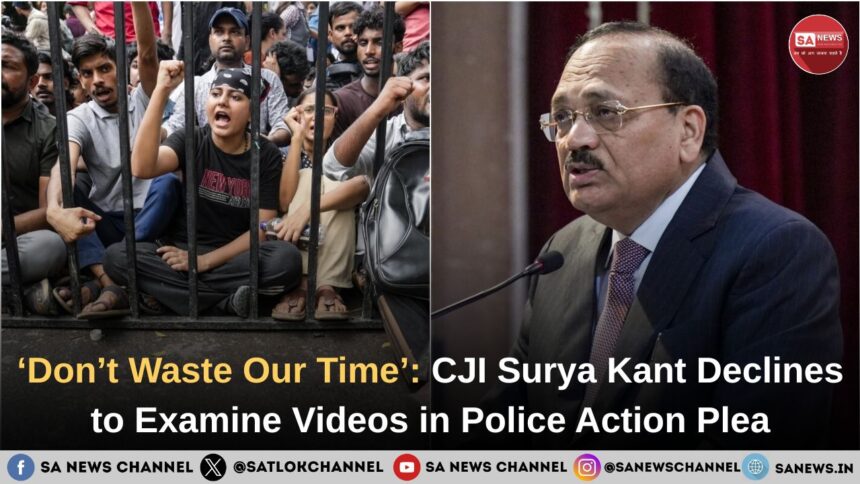
On 22nd July 2026, the Supreme Court of India witnessed a verbal mention before a three-judge Bench led by Chief Justice of India (CJI) Surya Kant, along with Justice Joymalya Bagchi and Justice V. Mohana. The request sought the urgent listing of a petition concerning the alleged police action against protesters associated with the Cockroach Janta Party (CJP) during the 20 July ‘Sansad Chalo’ march in New Delhi.
- The petitioners’ lawyer informed the Court that participants in the march, many of them students, were allegedly dispersed through the use of lathi charges, tear gas and other forms of police force while making their way towards Parliament from Jantar Mantar.
- The lawyer informed the Court that the petition contained three specific prayers and requested either an immediate hearing or the Court’s intervention at the earliest opportunity.
- During the mentioning, counsel also stated that video recordings were available to support the allegations and expressed readiness to place them before the Court.
- The Bench, however, declined to treat the matter as one requiring urgent listing.
- During the exchange, the petitioner’s counsel requested the Court to consider video recordings that, according to the petition, supported the allegations being raised. The Bench, however, indicated that it was not inclined to examine such material at the mentioning stage.
- Explaining the Bench’s position, the Chief Justice observed, “We are not interested in videos; we don’t have time to watch. We don’t want to watch videos”.
- When counsel continued to press for an urgent hearing, emphasising both the seriousness of the allegations and the availability of video evidence, the Bench reiterated its position.
- The Chief Justice’s response, as reflected in media accounts of the proceedings, was, “Don’t waste our time. We don’t want to watch any videos”
- Several legal news outlets also reported a closely related version of the exchange, “Don’t waste our time, and don’t waste your time”
- During the mentioning, counsel also sought to highlight the broader issues underlying the student protests, including concerns over the conduct of public examinations and the need for reforms within the National Testing Agency (NTA).
- However, the Bench did not entertain further submissions at that stage, reportedly bringing the oral mentioning to a close with a brief acknowledgement.
- Importantly, the Supreme Court did not examine the factual allegations, assess the authenticity of the videos or express any opinion on whether the police action was lawful or unlawful.
- Since the matter was not taken up for urgent listing, the Court did not enter into the merits of the dispute.
The development followed a similar decision by the Delhi High Court a day earlier, where urgent relief in a related matter was also declined. The incident has triggered a widespread speculation of the judicial procedures especially in urgent cases.
Background of the Petition
The petition mentioned before the Supreme Court on 22nd July 2026 stemmed from the 20th July ‘Sansad Chalo’ protest organised by the Cockroach Janta Party (CJP).
- The youth-led movement, which emerged following earlier remarks by CJI Surya Kant, was protesting against alleged irregularities in the NEET-UG 2026 examination and demanding the resignation of Union Education Minister Dharmendra Pradhan, along with reforms in the National Testing Agency (NTA).
- As protesters marched from Jantar Mantar towards Parliament despite prohibitory orders and the denial of permission by Delhi Police, clashes broke out.
- Police resorted to lathi charges and tear gas to disperse the crowd, while reports also referred to stone-pelting and damage to public property.
- Injuries were reported among both protesters and police personnel, and multiple FIRs were subsequently registered.
- Against this backdrop, the petitioners approached the Supreme Court seeking urgent intervention, alleging excessive police force and offering video footage in support of their claims.
- The matter was raised through an oral mention with a request for urgent listing or suo motu cognisance.
A day earlier, the Delhi High Court had similarly declined to grant an urgent hearing on a related plea.
Also Read: Biography of Nelson Mandela: An Icon of Resilience and Justice
The Delhi High Court’s Earlier Decision
A day before the matter reached the Supreme Court, a similar plea was mentioned before the Delhi High Court seeking urgent judicial intervention over the alleged police action against CJP protesters during the 20th July ‘Sansad Chalo’ march.
- The petition alleged excessive use of force, including lathi charges and tear gas, and requested an expedited hearing.
- The High Court, however, declined to accord urgent listing.
- According to media reports, the Bench observed words to the effect of, ‘Don’t drag the Court into this’, indicating that the matter did not warrant immediate intervention at that stage.
The Supreme Court’s decision on 22 July 2026 to also decline urgent listing meant that, within two days, both constitutional courts chose not to entertain the matter on an emergency basis, leaving the petitioners to pursue the ordinary judicial process.
The Incident That Sparked the Cockroach Janta Party
Interestingly, the Cockroach Janta Party (CJP) traces its origins to oral observations made by Chief Justice of India Surya Kant during a Supreme Court hearing on 15th May 2026, in which he referred to certain unemployed youngsters and activists as ‘cockroaches’ and ‘parasites’. The remarks quickly went viral and sparked widespread public debate, prompting many young people to adopt the term ‘cockroach’ as a symbol of protest.
Although the Chief Justice clarified the following day that his comments were directed only at individuals who had entered professions using fake or bogus degrees and not at India’s youth in general, the satirical movement had already gathered momentum and eventually evolved into the Cockroach Janta Party.
Can True Justice Ever Exist in This World?
The past few days have shocked the nation in all aspects. Rising above all the happenings, one truth remains unheard. Can there ever be Justice in this world? The deep-rooted origins of the world we live in actually lie in deceit, that automatically reflects in our surroundings, forcing us to face betrayals and disappointments at all levels.
Despite this, there exists a silver lining of hope – the refuge of a Tatvdarshi Sant. Jagatguru Tatvdarshi Sant Rampal Ji Maharaj is that Tatvdarshi Sant about whom all scriptures testify as the One who will usher in real change across the world, the One who will establish truth, justice and equality for all.
Learn more about the Real Messiah of this world, Sant Rampal Ji Maharaj, and the silent, historic movement He is already spreading, by watching this video: