


The August 12, 2026 total solar eclipse has passed, leaving behind extraordinary scenes as the Moon’s shadow swept across Greenland, Iceland and Spain and briefly turned day into night. But beyond the breathtaking corona and crowds gathered under darkened skies lies a bigger story. What actually unfolded, what scientists learned, what comes next and why a centuries-old prediction about a far longer darkness is suddenly worth revisiting.
- Highlights of August 12, 2026 Total Solar Eclipse
- The August 12, 2026 Total Solar Eclipse
- Why Was the August 12, 2026 Total Solar Eclipse So Widely Discussed?
- What Actually Happened During the August 12, 2026 Total Solar Eclipse?
- How Long Did Totality Actually Last on August 12?
- Where Was the August 12 Total Solar Eclipse Visible?
- Was the August 12 Solar Eclipse Visible in India?
- What Time Did the August 12, 2026 Solar Eclipse Occur?
- Where Were the Best Views of the August 12 Eclipse?
- What Did the August 12 Total Solar Eclipse Look Like?
- Millions Gathered for Europe’s Historic Eclipse
- Why Were Eclipse Glasses Necessary During the August 12 Eclipse?
- What Did Scientists Study During the August 12 Eclipse?
- When Is the Next Total Solar Eclipse After August 12, 2026?
- From Minutes of Totality to Seven Days of Darkness: What Does Bhavishya Malika Predict?
- Have Earlier Bhavishya Malika Predictions Already Come True?
- Bhavishya Malika’s Greatest Revelation
- One Prophecy: Or a Message Repeated Across Centuries?
- The Saint Foretold Across Prophecies: Sant Rampal Ji Maharaj
- FAQs About the August 12 Total Solar Eclipse
Highlights of August 12, 2026 Total Solar Eclipse
- The August 12, 2026 total solar eclipse carried the Moon’s shadow across parts of Greenland, Iceland and Spain, while a much wider region witnessed a partial eclipse.
- Totality peaked at roughly 2 minutes and 18 seconds, although complete darkness lasted for a much shorter period in many populated viewing locations.
- The eclipse marked a historic moment for mainland Europe, which experienced its first total solar eclipse since 1999.
- Spain emerged as one of the standout viewing regions, where the low position of the Sun created dramatic scenes close to sunset; clouds made conditions more uncertain across parts of Iceland.
- The eclipse offered scientists a rare window for research, particularly for observing the normally obscured solar corona and studying atmospheric responses to a sudden loss of sunlight.
- The next total solar eclipse will occur on 2nd August 2027, with Spain once again lying within the path of totality. An annular eclipse follows in January 2028.
- Beyond astronomy, the eclipse draws attention to an intriguing centuries-old prophecy that describes a period when darkness would last not minutes, but seven consecutive days and nights.
The August 12, 2026 Total Solar Eclipse
The August 12, 2026 total solar eclipse occurred when the Moon passed directly between Earth and the Sun, completely covering the Sun’s bright face for observers within the path of totality.
- The event crossed parts of the Northern Hemisphere before reaching Europe, where totality was visible from Iceland and parts of Spain and Portugal.
- A total solar eclipse is possible because the Sun and Moon appear almost the same size in Earth’s sky despite being vastly different in actual size.
- When their apparent positions align precisely, the Moon can temporarily hide the Sun’s bright surface.
- The Moon casts two important types of shadow during an eclipse. The umbra is the narrow, darkest central shadow where observers experience a total eclipse. The penumbra covers a much larger area where observers see only part of the Sun disappear.
- The strip of Earth’s surface crossed by the umbra is known as the path of totality.
- People even slightly outside this path experience a partial rather than total eclipse.
Why Was the August 12, 2026 Total Solar Eclipse So Widely Discussed?
The August 12 eclipse was particularly important because it brought total solar eclipse conditions to mainland Europe for the first time since 1999 and provided scientists with a rare opportunity to investigate the Sun and Earth’s atmosphere.
- For Spain, the event was even more unusual.
- The August 12 eclipse formed part of an extraordinary sequence of eclipses over the Iberian Peninsula, with another total solar eclipse due on 2nd August 2027 and an annular eclipse following in January 2028.
- Totality briefly revealed the solar corona, the Sun’s faint outer atmosphere that is normally overwhelmed by the brightness of the solar surface.
- Total solar eclipses allow scientists to examine structures and changes within this difficult-to-observe region.
- NASA prepared several scientific experiments for the 2026 eclipse.
- One involved a WB-57 high-altitude aircraft flying at around 50,000 feet to photograph the corona in visible and infrared wavelengths. Its cameras were designed to capture at least 20 images every second as the aircraft chased the Moon’s shadow.
- In addition, NASA-supported teams planned atmospheric observations using scientific balloons in Iceland and Spain. Researchers intended to investigate how the sudden reduction in sunlight affected atmospheric conditions during the eclipse.
What Actually Happened During the August 12, 2026 Total Solar Eclipse?
The August 12, 2026 total solar eclipse carried the Moon’s shadow from the high Arctic through Greenland and Iceland before reaching Spain, briefly replacing daylight with totality along its narrow path.
- The event was especially significant for Europe, marking the first total solar eclipse visible from mainland Europe since 1999.
- The eclipse began its journey across sparsely populated northern regions before the Moon’s central shadow reached Greenland and then Iceland.
- After leaving Iceland, the shadow crossed the North Atlantic at tremendous speed and eventually entered northern Spain.
- In Iceland, observers experienced totality during the late afternoon. Reykjavík received a little over a minute of complete eclipse, while places positioned nearer the central line remained inside the Moon’s umbra for longer.
- Weather added an element of uncertainty, with clouds affecting viewing conditions in parts of the country.
- Spain provided a dramatically different setting. Totality reached the country shortly after 8:25 p.m. local time, when the Sun was already approaching the western horizon.
- Crowds watched the final sliver of sunlight vanish before the Moon revealed the Sun’s faint outer atmosphere (the corona) against a rapidly darkening sky.
- As totality approached and ended, some observers could also witness Baily’s beads, the brilliant points of sunlight created when rays pass through irregular valleys along the lunar edge.
- Cheers erupted among spectators as the much-awaited celestial spectacle finally unfolded.
Within moments, sunlight began returning and the landscape emerged from the Moon’s shadow.
How Long Did Totality Actually Last on August 12?
The longest totality anywhere along the August 12, 2026 eclipse path was approximately 2 minutes and 18 seconds, while many well-known viewing locations experienced considerably shorter periods of complete darkness.
- An observer’s duration of totality depended largely on their position within the Moon’s moving umbral shadow.
- Locations close to its central track generally remained in totality longer than places nearer its outer boundaries.
- This distinction is important because the entire eclipse lasted far longer than totality itself.
- References to several minutes or even hours of eclipse activity should therefore not be interpreted as several minutes of complete darkness at one location.
- As an example: Totality lasted roughly 1 minute 2 seconds in Reykjavík, approximately 1 minute 52 seconds around Grundarfjörður, and about 1 minute 45 seconds in Gijón. The precise experience varied from one location to another.
- No location experienced four minutes of complete totality during the August 12 eclipse. The maximum was approximately 2 minutes and 18 seconds.
And that short duration becomes especially significant when considered alongside another description of darkness that we will encounter later in this article – one measured in days, not in minutes.
Where Was the August 12 Total Solar Eclipse Visible?
The August 12 total solar eclipse was visible from parts of northern Russia, Greenland, Iceland, Spain and a very small section of Portugal, while a partial eclipse covered a far larger portion of the Northern Hemisphere.
The path began in northern Siberia and crossed the Arctic Ocean and eastern Greenland before reaching western Iceland. From there, the lunar shadow travelled across the North Atlantic and reached northern Spain, briefly crossed northeastern Portugal and eventually ended around sunset near Spain’s Mediterranean coast and the Balearic Islands.
Outside the narrow totality path, observers across much of Europe saw a partial solar eclipse. Partial phases were also geographically visible across most of Canada, parts of the northern United States and northwestern Africa.
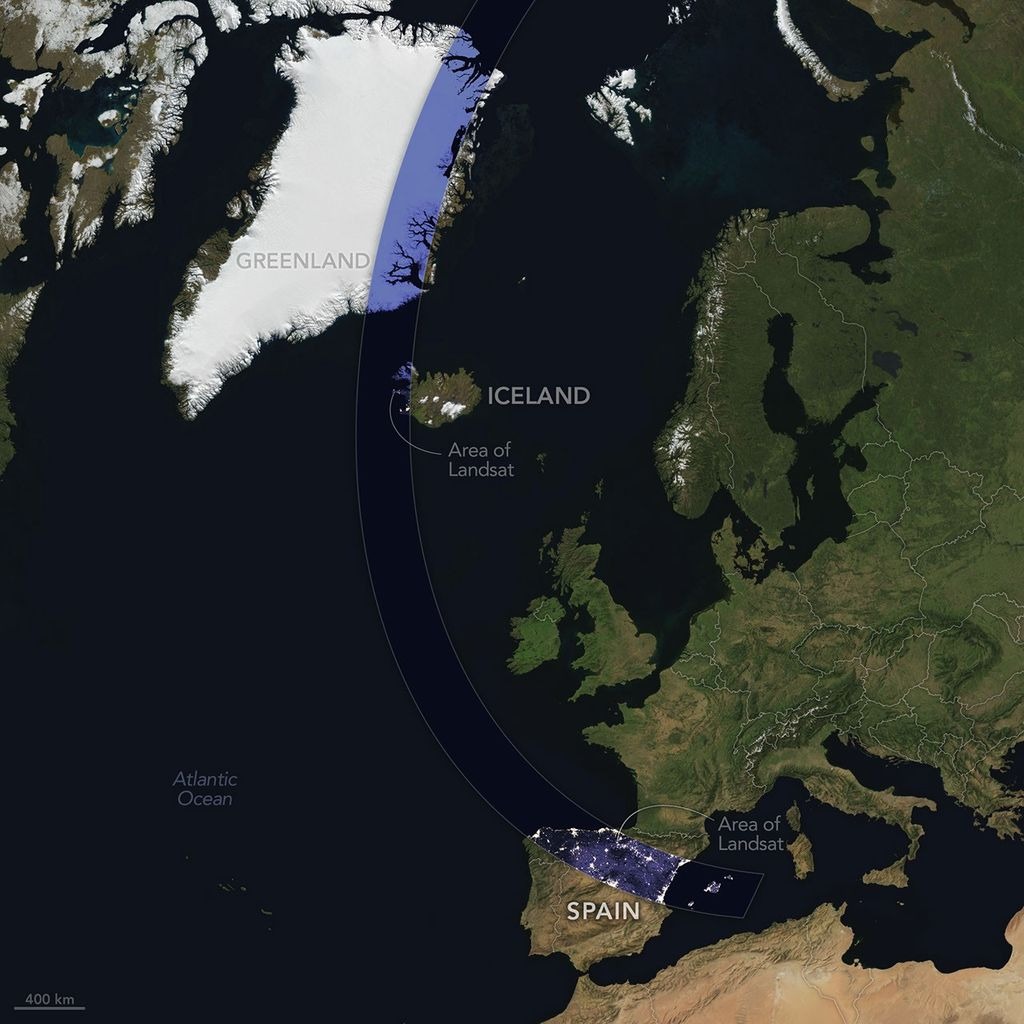
Image Title: Eclipse map showing totality across Russia, Greenland, Iceland and Spain
Photo: NASA Earth Observatory/Michala Garrison
Was the August 12 Solar Eclipse Visible in India?
The August 12, 2026 solar eclipse was not visible from India because the country lay outside both the total and partial visibility regions of this eclipse.
Instead, the eclipse primarily affected the Arctic, North Atlantic, Europe and parts of North America and northwestern Africa. Indian skywatchers therefore needed online broadcasts to follow totality as it occurred.
This distinction is important because the August 12 eclipse generated enormous international attention, which could easily create confusion over whether the phenomenon was visible worldwide. A solar eclipse is visible only from the part of Earth reached by the Moon’s shadow.
What Time Did the August 12, 2026 Solar Eclipse Occur?
The August 12 solar eclipse began globally at approximately 15:34 UTC, with totality beginning later as the Moon’s central shadow crossed Earth. The maximum eclipse occurred at approximately 17:46 UTC.
| Eclipse Stage | Approximate UTC Time |
| Partial eclipse first began | 15:34 |
| Total eclipse first began | 16:58 |
| Maximum eclipse | 17:46 |
| Final totality ended | 18:34 |
| Partial eclipse completely ended | 19:58 |
Because these times describe the eclipse globally, they should not be confused with local viewing times. Every location experienced the eclipse at a different point as the Moon’s shadow travelled across Earth.
Where Were the Best Views of the August 12 Eclipse?
Spain offered some of the most memorable views of the August 12 eclipse, while variable cloud conditions made successful viewing more uncertain in Iceland. Even so, observers and photographers in both countries managed to capture remarkable moments from totality.
- Across Spain, large gatherings formed within the path of totality, with striking eclipse photographs emerging from locations including Arija, Arcos de las Salinas and Teruel.
- The late-evening timing gave the Spanish eclipse an unusual visual character because the Sun was already descending towards the horizon.
- Rather than watching a blackened Sun high overhead, many Spanish observers saw totality unfold against an evening sky.
- The combination of a low Sun, surrounding twilight and the appearance of the corona created some of the event’s most distinctive scenes.
- Iceland presented a different challenge. Forecast cloud cover had threatened to obscure the spectacle in some areas, meaning observers had to rely on breaks in the clouds arriving at precisely the right time.
- Nevertheless, totality was successfully observed and recorded from parts of the country.
- For eclipse chasers, the contrasting experiences offered a familiar reminder – astronomy can tell you exactly where the Moon’s shadow will travel, but it cannot promise that local weather will let you see it.
Also Read: Evolution of Democracy: From Athens to Modern Global Contradictions
What Did the August 12 Total Solar Eclipse Look Like?
The August 12 total solar eclipse transformed the Sun from an increasingly narrow crescent into a dark lunar silhouette surrounded by the glowing solar corona before sunlight rapidly returned.
- During the partial phase, the Moon gradually moved across the Sun’s bright disc.
- For much of this stage, daylight remained surprisingly strong even as an increasingly large portion of the Sun disappeared.
- As totality approached, however, the transformation accelerated.
- The remaining crescent narrowed, the surrounding light weakened dramatically, and the landscape took on the unusual appearance associated with an approaching total eclipse.
- Then the last direct sunlight disappeared.
- For observers inside the path of totality, the Sun’s corona suddenly became visible around the completely darkened Moon.
- The corona is the Sun’s outer atmosphere, but its faint glow is normally overwhelmed by the brilliance of the solar surface.
- Around the beginning and end of totality, tiny bursts of sunlight could appear along the lunar edge as Baily’s beads, produced when sunlight passes through valleys and depressions on the Moon.
- Soon afterward, the sequence reversed. A brilliant point of sunlight returned, totality ended, and the Moon gradually uncovered the rest of the solar disc.
Outside the narrow path of totality, the experience was very different. Large areas of Europe and portions of North America and Africa saw a partial eclipse, meaning the Sun never disappeared completely.
Millions Gathered for Europe’s Historic Eclipse
The August 12 eclipse became a major public event as residents, tourists, scientists and dedicated eclipse chasers converged on Iceland and Spain to experience totality.
- Spain had prepared for up to six million additional visitors across areas affected by the eclipse, creating challenges extending far beyond astronomy.
- Authorities had to plan for traffic, crowd management, emergency response and the heightened wildfire danger associated with hot and dry summer conditions. Around 25,000 police personnel and roughly 100 aircraft formed part of the wider preparations.
- Iceland, meanwhile, had expected approximately 80,000 visitors around the event.
- For travellers who had crossed countries or continents to reach the path of totality, cloud cover remained the frustrating variable that no eclipse calculation could eliminate.
- The enormous interest demonstrated the extraordinary appeal of total solar eclipses.
- People may travel thousands of kilometres, plan years ahead and wait for hours simply to experience a minute or two inside the Moon’s shadow.
- Spain will not have to wait long for another major eclipse. A second total solar eclipse will cross parts of the country on 2nd August 2027, followed by an annular solar eclipse in January 2028.
- Together with the 2026 event, the sequence has become known as the Iberian Eclipse Trio.
Why Were Eclipse Glasses Necessary During the August 12 Eclipse?
Eclipse glasses were necessary throughout every partial phase because looking directly at any visible portion of the Sun can seriously damage the eyes.
- Ordinary sunglasses do not provide sufficient protection for direct solar viewing.
- Safe eclipse viewers should meet the ISO 12312-2 international standard.
- Only people experiencing complete totality could safely remove their solar viewers during the brief period when the Moon entirely covered the Sun’s bright face.
- Eye protection had to be replaced immediately when sunlight began to reappear.
- Cameras, telescopes and binoculars also required suitable solar filters over the front of their optics during the partial phases.
What Did Scientists Study During the August 12 Eclipse?
The August 12 total solar eclipse gave researchers a brief natural experiment for examining both the Sun’s normally obscured corona and changes in Earth’s atmosphere when incoming sunlight suddenly falls.
- Totality provides scientists with conditions that are difficult to reproduce during ordinary daylight.
- When the Moon hides the intensely bright solar surface, researchers can observe structures in the much fainter corona with greater clarity.
- Some NASA-supported research was designed to take advantage of altitude as well as totality.
- High-altitude observations can place instruments above much of the atmospheric interference and weather that affect observations made from the ground.
- Other experiments focused not on the Sun, but on Earth’s response to the eclipse. Because solar radiation drops quickly and then returns, researchers can examine how atmospheric conditions react to an abrupt interruption in normal daytime heating.
However, the completion of an experiment is not the same as the publication of a discovery. Scientists must first process and analyse the data collected during the eclipse, meaning important findings from August 12 may emerge well after the event itself.
When Is the Next Total Solar Eclipse After August 12, 2026?
The next total solar eclipse after 12th August 2026 will occur on 2nd August 2027, bringing totality to parts of southern Europe, North Africa and the Middle East.
The 2027 eclipse is particularly notable because its maximum totality will be considerably longer than the approximately 2-minute-18-second maximum of the 2026 event.
But beyond these precisely calculated celestial events lies a very different prediction of darkness. Not for two minutes or a few hours. But for seven days and seven nights with the Sun said to remain unseen.
And this centuries-old prophecy from India is where the story takes an unexpected turn.
Also Read: UK Spring Weather Forecast: Arctic Cold Snap Brings Frost Before Temperatures Rebound
From Minutes of Totality to Seven Days of Darkness: What Does Bhavishya Malika Predict?
The few extraordinary minutes of darkness during a total solar eclipse are strikingly juxtaposed with a far more unsettling period of darkness described in the Bhavishya Malika – seven days and seven nights during which the Sun is said to remain unseen.
Though the total solar eclipse was due to an astronomical reason, the prophecy of seven complete days of darkness has gained widespread acknowledgement in recent years.
The Bhavishya Malika is a collection of prophetic literature traditionally associated with the Panchasakha saints of Odisha and particularly Achyutananda Das, describes something fundamentally different. One verse circulated in modern publications and translations of the Bhavishya Malika reveals that a time will come on Earth when darkness will prevail for seven days and the Sun will not be visible (sato dino je andhakara baulo, surya no hoibe dekha).
Interpretations by Odia experts of the Bhavishya Malika puran connect this seven-day period of darkness with wider upheavals associated with the transition from Kali Yuga towards Satya Yuga and the appearance of Kalki. (However, Kalki is to appear at the end of Kaliyug and he is not the one to bring Satyuga, the reference here is for Supreme God Kabir Himself).
Though this prediction should not be confused with a solar eclipse, one will agree that the phenomenon described in the Bhavishya Malika is shocking.
Why have the prophetic revelations within Bhavishya Malika attracted so much attention in recent years?
Have Earlier Bhavishya Malika Predictions Already Come True?
The Bhavishya Malika’s warnings are attracting attention for another reason. Several of its earlier predictions have already unfolded. Passages have foretold Mahatma Gandhi and the end of British rule, the devastating 1999 Odisha Super Cyclone and even the COVID-19 pandemic. Other verses have subsequently been associated with political developments and remarkable occurrences at the Jagannath Temple in Puri, Odisha.
And that inevitably makes its predictions about what is yet to come far more compelling.
However, within all these prophetic revelations lies one prediction that, for most believers, is far more important than predictions concerning wars, disasters or darkness – one that shifts attention from what may happen to the world to Who will lead humanity through its transformation.
Bhavishya Malika’s Greatest Revelation
The seven days and seven nights of darkness may be among the most startling predictions attributed to the Bhavishya Malika, but they are not its most consequential prophecy. The prophetic narrative speaks of an extraordinary Mahapurush associated with the restoration of true Dharma and the emergence of Satyug-like conditions amid Kaliyug.
The Bhavishya Malika further reveals that false religious practices would eventually lose their hold, truth would rise and the Complete Supreme God (Purna Parmatma or Jagganath Mahaprabhu) Himself would guide humanity towards a radically transformed age, playing the role of that Real Satguru.
But, when will the Supreme God play His role just like the prophesied extraordinary figure?
This is where the prophecy becomes even more intriguing.
The Clues to the Identity of the Predicted Mahapurush
Bhavishya Malika interpretations do not merely announce the arrival of a great figure (the roleplay of the Supreme God). They leave distinct clues by which He can be recognised.
- He would not hunger for a throne. He would not pursue political authority, prestigious positions or material pleasures.
- According to the discourse, His overriding purpose would be the establishment of real Dharma and the spiritual welfare of His devotees.
- Another remarkable clue states that His recognition would not depend on conventional publicity or promotion.
- The transcript explains that the Mahapurush would become known through His own influence, His extraordinary works or leelas, and His darshan. People themselves would begin recognising and speaking about Him.
These characteristics already narrow the description considerably. But Bhavishya Malika gives an even more extraordinary clue.
The Crucial Clue: The Owner of 16 Maha Kalas
The predicted figure is described in the Bhavishya Malika discourse as the Avatar of Jagannath Mahaprabhu (the Supreme God) endowed with 16 Maha Kalas – a distinction presented as revealing His true spiritual identity. This detail is crucial.
This description should not simply be equated with the conventional expectation of Kalki as an incarnation of Vishnu or Krishna.
- Lord Krishna (Vishnu) is the owner of 16 Kalas
- Bhavishya Malika, however, attributes a very different distinction to the Avatar of Jagannath Mahaprabhu. He is described as possessing 16 Maha Kalas.
The Bhavishya Malika is pointing towards the Supreme God Himself appearing in human form to guide humanity during this decisive transition.
And then comes perhaps the most startling part of the entire prediction. The 16-Maha-Kala-endowed Jagannath Avatar is not waiting to appear at some distant point in the future.
He is already here. The real challenge is in recognising Him.
One Prophecy: Or a Message Repeated Across Centuries?
The prediction becomes even more thought-provoking when Bhavishya Malika is placed alongside prophecies attributed to foretellers from entirely different countries and periods.
If one text alone spoke of an extraordinary spiritual figure transforming humanity, the claim could remain confined to that particular prophetic tradition. But proponents point towards something much harder to ignore.
Despite the different names, countries and centuries, these predictions echo remarkably similar characteristics of that One Saviour.
- A great spiritual personality would emerge from India.
- His influence would eventually cross national boundaries.
- He would possess extraordinary spiritual knowledge.
- He would challenge prevailing religious misconceptions.
- He will stop a deadly war.
- He would work towards human unity rather than division.
- Distinctions based upon caste, creed, wealth and social status would lose their importance.
- And through true spiritual knowledge, He would help lead humanity towards a new Golden Age, not through military conquest.
Among the most widely discussed of these are predictions attributed to Nostradamus, Jean Dixon, Chiero, Anderson, Gerard Crise and Charles Clarke.
The Saint Foretold Across Prophecies: Sant Rampal Ji Maharaj
Jagatguru Tatvdarshi Sant Rampal Ji Maharaj is the only Saint whose life, spiritual teachings and ongoing work align exactly with the identifying markers presented in these prophetic interpretations. The significance lies not in one isolated similarity, but in how the different clues converge upon the same figure.
Sant Rampal Ji Maharaj is that sole spiritual guru Who imparts scripture-based spiritual knowledge, has restored true worship, rejected caste and religious discrimination, created a dowry-free and addiction-free society, and shows the absence of political ambition. His extraordinary humanitarian services without any discrimination are now well-known and awe-inspiring. He has already begun the establishment of Satyug within this horrid Kaliyug.
These are not promises of what Sant Rampal Ji Maharaj might someday do. They are already visible. And that is where the prophecies become difficult to dismiss merely as descriptions of some distant future personality.
The predicted Saint does not have to be awaited. Jagatguru Tatvdarshi Sant Rampal Ji Maharaj is that Saint. The question before humanity, therefore, is no longer when will the Saviour appear? The question is – will we recognise Him in time?
The August 12 eclipse asked people to look towards the sky and celebrate the darkness that lasted a few minutes. The prophecies discussed above ask humanity to look towards the real light that leads us away from the invisible, destructive darkness in our lives – at the most difficult and uncertain times we are living through. Humanity desperately needs that prophesied spiritual guide.
To know more about the Saviour of this world, Jagatguru Tatvdarshi Sant Rampal Ji Maharaj, visit:
- Website: www.jagatgururampalji.org
- YouTube: Sant Rampal Ji Maharaj
- Facebook: Spiritual Leader Saint Rampal Ji
- ‘X’ handle: @SaintRampalJiM
FAQs About the August 12 Total Solar Eclipse
Q1) Was the August 12, 2026, eclipse a total solar eclipse?
Answer: Yes. The Moon completely covered the Sun for observers located within the narrow path of totality.
Q2) Which countries saw the August 12 eclipse in totality?
Answer: Totality crossed parts of northern Russia, Greenland, Iceland, Spain and a very small area of Portugal.
Q3) How long did the August 12 eclipse last?
Answer: Maximum totality lasted approximately 2 minutes and 18 seconds, although the duration was shorter in many populated viewing locations.
Q4) Was the August 12 solar eclipse visible in India?
Answer: No. India was outside the geographical visibility region of the 12th August 2026 solar eclipse.
Q5) What time was the maximum August 12 eclipse?
Answer: The eclipse reached its global maximum at approximately 17:46 UTC on 12th August 2026.
Q6) When is the next total solar eclipse?
Answer: The next total solar eclipse occurs on 2nd August 2027.