


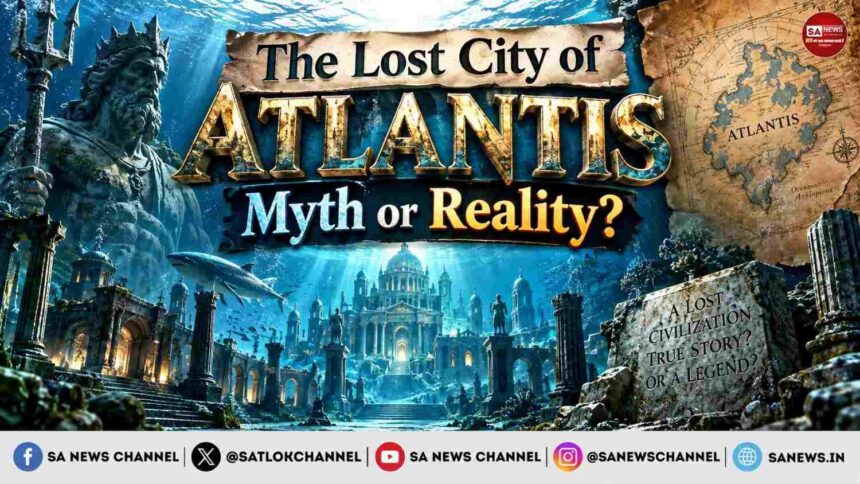
For more than 2,300 years, the Lost City of Atlantis has remained one of the most fascinating mysteries in human history. The story tells of a civilisation so advanced that it was said to rival the gods. Then, in a single devastating night, it supposedly disappeared beneath the sea, leaving behind ruins that may still be somewhere under the waves.
- Where the Atlantis Story Actually Begins
- Was Plato Writing History or Philosophy?
- The Leading Scientific Theory: Santorini and the Minoans
- Why the Minoans Fit the Profile
- Sensational “Discoveries” That Fell Apart
- Atlantis vs. Doggerland: What Real Submerged Land Looks Like
- So, Myth or Reality? What the Evidence Actually Shows
- Conclusion: A Legend Worth Reflecting On
But was Atlantis ever a real civilisation, or is it simply one of history’s most enduring fictional stories? To explore that question, we have to go back to a philosophical text written about 2,400 years ago, examine one of the most powerful volcanic eruptions in human history, and look at the many expeditions that claimed to have found Atlantis but failed to produce convincing evidence.
This article takes the story back to its earliest known source, looks at the main scientific theories about events that may have inspired it, and separates genuine archaeological evidence from the sensational discoveries that repeatedly make headlines. By the end, the reasons Atlantis has survived for so long should become clearer, along with what modern science actually says about the mystery.
Where the Atlantis Story Actually Begins
Almost everything we know about Atlantis comes from one source: the Greek philosopher Plato, who was writing around 360 BCE.
Plato’s description appears in two dialogues, Timaeus and Critias. These contain the earliest known references to the lost civilisation. There is no older Egyptian inscription describing Atlantis, no earlier Greek poem that records the story, and no independent historical account confirming it. Everything ultimately leads back to Plato.
In the story, Critias recalls a tale that he considers historical. It also fits perfectly with the idea of an “ideal society” that Plato had previously explored in The Republic. Ancient Athens represents the ideal society, while Atlantis represents its opposite.
According to Plato’s account, Atlantis was supposedly larger than Asia and Libya combined. It was located beyond the Pillars of Hercules and was home to advanced people who built canals, enormous temples and other impressive structures. Some later interpretations have also described mysterious energy sources associated with the civilisation.
The story takes a much darker turn at the end. Atlantis launched an unsuccessful invasion against Athens. After this failed attack, the civilisation was supposedly punished and swallowed by the sea in a single catastrophic event.
Was Plato Writing History or Philosophy?
This is the central question that has divided scholars for more than two thousand years.
Many scholars believe Plato used mythology as another way of exploring philosophical ideas and speculation rather than attempting to record actual history. Others have argued that the story was intended to describe genuine historical events.
The disagreement is not a modern one. Even in antiquity, Plato’s own followers disagreed about whether the Atlantis story should be understood as history or allegory. The debate can be traced back to the early Academic philosopher Crantor.
More recent academic analysis has proposed an additional interpretation. It argues that Plato’s Atlantis may have been created partly as a response to claims by the Greek historian Herodotus about Egyptian superiority. The story may also have been intended to persuade Athenians to follow the ideals Plato had presented in The Republic.
If this interpretation is correct, Atlantis was never supposed to be discovered. It was essentially a philosophical argument presented in the form of a story about a lost civilization.
Read More: Yuri Gagarin: The First Human to Travel Into Space
The Leading Scientific Theory: Santorini and the Minoans
If the Atlantis story was inspired by a real historical event, the strongest candidate is a massive volcanic eruption.
The Minoan eruption was one of the largest volcanic events in recorded history. It devastated the island of Thera, now called Santorini, along with the Minoan settlement at Akrotiri. Communities on nearby islands and along the coast of Crete were also affected. The eruption may even have played a role in the eventual collapse of Minoan culture.
This theory is not a fringe idea. In 1960, researcher Angelos Galanopoulos proposed that Thera may have been the location of Atlantis’s capital. His proposal followed earlier work connecting the vanished Minoan civilisation with the Atlantis story, particularly after the Minoan palace at Knossos was discovered in 1900.
Why the Minoans Fit the Profile
The Minoan theory is compelling for more than the eruption itself. There are also striking similarities between the Minoan civilisation and some elements of Plato’s description.
Excavations at Knossos on Crete and Akrotiri on Thera revealed evidence of sophisticated Minoan engineering. The civilisation built three and four-storey structures with complex water-piping systems, advanced methods for managing airflow and construction techniques designed to withstand earthquakes.
For the time, this represented remarkably advanced technology, especially compared with what had been found on mainland Greece.
The Minoans were therefore a genuinely sophisticated Bronze Age civilisation. Their world was also disrupted with extraordinary speed, which makes the historical events surrounding them resemble certain aspects of Plato’s account.
Scientists have also tried to determine the precise date of the Thera eruption. Researchers have used ancient tree rings to help resolve a long-running disagreement about exactly when the eruption occurred. It remains one of the largest volcanic explosions of the past 4,000 years.
Read More: The Silk Road: An Ancient Trade Route That Shaped the World
Sensational “Discoveries” That Fell Apart
Alongside serious research into Santorini and the Minoans, there have also been numerous claims from people who said they had discovered Atlantis itself. These announcements often attracted significant media attention but were supported by little convincing evidence.
In 2004, headlines appeared after researchers announced that they had located Atlantis in southern Spain. An international team used ground-penetrating radar and electrical resistivity tomography and claimed that a site on the southern Spanish coast, near Cadiz, showed evidence that it may once have been the location of what could have been humanity’s first metropolis.
The location helped make the claim more interesting. Researchers pointed out that the site was around 60 miles inland. They suggested that this might explain why it had remained undiscovered for so long because it would not necessarily be expected to show evidence of tidal-wave damage, despite Plato’s account describing a tidal event as the mechanism that destroyed Atlantis.
Around the same period, another unrelated claim emerged from Cyprus. An amateur explorer said that sonar scanning had revealed Atlantis roughly 50 miles southeast of Cyprus. The explorer argued that the walls and trenches detected by the scans matched Plato’s description of the acropolis of Atlantis exactly.
Professional archaeologists were not persuaded. Despo Pilides, an archaeologist with Cyprus’s Department of Antiquities, said the theory should be treated with a very large degree of scepticism.
This pattern has appeared again and again for more than a century: an extraordinary claim is made, newspapers and other media outlets report it widely, and the claim eventually fades after failing to stand up to scrutiny.
Not one of these supposed “discoveries” has produced peer-reviewed, independently verified evidence proving that Atlantis existed.
Atlantis vs. Doggerland: What Real Submerged Land Looks Like
This is where the Atlantis story becomes particularly interesting. Comparing Atlantis with a real submerged landmass helps show what genuine evidence looks like and, at the same time, what is missing from the Atlantis story.
Doggerland was once a large area of land in Northern Europe. Today, it lies beneath the North Sea. It connected Britain with continental Europe until rising sea levels flooded the region around 6500 to 6200 BCE.
Geological surveys indicate that Doggerland extended from the eastern coast of Great Britain towards the Netherlands, the western coast of Germany and the Jutland peninsula.
Unlike Atlantis, Doggerland is not merely an ancient story. It is a physically documented place.
| Feature | Atlantis, according to Plato | Doggerland, verified |
| Primary Source | A single philosophical text by Plato, around 360 BCE | Physical geological and archaeological data |
| Physical Evidence | None confirmed | Mammoth remains, tools, peat and submerged forests |
| Cause of Submersion | A single catastrophic night | Gradual sea-level rise, together with a possible tsunami |
| Timeframe | Roughly 9,600 BCE, according to Plato | Confirmed flooding around 6,500 to 6,200 BCE |
| Scientific Consensus | Disputed, with an ongoing myth-versus-history debate | Accepted as historical fact |
Archaeologists first recognised the potential importance of the Doggerland region in the early 20th century. Since then, direct physical evidence recovered from the seabed has confirmed its existence. This includes the remains of mammoths and lions, as well as prehistoric tools.
That is the fundamental difference between the two.
Doggerland has physical remains, tools and dated sediment. Atlantis has a story that has been repeated for more than two thousand years, but the physical evidence needed to confirm the civilization described by Plato remains missing.
Interestingly, some researchers have tried to connect the two subjects. Some point out that Atlantis remains a legend because virtually everything known about it comes from Plato’s writings. Scientists still cannot agree about where Atlantis was supposed to have been located, with proposed locations ranging from the Mediterranean to Antarctica.
Doggerland is entirely different in this respect. It is not considered a myth because its existence is supported by direct physical evidence.
So, Myth or Reality? What the Evidence Actually Shows
When all of this evidence is considered together, three clear conclusions emerge.
A city-sized Atlantis exactly matching Plato’s description has never been discovered, despite more than a century of expeditions searching for it.
The Minoan eruption on Santorini remains the most scientifically credible possible inspiration for the Atlantis story because there are genuine archaeological and geological similarities.
And every supposed “confirmed discovery” of Atlantis has failed to survive independent scrutiny.
The most likely explanation may therefore lie somewhere between complete fiction and literal history. Plato may have been constructing a philosophical warning about hubris and empire while drawing inspiration from the real and devastating Thera eruption.
It is possible that the myth and the historical memory ultimately came from the same event, with the original memory being transformed through more than two thousand years of retelling.
That does not make Atlantis any less fascinating. If anything, it makes the story feel more human. A real catastrophe, filtered through the imagination of a philosopher, may have produced a story that survived almost every civilisation that existed around it.
Conclusion: A Legend Worth Reflecting On
Whether Atlantis was a genuine island empire or a carefully constructed philosophical allegory, the fact that its story has survived for so long says something significant about human curiosity.
We repeatedly return to stories about things that have been lost and about the possibility that something from the past might still be discovered if we search deeply enough.
Perhaps the real lesson of Atlantis is not about geography at all. Perhaps it is about what remains after everything visible has disappeared: ideas, warnings and the search for meaning beneath the surface of things.
That same desire to find something lasting beneath a world that is constantly changing is also at the centre of spiritual inquiry.
For people drawn towards that deeper search, Gyan Ganga and Way of Living by Saint Rampal Ji Maharaj offer a thoughtful starting point. They explore what truly remains permanent when everything else, including cities, empires and even legends, eventually disappears.