

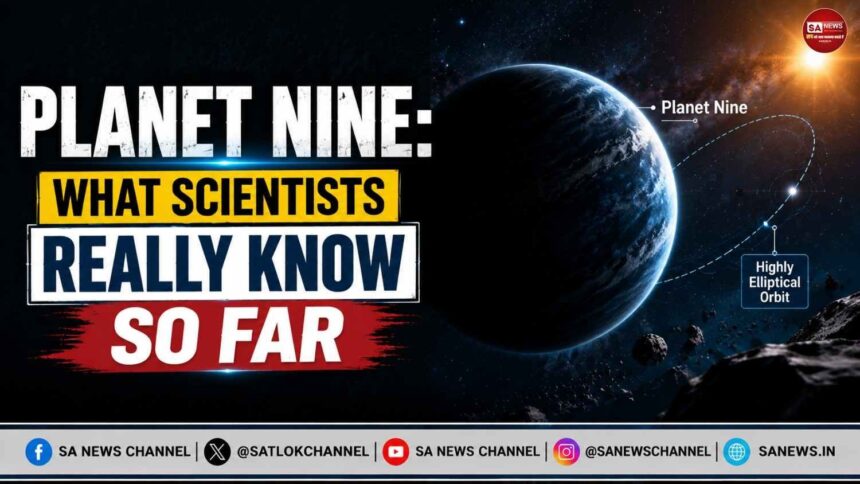
Planet Nine 2026: Sunlight needs more than two days to cross the stretch of space beyond Neptune. Out there, a handful of icy worlds follow orbits that line up with each other far too neatly for coincidence, and that alignment is what started the Planet Nine hypothesis: the idea of a hidden, massive world orbiting the sun hundreds of times farther out than Earth. The idea is nearly a decade old now, and 2026 alone has brought more twists than most years combined.
- What is Planet Nine? The hypothesis explained
- How the idea began: Batygin and Brown’s 2016 discovery
- What Planet Nine might look like
- The new infrared candidate that reignited the search
- The Ammonite discovery that complicated the picture
- Alternative explanations: is Planet Nine even necessary?
- The Vera Rubin Observatory: humanity’s best shot at finding it
- Planet Nine at a glance: data and timeline
- Conclusion: a mystery the next decade should finally resolve
A tentative infrared candidate turned up, a newly found dwarf planet muddied the evidence, and the world’s most powerful sky-survey telescope finally began its long-awaited observations, each development nudging the question a little closer to an answer. Here’s where the science stands, and what the next few years might settle.
What is Planet Nine? The hypothesis explained
Planet Nine is a nickname, not a confirmed discovery: a proposed planet that would orbit the sun far past the Kuiper Belt, the ring of icy debris beyond Neptune. Nobody has ever seen it directly. What convinces astronomers it might exist is purely gravitational, the way it seems to be shaping the orbits of smaller, far-off objects.
It has nothing to do with the “Planet X” of the early twentieth century, the planet astronomers once invoked to explain what looked like irregularities in Uranus’s and Neptune’s orbits, a hunt that ended up turning up Pluto instead. Planet Nine rests on an entirely different, far newer set of data.
Assuming it exists, Planet Nine would control more solar-system real estate than any other planet, purely by virtue of orbiting so far out. In terms of size and mass, it would land somewhere above Earth and below Uranus and Neptune, in the loosely defined bracket some astronomers call a mini-Neptune, or an ice-giant-class world.
Since nobody has found it, there’s no name to fight over yet. Even after a direct confirmed sighting, whatever it ends up being called would still need sign-off from the International Astronomical Union, the organization responsible for officially recognizing every planet and dwarf planet in the solar system.
How the idea began: Batygin and Brown’s 2016 discovery
Two Caltech scientists, Konstantin Batygin and Mike Brown, put forward the modern Planet Nine hypothesis in January 2016, publishing their case in the Astronomical Journal. Brown had already made a name for himself a decade earlier by helping demote Pluto, so his turning around to argue for a brand-new planet counts as one of astronomy’s neater ironies.
The clue hidden in Kuiper Belt orbits
Neither of them set out to find a planet. Their actual project was a small set of extreme trans-Neptunian objects, or ETNOs, icy bodies whose orbits stretch out well past Pluto’s.
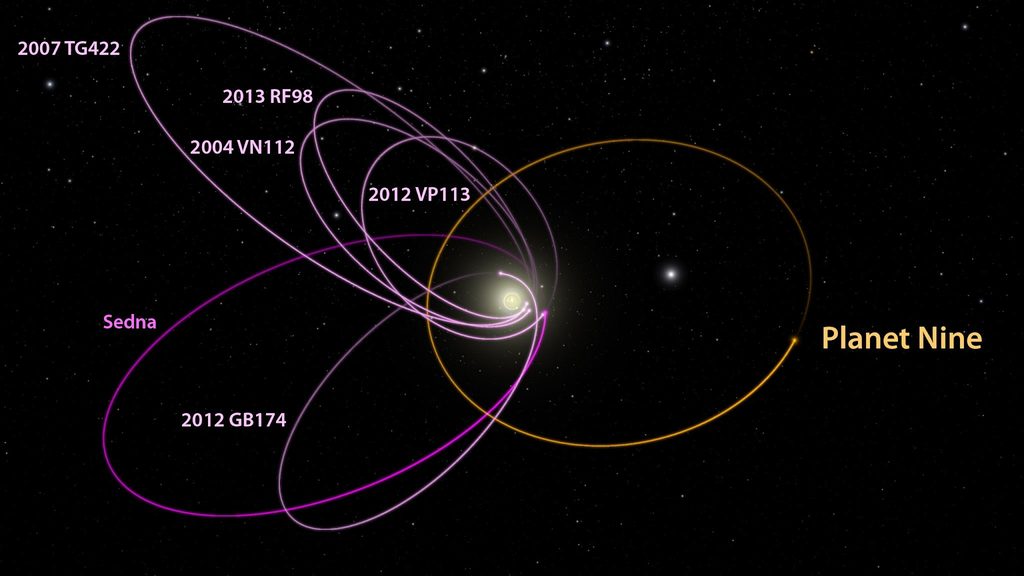
Several of those objects, Sedna among them, turned out to share strikingly similar orbital orientations, a pattern too tight to chalk up to coincidence. Running the numbers, Batygin and Brown found the best explanation was the steady pull of an unseen planet several times heavier than Earth.
What Planet Nine might look like
Mass, size and orbit estimates
Back in 2016, the estimate put Planet Nine at 5 to 10 Earth masses, on a highly stretched-out orbit with a semi-major axis somewhere between 400 and 800 astronomical units (an AU is the Earth-sun distance). At that distance, one full orbit would take 10,000 to 20,000 years.
The picture has since gotten sharper. Siraj and colleagues, in a 2024-2025 analysis, pulled the mass estimate down to a more modest 4.4 Earth masses, give or take 1.1. Separately, researchers have modeled a likely perihelion, the closest point to the sun, of roughly 240 to 385 AU, with an aphelion possibly reaching 600 AU or more. A lighter planet sitting closer in is also easier to spot, since it reflects more sunlight than the heavier, farther-out version first proposed.
A 2025 study went further still, using data from known exoplanets with similarly cold temperatures to estimate Planet Nine’s probable radius, composition, and reflectivity. The picture that emerges is a cold, gaseous world, smaller than Neptune but far larger than any rocky planet, similar in character to the solar system’s existing ice giants.
Also Read: Largest 2D Map of Universe: 5.6 Trillion Pixels Explained – sanews.in
The new infrared candidate that reignited the search
A different strategy came from a 2025 study led by Terry Long Phan of National Tsing Hua University in Taiwan, working alongside astronomer Tomotsugu Goto. Rather than hunting through new images, they set two archival infrared surveys side by side, 23 years apart: NASA’s IRAS mission from 1983 and Japan’s AKARI satellite survey, which ran from 2006 to 2011.
Somewhere in that data sat a faint source that had shifted position between the two surveys, a shift roughly matching the distance, brightness, and infrared signature predicted for Planet Nine. Confirmed, it would sit around 700 times farther from the sun than Earth, and could outweigh Neptune.
They posted the result as a preprint first; it was later accepted into Publications of the Astronomical Society of Australia. Reactions split: some excitement, plenty of caution. Mike Brown, one of the two scientists behind the original hypothesis, has stayed openly doubtful that this particular candidate is Planet Nine, pointing out that turning a single faint infrared dot into a confirmed planet takes a lot more follow-up work than comparing two old surveys can provide.
The Ammonite discovery that complicated the picture
Right as the infrared candidate was picking up attention, a different discovery pulled the story the other way. On June 8, 2026, astronomers working with Hawaii’s Subaru Telescope announced a newly discovered dwarf planet nicknamed “Ammonite,” formally designated 2023 KQ14.
It falls into a rare category called sednoids, extremely distant bodies related to Sedna, and that alone would have made it noteworthy. What mattered for the Planet Nine debate is that Ammonite’s orbit breaks from the clustering pattern shown by the other known sednoids, the same clustering that originally helped make the case for Planet Nine.
Researchers at Japan’s National Astronomical Observatory say the mismatch weakens the original clustering argument, though it doesn’t rule Planet Nine out completely. One idea floated is that a planet once sat out there earlier in solar-system history and was eventually ejected altogether, leaving this kind of inconsistent debris behind.
Alternative explanations: is Planet Nine even necessary?
Not every astronomer accepts that a hidden planet is the best explanation for the strange orbits observed. Some researchers argue the clustering could reflect observational bias: the handful of known ETNOs were mostly found by surveys that scanned specific patches of sky, which could easily create the appearance of clustering that doesn’t exist in the full population.
Some scientists studying these orbits describe the question as a genuine gray area, since different research groups rely on different samples of distant objects, and that choice alone can produce different apparent clustering strengths from the same underlying sky.
Proposed alternatives run from statistical selection effects on one end to more exotic dark-matter-based ideas on the other, though most researchers still consider a single hidden planet the simplest fit for what’s observed.
Rather than dropping the idea altogether, some researchers have proposed smaller variations on it. One 2026 theoretical paper laid out two further candidates, nicknamed Planet X and Planet Y (unrelated to the historical, early-1900s Planet X). In this version, Planet X is a smaller relative of Planet Nine, while Planet Y is lighter again, somewhere between Mercury and Earth in mass, and orbiting much closer in, at 100 to 200 AU.
Also Read: Craziest Planets in the Universe That Feel Unreal – sanews.in
Settling the question either way would also change how astronomers read the outer solar system’s history. A planet this large, sitting this far out, almost certainly didn’t form there. It more likely formed much closer to the sun and got flung outward by gravitational encounters with Jupiter or Saturn billions of years ago. Confirming that history would give a direct look at the messy early period of planet formation, something astronomers think plays out in plenty of other star systems as well.
The Vera Rubin Observatory: humanity’s best shot at finding it
If 2026 matters this much to the story, it’s mostly because of a telescope rather than any single paper. The NSF-DOE Vera C. Rubin Observatory, on Cerro Pachón in Chile, kicked off its full ten-year Legacy Survey of Space and Time (LSST) in mid-2026, after wrapping up final commissioning earlier that year and drawing plenty of attention at the American Astronomical Society’s January meeting in Pasadena.
Its camera is the largest digital one ever built, a 3.2-gigapixel instrument that can photograph the entire visible southern sky every few nights. The method is difference imaging: each new image gets compared automatically against a template built from earlier shots, and anything that moved or changed brightness sets off an alert. In one night of commissioning tests back in February 2026, that system triggered more than 800,000 alerts.
Something as far out as Planet Nine would only creep a few arcseconds across the sky per year, far too slow to catch in any one image. Rubin’s advantage is repetition: by revisiting the same patches of sky over and over across a full decade, it can catch exactly this kind of extremely slow, faint motion that shorter surveys miss entirely. Within its first year and a half of operations, the observatory’s commissioning run alone had already turned up more than 11,000 new asteroids, a preview of the discovery rate it’s capable of.
Scientists involved in the project, including Brown himself, have said plainly that Rubin should finally provide a clear answer, whether that means directly imaging Planet Nine or gathering enough data to show that the clustering pattern doesn’t hold up under closer scrutiny.
Planet Nine at a glance: data and timeline
| Year | Milestone | What It Means |
| 2016 | Batygin and Brown publish the original hypothesis | First rigorous case for a hidden ninth planet, based on ETNO clustering |
| 2025 | Phan and Goto identify an infrared candidate | First tentative visual evidence, still unconfirmed and contested |
| 2025 | Siraj et al. refine the mass estimate | Narrows the target from a broad 5-10 Earth masses to about 4.4 |
| June 2026 | “Ammonite” dwarf planet discovered | Its misaligned orbit weakens part of the original clustering evidence |
| Mid-2026 | Vera Rubin Observatory begins its 10-year survey | Best tool yet to directly detect Planet Nine or rule it out |
The timeline shows a field being pulled two ways at once, each year adding evidence that both strengthens and complicates the case, which is why Rubin’s systematic, ten-year approach outweighs any single discovery.
| Property | Original 2016 Estimate | Current Working Range (2026) |
| Mass | 5 to 10 Earth masses | About 4.4 Earth masses (± 1.1) |
| Orbital period | 10,000 to 20,000 years | Broadly unchanged |
| Perihelion (closest point) | Not precisely modeled | Roughly 240 to 385 AU |
| Aphelion (farthest point) | Up to 1,200 AU | Similar, upper bound still debated |
The mass estimate has come down noticeably since 2016, while the orbital shape remains roughly as extreme as first proposed. A smaller, closer-in planet is also easier for a telescope like Rubin to detect, since it would appear relatively brighter than the original, more massive and distant version of the hypothesis.
Conclusion: a mystery the next decade should finally resolve
Planet Nine still hasn’t been found, and 2026’s mixed evidence, a promising infrared hint on one side and an inconvenient dwarf planet on the other, shows just how unsettled the question remains. What’s changed is the tool now available to answer it: a systematic, decade-long survey scanning exactly the sky where this planet would have to hide.
There’s something distinctly human about this kind of search: the urge to look past what’s visible and ask what else might be hiding, whether that’s at the outer edge of the solar system or somewhere in our own understanding of existence. That same curiosity has, throughout history, pushed people toward questions no telescope alone can answer. Readers interested in that wider search might start with “Gyan Ganga” and “Way of Living” by Saint Rampal Ji Maharaj, not as a replacement for scientific inquiry, but as a companion to it.