

Pharaoh’s Curse: November 4, 1922. A young water boy stumbles over a stone buried in the sand of Egypt’sValley of the Kings. He falls. He looks down. Beneath the desert floor: a step, cut cleanly into bedrock.
- A Last-Chance Dig in the Desert
- Who Was Tutankhamun? The Boy Behind the Golden Mask
- The Pharaoh’s Curse: What It Claimed and How It Spread
- The Omens: Signs That Seemed to Confirm Everything
- The Cobra and the Canary
- The Lights of Cairo Go Dark
- The Dog at Highclere Castle
- The Face of the Dead King
- The Deaths: A Body Count That Shook the World
- Debunking the Pharaoh’s Curse: What Science Concluded
- The Numbers Tell a Different Story
- The Most Important Person Did Not Die
- The Survivors Nobody Wrote About
- Lord Carnarvon Was Already a Very Sick Man
- The Lights of Cairo: A Power Cut, Not a Curse
- The Dog and the Distant Death
- The Inscription That Was Never a Curse
- Was Toxic Mold the Scientific Explanation?
- Conclusion: The Legend Lives, the Curse Does Not
Then another step. Then another. Then a sealed door, shut with plaster and stamped with ancient marks, untouched for over three thousand years.
Nobody in the team knows yet whose tomb this is. Nobody knows what is sleeping on the other side of that door. They know only one thing: something enormous has been waiting here, completely undisturbed, since before Rome was a city, since before the Bible was written, since before most of the ancient world’s memory even begins.
A Last-Chance Dig in the Desert
The Man Who Refused to Give Up
By the early 1920s, almost every professional archaeologist believed the Valley of the Kings had given up all its secrets. The great tombs had already been found. What remained, experts said, was just sand and empty ground.
One man disagreed. Howard Carter, a British archaeologist with extraordinary determination, had spent years believing that at least one royal burial still lay hidden beneath the valley floor. His supporter, Lord George Herbert, the 5th Earl of Carnarvon, had been paying for Carter’s increasingly disappointing excavations for years with a collector’s passion and a wealthy man’s patience.
By 1922, Lord Carnarvon had become dissatisfied with the lack of results after several years of finding little. After considering withdrawing his funding, Carnarvon agreed, after a discussion with Carter, that he would fund one more season of work in the Valley of the Kings.
One final season. If nothing was found, it was over.
The Step That Changed History
Carter went back to a patch of ground beneath the remains of ancient workers’ huts, close to the entrance of the tomb of Ramesses VI, that had never been properly cleared. On 4th November 1922, a startling discovery was made by a boy carrying water who found himself falling over a stone. This was not just any piece of rock: it was the beginning of a flight of steps.
At the bottom stood a doorway sealed with limestone and plaster. Carter cut a small hole and saw that the passage beyond was filled with rubble. He sent a telegram to Carnarvon in England and had the workers refill the pit to keep the tomb safe until Carnarvon arrived.
He waited. Days passed. The site sat buried and silent again. Carter later described this as one of the hardest waits of his professional life.
A Name Comes Out of the Plaster
On 24 November 1922, the full stairway was cleared, and a seal containing a royal cartouche was found pressed into the outer doorway. The name on that cartouche: Tutankhamun.
A name known to scholars but barely studied. A ruler so unknown that his tomb had never been found, his reign so short it had almost been wiped from history for thirty-three centuries. Could this really be an intact royal burial, untouched all this time?
On 26 November, Carter, with Carnarvon, Lady Evelyn, and assistant Arthur Callender present, made a tiny hole in the top left-hand corner of the doorway using a chisel his grandmother had given him for his 17th birthday.

He held a candle to the hole. The hot air coming out from inside made the flame shake. Then, as his eyes got used to the darkness, gold appeared. Everywhere, gold. Statues. Chariots. Gilded thrones. Beds shaped like animals. An entire royal world, sealed and untouched for three thousand years, shining back at him from the dark.
Carnarvon asked from behind him: “Can you see anything?”
“Yes. Wonderful things.”
On 16 February 1923, Carter opened the inner sealed doorway and confirmed it led to the burial chamber itself, containing the sarcophagus of Tutankhamun. The discovery was eagerly covered by the world’s press.
Who Was Tutankhamun? The Boy Behind the Golden Mask
A Child Ruler in a Kingdom Full of Trouble
Tutankhamun (c. 1342 BC – c. 1323 BC) was the antepenultimate (third from last) pharaoh of the Eighteenth Dynasty of ancient Egypt, ruling c. 1332–1323 BC. Born Tutankhaten, he brought back the traditional polytheistic (multiple God’s worship) form of ancient Egyptian religion, reversing a shift to the religion known as Atenism.
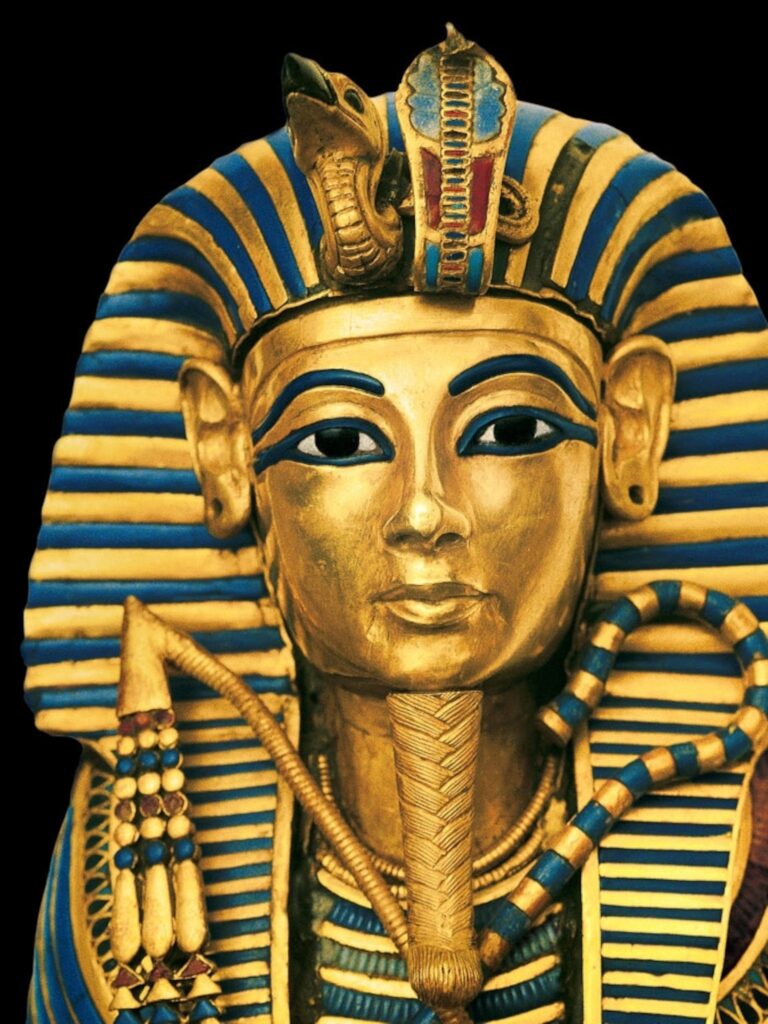
He came to the throne as a child of around nine years old. His father, the pharaoh Akhenaten, had torn apart Egypt’s entire religious system, banned the worship of traditional gods, and turned the powerful priesthood against the crown. The country was deeply unsettled. Under Tutankhamun, the cult of the god Amun at Thebes city was brought back to power, and he moved the royal court from Akhenaten’s capital of Amarna back to the traditional centres of power.
He ruled for about nine years. Then, at around 18 years of age, he died suddenly and without an heir. His tomb was finished in a hurry because nobody had expected the young king to die so soon.
The Sick Boy Inside the Golden Coffin
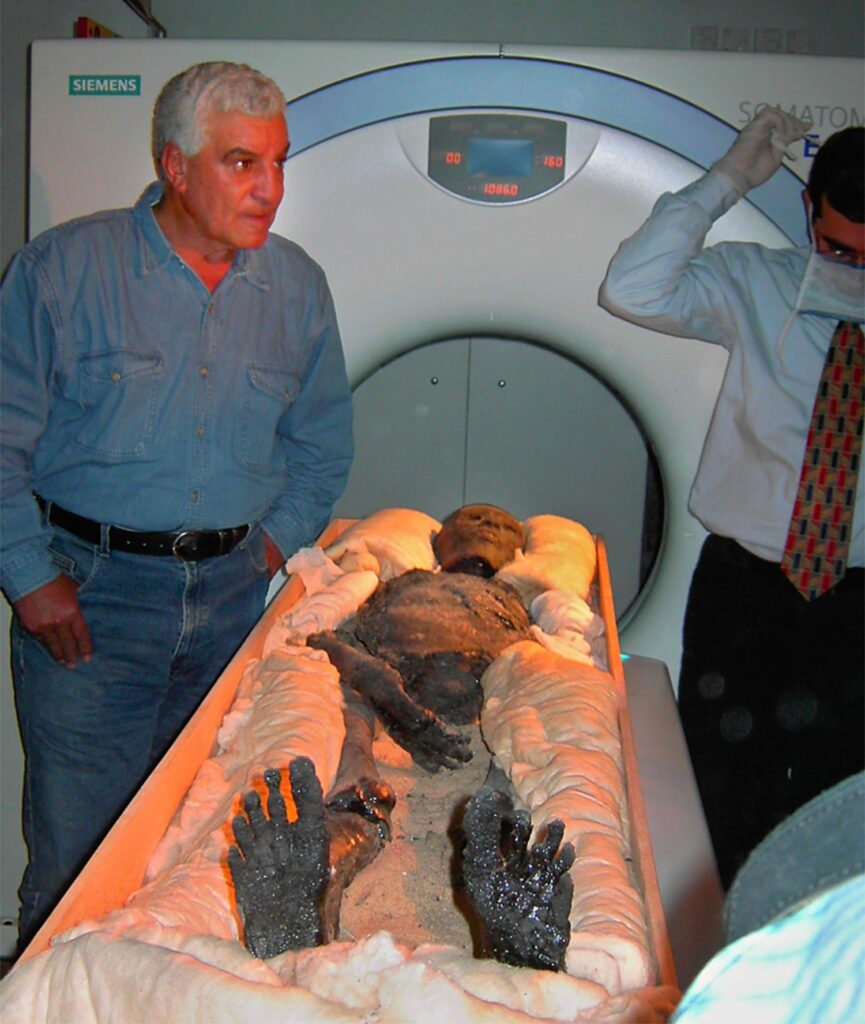
Modern DNA analysis and CT scans have revealed the difficult physical reality of the boy inside those golden coffins. Several health problems including Köhler disease II were found in Tutankhamun. Tests revealed signs of malaria in four mummies including his own. His walking problems and illness are supported by the discovery of canes and a medicine collection in his tomb.
A boy king who walked with canes, carried multiple diseases, and whose leg broke shortly before his death in a world with no medicines and no cure for malaria. Behind the legend of golden treasure and royal power was a teenager whose body was failing him every single day.
Read More : Ancient Egyptian Pharaohs Explained: Kings, Gods, and Rulers
The Pharaoh’s Curse: What It Claimed and How It Spread
The Ancient Warning
Almost right after Lord Carnarvon died in April 1923, a story swept across the world’s newspapers that nobody could stop.
It was reported that carved in stone above the entrance to Tutankhamun’s tomb was an ancient warning, placed there by Egypt’s priests to guard their king’s eternal rest forever. The inscription read:
“Death shall come on swift wings to him that toucheth the tomb of a Pharaoh.”
This was the Pharaoh’s Curse in its most complete form. The priests of Egypt, masters of ritual and the deep mysteries of death, had placed a supernatural punishment on anyone who dared cross the threshold of their king’s burial. The curse made no difference between a thief and a scholar. It did not look at reasons or measure guilt. Whoever broke the seal, whoever disturbed what had been laid to rest three thousand years ago, was marked for death.
The Voice of the Age
The warning spread at the speed of telegraph and steamship. It was talked about in drawing rooms, argued in newspapers, and supported by people whose opinions the world took seriously.
Sir Arthur Conan Doyle, creator of Sherlock Holmes and a committed public spiritualist, suggested that Lord Carnarvon’s death had been caused by “elementals” created by Tutankhamun’s priests to guard the royal tomb. This further fueled interest across the world.
Two weeks before Carnarvon died, Marie Corelli wrote a letter published in the New York World magazine, quoting an obscure book that said “dire punishment” would follow any entry into a sealed tomb. Her letter landed just before the death of the expedition’s most prominent figure, giving the warning a weight that gripped millions of readers.
Scholars debated it. Priests referenced it. Readers across continents followed every new development. The Pharaoh’s Curse had become one of the biggest stories of the modern age, and the deaths had only just begun.
The Ancient Egyptian Tradition of Tomb Protection
The idea of curses guarding royal burials was not new to Egypt. Ancient writings in some tombs contained warnings aimed at those who might disturb or damage the dead. These were understood as genuine spiritual punishments, calling on the power of the gods to deal with anyone who crossed the line.
The priests of the New Kingdom were among the most powerful people in Egyptian society. They ran the rituals of death, prepared the dead for the journey to the afterlife, and kept the sacred boundary between the world of the living and the realm of Osiris. If anyone had the authority and knowledge to place a real supernatural curse on a royal tomb, it was them.
To people in 1923, living in a world that still widely accepted divine punishment and the power of ancient forces, the idea that Egypt’s priests had successfully protected their king across three thousand years felt completely believable.
Read More : The History of the Phoenicians: The Seafaring People
The Omens: Signs That Seemed to Confirm Everything
The Cobra and the Canary
Even before Lord Carnarvon died, strange things happened around the dig site that seemed to signal something ancient had been woken up.
On the very day Carter’s team began clearing the staircase down to the tomb, one of his workers went back to Carter’s house and found a cobra inside. Carter’s beloved pet canary was dead in its mouth.
This was not just any snake. The cobra was the uraeus, the royal serpent worn on the pharaoh’s crown. It was the living symbol of the king’s divine power, his ability to protect himself and strike down his enemies. According to ancient Egyptian belief, this snake belonged to the king. And now it had come to Carter’s house on the exact day his team disturbed the king’s resting place and killed the small golden bird that had been singing there.
To the local Egyptian workers on the dig, this was not a coincidence. This was a sign, clear and direct, from the king whose sleep had been broken. Word spread quickly through the site, into nearby villages, and eventually into the international press. It was exactly the kind of story that a legend about a three-thousand-year-old curse needed to feel real.
The Lights of Cairo Go Dark
When Lord Carnarvon took his last breath in his Cairo hotel room on the morning of April 5, 1923, something happened in the city outside that nobody who was there ever forgot.
At that exact moment, the lights across Cairo went dark. The whole city lost power at once, plunging streets and buildings into sudden darkness, at the very hour the expedition’s most important member died. People who were awake at that time connected the two events immediately. The ancient king, they said, had reached out and turned off the lights of the modern city as his first victim fell.
Power failures were not unusual in Cairo in 1923. The city’s electricity supply was unreliable. But the timing was so precise, so perfectly matched to the moment of Carnarvon’s death, that no amount of practical explanation seemed to satisfy those who had witnessed it. For them, the darkness was not a technical problem. It was a message.
The Dog at Highclere Castle
The story did not stop in Cairo. Thousands of miles away in England, at Carnarvon’s grand estate of Highclere Castle, something equally unsettling was reported.
At the same hour that Lord Carnarvon died in Egypt, his dog, a terrier he had kept at the estate, reportedly let out a single long howl and dropped dead. No illness. No injury. Just one cry and then silence, at the very moment its master left the world on another continent.
The idea of an animal sensing and responding to its owner’s death at the moment of passing was not unheard of in that era. But the combination of the Cairo blackout and the dog’s death, both at the same moment and both connected to the same man, made the story feel less like two separate coincidences and more like a single coordinated event. People began to feel that something was happening that went beyond normal explanation.
The Face of the Dead King
When the mummy was finally examined, one more detail entered the record that sent a shiver through those following the story. The first examination found a mark on the left cheek of Tutankhamun’s mummy. Lord Carnarvon, the first to die, had his fatal infected wound in almost exactly the same place on his own face, a mosquito bite on his left cheek that he had cut while shaving.
The king’s cheek. The living man’s cheek. The same spot. The same side. People who believed in the curse saw this as the most personal sign of all: that Tutankhamun had marked his first victim with the same wound he himself carried into death.
The Deaths: A Body Count That Shook the World
Over the following years, deaths among those connected to the excavation came in a steady, chilling sequence. Each one was reported, counted, and added to the curse’s growing record:
| Person | Connection to Tomb | Year of Death | Age |
| Lord Carnarvon | Expedition financier, attended opening | 1923 | 57 |
| George Jay Gould | American financier, visited the tomb | 1923 | 58 |
| Sir Archibald Douglas Reid | Radiologist who X-rayed the mummy | 1924 | 56 |
| Arthur Mace | Helped Carter open the burial chamber | 1928 | 54 |
| Lord Carnarvon’s half-brother | Family of expedition sponsor | 1929 | — |
| Arthur Weigall | Former Inspector-General of Antiquities | 1934 | 53 |
Six deaths. All connected to the tomb. All within a decade of the opening. The world watched the list grow and drew its own conclusions. The Pharaoh’s Curse, it seemed, was patient, precise, and entirely real.
Debunking the Pharaoh’s Curse: What Science Concluded
The Numbers Tell a Different Story
The most basic problem with the curse story is one of simple counting. Of the twenty-two people present at the opening of the tomb, only six had died by 1934, over a decade later. Scientists such as Herbert Winlock pointed out that the deaths were no more than should be statistically expected.
Think about who these people were: middle-aged and older Europeans, travelling long distances to Egypt in the 1920s, working in very hot conditions, drinking water that was not always clean, and living in a time when there were no antibiotics for any infection. A handful of deaths over ten years among this group is not surprising. It is simply what happens when older people face difficult conditions without modern medicine.
A major 2002 study published in the British Medical Journal looked at 44 Westerners identified by Carter as present during the excavations. In the 25 people who had been inside the tomb, the average age at death was 70 years, compared with 75 in those who had not been exposed. There was no significant connection between being near the tomb and dying earlier.
The science was clear: people who entered the tomb lived just as long as people who never went near it.
The Most Important Person Did Not Die
Here is the single most powerful argument against the curse, and it is one that is almost never discussed in popular retellings of the story.
Howard Carter was the man who physically opened the tomb. He broke the three-thousand-year-old seal with his own hands. He was the first living person to enter the burial chamber. He touched the objects inside. He unwrapped the mummy. If the Pharaoh’s Curse was real and it punished those who disturbed the king’s rest, Carter should have been its very first and most severely punished victim.
He lived for another seventeen years. He died in 1939 at the age of 64, of lymphoma, an illness completely unrelated to any tomb, any mummy, or any ancient curse. The man at the very centre of the story, the one most directly responsible for the disturbance, lived a full life and died of natural causes nearly two decades later.
The Survivors Nobody Wrote About
Of the 58 people present when the tomb and sarcophagus were opened, only eight died within a dozen years. Lady Evelyn Herbert, one of the very first people to enter the tomb in November 1922, lived for a further 57 years and died in 1980.
Sergeant Richard Adamson guarded the burial chamber for seven consecutive years, sleeping beside Tutankhamun’s remains night after night as the European physically closest to the mummy. He lived for another 60 years and died in 1982.
The woman who first stepped into the burial chamber: alive for 57 more years. The soldier who slept next to the mummy every night for seven years: alive for 60 more years. Howard Carter, who opened the seal: alive for 17 more years. These people received no headlines. The curse story was built entirely on the deaths, and it ignored the very long lives of everyone else.
Lord Carnarvon Was Already a Very Sick Man
Lord Carnarvon was chronically ill before he even set foot in Tutankhamun’s tomb. His death came months after his first exposure to the tomb.
He had seriously damaged his lungs in a car accident many years earlier and had been living in Egypt because doctors recommended the dry desert air for his breathing problems. He was already fragile. He had no natural defenses against infection. He died of an infected mosquito bite in a time before penicillin existed. Every part of this death has a clear, simple medical explanation. None of it requires a supernatural cause.
The Lights of Cairo: A Power Cut, Not a Curse
The Cairo blackout, which happened at the moment of Carnarvon’s death and became one of the most repeated pieces of evidence for the curse, has a straightforward explanation.
Cairo in 1923 had a young and very unreliable electricity system. Power cuts happened regularly, sometimes several times a week. The city was growing fast and its infrastructure could not keep up. On any given night in Cairo at that time, the lights going out was not unusual. It was routine.
The blackout became part of the curse story only because it happened on the same night Carnarvon died. If he had died on a different night, one where the power also went out, nobody would have connected the two things. The connection existed only in the timing, and the timing was coincidence.
The Dog and the Distant Death
The story of Carnarvon’s dog dying at Highclere Castle at the exact moment of his master’s death in Cairo is emotionally powerful and widely repeated. But it rests entirely on the account of one person, told after the fact, in a moment of grief, during a period when the entire world was already talking about a supernatural curse.
No independent witnesses confirmed the timing. No record was made at the time of the dog’s death. The story entered the record through a grieving family member in the days after Carnarvon died, at a moment when the curse was already the biggest news story in the world. Human memory, especially in grief, is strongly shaped by the stories surrounding it.
The Inscription That Was Never a Curse
The famous inscription, “Death shall come on swift wings to him that toucheth the tomb of a Pharaoh,” was never found in or on Tutankhamun’s tomb. What was found near the entrance was a ceremonial text from the Book of the Dead, a standard ritual passage placed in royal burials to protect the king’s journey to the afterlife. It said nothing about punishing the living. It was a prayer for the dead, not a threat to the living. The threatening version that newspapers printed around the world was a misreading of this text.
Was Toxic Mold the Scientific Explanation?
Some scientists proposed a more rational version of the curse: not supernatural punishment but dangerous biological material sealed inside the tomb for thousands of years.
Studies found that some ancient mummies carry mold including Aspergillus niger and Aspergillus flavus, which can cause reactions ranging from breathing problems to bleeding in the lungs. Tomb walls may also carry harmful bacteria, and gases like ammonia, formaldehyde, and hydrogen sulfide have been found inside sealed burial chambers.
In the 1970s, ten out of twelve scientists who entered the tomb of Polish King Casimir IV died shortly after exposure to Aspergillus flavus, which gave this theory real weight.
But for Tutankhamun’s tomb specifically, this explanation also falls apart. The Lancet concluded it was unlikely that Carnarvon’s death had anything to do with the tomb, noting that he was only one of many people to enter it multiple times and that none of the others were affected.
And in a remarkable recent development, the same Aspergillus flavus once connected to mysterious tomb deaths is now being studied at the University of Pennsylvania as a source of cancer-fighting molecules, showing strong results against leukemia cells in laboratory tests. The organism linked to the curse may one day be used to save lives.
Conclusion: The Legend Lives, the Curse Does Not
The Pharaoh’s Curse is one of history’s most perfectly timed stories: a golden tomb, a sudden death, a world ready to believe, and a press ready to print. Science has answered it clearly and fully. The 2002 BMJ study found no link between the tomb and early death. The Lancet found no toxic evidence against Carnarvon. Howard Carter, who opened the seal himself, lived 17 more years. Lady Evelyn Herbert lived 57 more years. Sergeant Adamson slept beside the mummy for seven years and died peacefully at 82.
What survives is not a curse but a very human truth: that people need mystery, and they need meaning, especially when facing the silence of ancient death. That hunger is real and worth taking seriously. For those who want to explore genuine spiritual truth rather than legend, the books Gyan Ganga and Way of Living by Saint Rampal Ji Maharaj offer wisdom grounded in real scripture, pointing toward knowledge that no tomb can hide and no curse can threaten.