

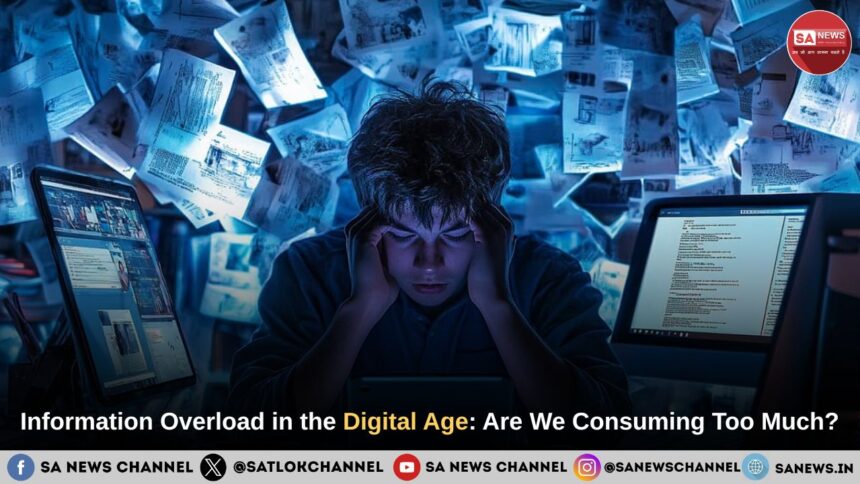
Every morning, before you even get out of bed, your phone has already given you dozens of notifications, news headlines, emails, and messages. By the time you finish breakfast, you may have consumed more information than previous generations encountered in days. This is the daily reality of living in the age of information overload.
- What Is Information Overload?
- How Much Information Is Actually Out There?
- What Is Happening to Your Attention Span?
- The Mental Health Cost of Too Much Information
- The Misinformation Problem
- Who Is Most Affected?
- Data and Trends: Information Consumption in Numbers
- How to Manage Information Overload
- A Quieter Kind of Knowledge
The world has never produced more content than it does right now. Global data creation continues to grow at an extraordinary rate, with analysts estimating that the world’s datasphere will expand from around 149 zettabytes in 2024 to nearly 394 zettabytes by 2028. As the amount of information grows, a very important question follows: is your brain actually able to handle all of it?
This article breaks down what information overload really means, where it comes from, how it is affecting attention, decision-making, and mental health, and what you can actually do to protect yourself.
What Is Information Overload?
Information overload happens when the amount of information coming into your brain exceeds your ability to process it effectively. Think of it like a tap filling a cup. If the tap runs too fast, the water spills over. Your brain works in a similar way.
The term was first popularized by sociologist Alvin Toffler in his 1970 book Future Shock. He warned that modern society would eventually produce more information than people could comfortably absorb. More than fifty years later, his prediction appears remarkably relevant.
The problem is not just the amount of information. It is the speed, the variety, and the fact that it never stops.
You are not just reading articles. You are watching short videos, getting news alerts, checking emails, scrolling through social feeds, listening to podcasts, and receiving messages on multiple apps at the same time. Every one of these channels is competing for the same thing: your attention.
How Much Information Is Actually Out There?
The scale of data being produced today is almost impossible to picture with everyday numbers. Estimates suggest that hundreds of millions of terabytes of data are created every day across the world through internet activity, cloud services, mobile devices, sensors, video platforms, and digital communications.
The global volume of stored and processed data sits at around 149 zettabytes in 2024, and analysts expect it to reach approximately 181 zettabytes by the end of 2025. By 2028, that figure is projected to rise to 394 zettabytes.
The overwhelming majority of the world’s digital data has been created within the last few years. While exact percentages vary between reports and methodologies, experts agree that global data generation is growing at an extraordinary rate.
| Year | Global Data Volume (Approx.) |
| 2020 | 60 zettabytes |
| 2024 | 149 zettabytes |
| 2025 (projected) | 181 zettabytes |
| 2028 (projected) | 394 zettabytes |
Sources: IDC, Statista, Wedia Group, The Employee App. Data reflects the global datasphere, including captured, created, copied, and consumed data.
On WhatsApp alone, more than 140 billion messages are exchanged every day. On YouTube, millions of videos are uploaded each year, while social media platforms collectively process billions of interactions daily. This is happening around the clock, without pause. And you are not just observing it from a distance. You are right in the middle of it.
Read More : Top Educational Apps in India: Best 14 Apps for Online Learning
What Is Happening to Your Attention Span?
One of the clearest signs of information overload is what it has done to human attention. Research tracking screen-based attention has found that people switch between tasks, tabs, screens, and applications more frequently than ever before.
Studies conducted by researchers such as Gloria Mark have shown that the average time spent focusing on a single screen activity has declined significantly over the past two decades, with frequent interruptions becoming a defining feature of digital life.
To put that in plain language: many people struggle to maintain concentration for long periods before something pulls their attention away.
Popular claims that the average human attention span has fallen from 12 seconds to 8 seconds are widely circulated online, but researchers dispute the scientific basis of those exact figures. Likewise, comparisons between human attention and a goldfish’s attention span are generally regarded as oversimplified and unreliable.
What researchers do broadly agree on is that constant digital interruptions, multitasking, and rapid switching between tasks make it more difficult to maintain sustained focus over long periods.
Why Is This Happening?
The brain is naturally designed to notice new information. This ability helped humans detect opportunities and threats throughout history. Today, the same system is constantly activated by notifications, social media feeds, recommendation algorithms, and endless streams of new content.
Every time you encounter something novel or rewarding, your brain releases dopamine, a neurotransmitter associated with motivation and reward. Digital platforms are designed to maximize engagement by continuously presenting new stimuli that encourage users to keep scrolling, clicking, and watching.
Over time, continuous partial attention can become the default state. You are constantly aware of multiple streams of information but rarely fully focused on any one of them. While Continuous Partial Attention is widely discussed in psychology and digital behavior research, it is not recognized as an official medical or psychiatric disorder.
Signs You May Be Experiencing Information Overload
Information overload does not always feel obvious. Many people assume they are simply busy or tired when they are actually experiencing cognitive overload.
Common signs include:
- Difficulty concentrating on a single task
- Frequently switching between apps, tabs, or devices
- Feeling mentally exhausted despite doing little physical work
- Forgetting information shortly after reading it
- Feeling anxious when disconnected from notifications
- Struggling to make simple decisions
- Consuming large amounts of content without feeling genuinely informed
The Mental Health Cost of Too Much Information
Information overload does not just make you distracted. It can also affect mental health and emotional well-being.
Multiple workplace studies have found strong links between information overload, stress, anxiety, burnout, and reduced productivity. Surveys conducted across different industries consistently show that many employees feel overwhelmed by the volume of emails, messages, meetings, reports, and digital information they are expected to process each day.
A separate 2024 survey of workers in the United States found that a large majority felt overwhelmed to some degree by the information required for their jobs. Many reported that this overload negatively affected productivity, job satisfaction, and overall well-being.
Among young people, the effects are even more concerning:
- Numerous studies have found associations between heavy social media use and higher rates of anxiety, depression, sleep problems, and reduced psychological well-being among adolescents.
- Research suggests that excessive social media use may contribute to shorter periods of sustained attention and increased emotional reactivity.
- The constant availability of devices can contribute to overstimulation, mental fatigue, and difficulties disengaging from digital environments.
Brain rot became Oxford University Press’s Word of the Year for 2024. The term refers to the perceived decline in mental sharpness associated with excessive consumption of low-quality online content. It is important to note that brain rot is not a medical diagnosis. Rather, it reflects growing public concern about how endless streams of highly stimulating digital content may affect focus, attention, and cognitive well-being.
The Misinformation Problem
There is one more layer to this that makes information overload more dangerous than just tiredness or distraction: not all of the information flooding your feed is true.
Research from MIT found that false news spreads significantly faster and farther on social media than accurate reporting. Algorithms do not necessarily reward accuracy. They reward engagement. A shocking or emotionally charged headline often generates more clicks, shares, and interactions than a calm, well-sourced article.
Information overload also makes misinformation harder to detect because people have less time to evaluate sources carefully. When individuals are exposed to large volumes of content in rapid succession, they are more likely to rely on emotional reactions, familiarity, and mental shortcuts rather than deliberate fact-checking and critical analysis.
People who spend the most time on social media may also be more vulnerable to misinformation, particularly when usage becomes compulsive or habitual. The combination of information overload and social media addiction creates an environment where false information can spread rapidly and be accepted without sufficient scrutiny.
This has real-world consequences. During the COVID-19 pandemic, false health information affected treatment choices, vaccine decisions, and public health behavior across the world. Major elections in many countries have also been influenced by organized misinformation campaigns designed to confuse, manipulate, or polarize voters.
Read More : Endless Reels Scrolling: How It Affects Everyday Life and Mental Health
Who Is Most Affected?
Children and teenagers are in one of the most vulnerable positions. Adolescence is a critical period of brain development. The brain systems responsible for attention, impulse control, emotional regulation, and decision-making continue developing well into early adulthood.
When developing brains are constantly exposed to rapid-fire stimulation, short videos, notifications, and infinite scrolling environments, maintaining focus becomes more challenging.
A survey of EU teachers found that many educators believe smartphone use negatively affects students’ ability to concentrate in class. Similarly, surveys conducted among teachers in the United States consistently identify mobile phone distraction as a major classroom challenge.
This is not about banning technology. It is about understanding the effects of heavy, unregulated digital consumption during key developmental years.
| Group | Key Impact Area |
| Children (under 13) | Brain development, attention formation |
| Teenagers (13-18) | Emotional regulation, academic focus, self-image |
| Young adults (18-25) | Decision-making, critical thinking, sleep quality |
| Working adults | Productivity, burnout, decision fatigue |
Adults are not immune either. Modern life requires thousands of decisions every day. When the brain is already saturated with information, decision-making becomes harder rather than easier.
Cognitive load theory helps explain why. Human working memory has limits. When those limits are consistently exceeded, performance can decline across multiple areas, including memory, creativity, learning, and judgment.
Data and Trends: Information Consumption in Numbers
The average person globally spends several hours each day in front of screens. Social media alone accounts for a significant share of that time, particularly among younger generations.
Global mobile data consumption has increased dramatically over the past decade as smartphones, streaming services, cloud computing, and social media have become central parts of everyday life.
The average smartphone user now consumes several times more data each month than users did just a few years ago. Meanwhile, global internet traffic continues to reach new records annually as more people connect to digital services.
The economic impact is also substantial. Researchers and industry analysts estimate that information overload costs organizations billions of dollars each year through reduced productivity, communication inefficiencies, employee burnout, and poor decision-making.
How to Manage Information Overload
The good news is that this problem can be addressed. You do not need to go offline or give up your phone. You need a smarter relationship with information.
Here are practical steps that research and experts consistently support:
- Set fixed times for checking your phone. Constant checking keeps your brain in a state of low-level alert. Checking at scheduled intervals gives your mind time to recover between inputs.
- Turn off non-essential notifications. Every notification creates a small interruption. Many interruptions throughout the day create significant cognitive fragmentation.
- Follow fewer, better sources. More information does not necessarily mean better information. A smaller number of trusted sources often provides higher-quality knowledge.
- Practice single-tasking. Research consistently shows that multitasking reduces performance on complex tasks.
- Create screen-free windows. Time away from screens, especially before sleep, allows the brain to recover from cognitive load and supports memory consolidation.
- Read longer content deliberately. Books, long-form articles, and in-depth documentaries help strengthen sustained attention and critical thinking.
A Quieter Kind of Knowledge
In a world drowning in data, the ability to think clearly has become one of the rarest and most valuable skills a person can have. We are not lacking information. We are lacking the stillness to make sense of it.
Every generation has faced its own version of this challenge, but ours is the first where the flood of information is deliberately engineered to keep us consuming more. Recognizing that is the first step toward taking control.
True knowledge is not the same as collected data. Real understanding comes from reflection, critical thinking, and the ability to separate signals from noise. In this pursuit, the spiritual wisdom found in “Gyan Ganga” and “Way of Living” by Saint Rampal Ji Maharaj offers guidance toward inner stillness, purposeful living, and the kind of knowledge that brings lasting peace rather than endless noise.