

A fascinating convergence of information theory and molecular biology has revealed that the preservation of human life relies on a biological “Error Correction Code.” Much like the algorithms that safeguard digital data transmission across the internet, the human genome utilizes sophisticated, multi-layered constraints and enzymatic “debuggers” to prevent catastrophic mutations. This ensures that our genetic data remains stable across generations despite constant exposure to environmental and replication-induced damage.
News Highlights
- Digital Nature of Life: DNA functions as a quaternary (base-4) digital code using the characters A, C, G, and T to store and transmit complex data.
- The Entropy Threat: Without internal correction systems, cosmic radiation, quantum indeterminism, and replication slips would quickly corrupt genetic memory, making long-term evolution impossible.
- Algorithmic Protections: Structural, chemical, and steric constraints within the genetic code operate similarly to linear block codes and parity checks used in modern computing.
- Enzymatic Debuggers: A continuous, three-tiered cellular proofreading pipeline catches, snips, and replaces mismatched data segments in real time.
- Biotech Mimicry: Inspired by nature, modern scientists are now embedding actual mathematical codes (like the Hamming Code) into synthetic DNA for flawless petabyte-scale data storage.
Cracking the Biological Firewall: How the Genomic Error Correction Code Saves Human DNA from Total Corruption
For decades, we have viewed biology and computer science as two entirely separate fields. However, as our understanding of the human genome deepens, the line between software and organic life is rapidly blurring. At its core, human DNA is a digital system. It uses an alphabet of four chemical bases Adenine (A), Cytosine (C), Guanine (G), and Thymine (T) to store the complete blueprint for human life.
But code, whether written in Python or encoded in nucleic acids, is highly susceptible to corruption. Every time a human cell divides, it must accurately copy billions of base pairs. Concurrently, environmental factors such as ultraviolet radiation, chemical toxins, and basic quantum indeterminism constantly threaten to damage this data. In the absence of a stabilizing mechanism, the accumulation of these errors would lead to rapid genetic decay, halting evolution and making life untenable over geological timescales.
To combat this inevitable entropy, the human body relies on what scientists and information theorists refer to as a Genomic Error Correction Code.
The Mathematical Architecture of DNA
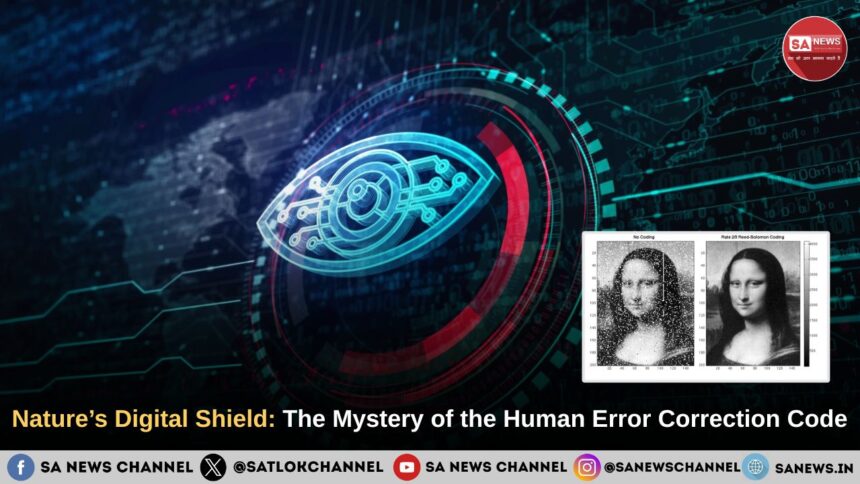
In data science, an Error-Correcting Code (ECC) introduces structured redundancy to a message. By making the symbols within a dataset mutually dependent, a computer can pinpoint exactly where a transmission went wrong and restore the original file.
Remarkably, our biological code features built-in mathematical constraints that mirror this process. Biological information theory suggests that the genetic code is heavily constrained by steric, physical, and linguistic rules. These rules ensure that the “words” (codons) used to build human proteins are spaced out in a biological version of a “Hamming Space.” Because the valid sequences are highly distinct, the cellular machinery can easily flag an anomalous, mutated sequence as an “illegal” entry, triggering immediate repair protocols.
The Three-Tiered Cellular IT Department
The actual implementation of this human error correction code is carried out by an automated, highly efficient network of specialized enzymes that act as the body’s internal debugging team:
- First-Line Proofreading: As copying enzymes (polymerases) synthesize new DNA, they physically detect the geometric shape of each matching pair (A with T, G with C). If an incorrect shape is detected, the enzyme spits out the bad nucleotide and retries.
- Mismatch Repair (MMR): If an error slips past the initial copier, a secondary group of scanning enzymes zooms down the newly synthesized DNA strand, looking specifically for structural distortions. Once found, they cleanly excise the corrupted base and insert the correct one.
- Translesion Synthesis (The Final Guess): In cases of severe, unreadable DNA damage, specialized low-fidelity polymerases step in. Operating like a computer skipping a corrupted sector to avoid a total system crash, these enzymes take an educated guess to keep the replication process moving, choosing minor mutations over cell death.
Bridging Biology and Tech
This profound realization that nature uses error-correcting codes has turned full circle. Today, computer scientists are using biological mechanics to revolutionize digital storage. By converting binary data (0s and 1s) into quaternary DNA sequences and embedding algorithms like the Hamming Code, engineers have built synthetic DNA storage networks. These systems can safely hold petabytes of data for thousands of years, mimicking the very resilience that has kept the human race alive for millennia.
FAQs
1. What exactly is a Human Error Correction Code?
It is the biological and mathematical framework that the human body uses to detect and fix mutations within our DNA. It combines the physical constraints of the genetic code with a network of proofreading enzymes to ensure our genetic data isn’t lost to environmental damage or replication errors.
2. How does DNA mirror digital computer data?
Computers use binary code (0s and 1s) to store information. DNA uses a quaternary code consisting of four chemical bases: A, C, G, and T. Both systems rely on precise sequences of these digits to execute commands and build complex structures.
3. What happens if the human error correction code fails?
If an error evades all three tiers of cellular proofreading, it permanently integrates into the genome as a mutation. While minor mutations drive evolution and human diversity, major failures in error correction can lead to cellular malfunction, aging, and diseases like cancer.
4. How are scientists using this concept in modern technology?
Scientists are reversing the concept by using computer-based error-correcting codes (like Hamming and convolutional codes) to store digital files inside synthetic DNA. This allows us to archive vast amounts of digital data in highly stable, compact, biological formats.