



Joharkheda village in Haryana’s Palwal district has taken a significant step towards addressing its decades-old waterlogging problem after villagers approached Tatvdarshi Sant Rampal Ji Maharaj for assistance. Under the Kisan Mazdoor Bachao Abhiyan – Phase II, a technical survey was conducted, following which 11,000 feet of pipeline, along with related materials, was handed over to facilitate drainage from the affected agricultural land.
- Key Highlights: Joharkheda Village Flood Relief – Phase II
- Decades-Old Waterlogging Affected Agricultural Land
- Survey Conducted at Two Locations
- Villagers Describe the Extent of the Problem
- Materials Handed Over After Approval
- Village Welcomes the Relief Material
- Pipeline Work Planned at Two Drainage Points
- What the Development Means for Joharkheda Village
According to the villagers, they submitted a prayer to Sant Rampal Ji Maharaj seeking help after repeated appeals to governments and the administration did not resolve the long-standing issue. Acting on the request, He directed a survey team to assess the affected areas and determine the technical requirements for drainage.
Key Highlights: Joharkheda Village Flood Relief – Phase II
- Joharkheda village in Palwal district, Haryana, has faced waterlogging for around 60 years.
- Around 150–200 acres of farmland were affected, with nearly 60 acres remaining uncultivated for years.
- A technical survey identified two drainage points.
- A total of 11,000 feet of 8-inch pipeline was approved under the Kisan Mazdoor Bachao Abhiyan – Phase II.
- Two 10 HP motors were also approved for installation after the pipelines are laid underground.
- Villagers said the survey and material support were arranged within 24 hours of their request.
Decades-Old Waterlogging Affected Agricultural Land
Residents of Joharkheda village said waterlogging had remained a major challenge for nearly six decades. During the monsoon, water accumulated up to four to five feet in several fields, while another affected area witnessed water levels of around two to three feet.
According to villagers, nearly 150–200 acres experienced reduced agricultural productivity because of prolonged waterlogging, while around 60 acres remained unsuitable for cultivation for years. They stated that stagnant water had also increased soil salinity, making farming increasingly difficult.
Farmers said even those owning around 10 acres had, at times, been compelled to purchase food grains from local mandis to support their families and livestock due to repeated crop losses.
Survey Conducted at Two Locations
Following the villagers’ request, a survey team visited Joharkheda village and carried out a technical assessment at two separate locations.
| Survey Point | Area Covered | Pipeline Length |
| Point 1 | Around 60 acres | 4,000 feet |
| Point 2 | Around 100 acres | 7,000 feet |
| Total | Affected agricultural land | 11,000 feet |
Survey members stated that the first point required approximately 4,000 feet of pipeline to connect with the drain, while the second point required around 7,000 feet. Together, the proposal totalled 11,000 feet of pipeline.
The survey team also approved two 10 HP motors, which, according to the plan, will be installed after the underground pipeline work is completed.
Villagers Describe the Extent of the Problem
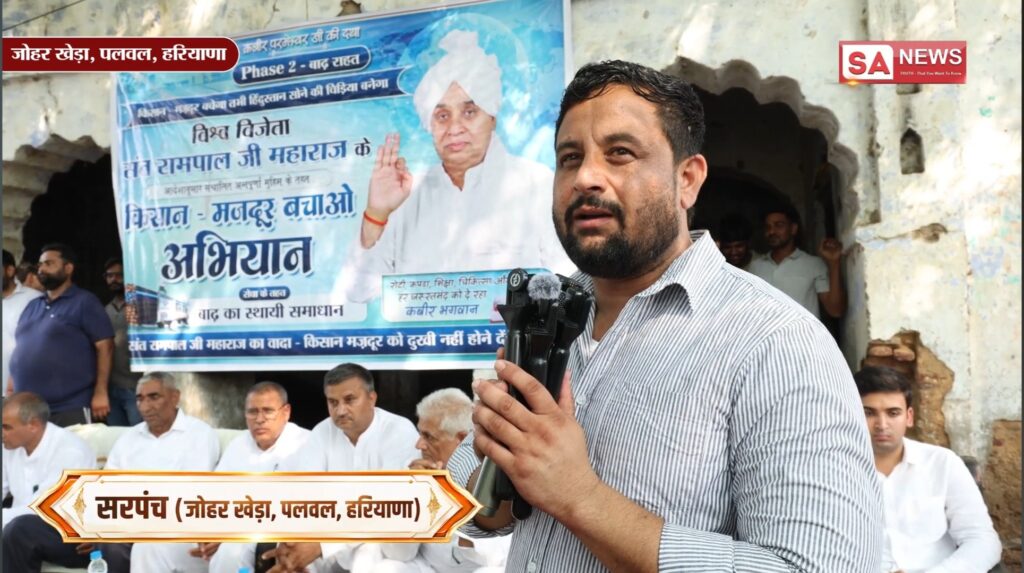
During the survey, several villagers and farmers described the long-standing impact of waterlogging.
The village Sarpanch, Manoj, said repeated requests had been made to the government over the years, but no permanent solution had been implemented. He stated that the first rainfall of the monsoon often turned the affected fields into a large water body, with water remaining for months.
An elderly farmer, aged 72, said he had witnessed the problem for nearly 60 years. He stated that farming had become extremely difficult, with some fields remaining uncultivated throughout the year because of stagnant water and increased soil salinity.
Also Read: The Painful Story of Behlba Village: From Flood Devastation to Green Fields
Villagers further said nearly 70–75% of households in the village were affected directly or indirectly by the waterlogging problem.
Materials Handed Over After Approval
According to the survey team, Tatvdarshi Sant Rampal Ji Maharaj approved the proposal after reviewing the survey findings.
The following materials were handed over to the Gram Panchayat:
- 11,000 feet of 8-inch pipeline
- Accessories required for installation
- Air valves
- Bends and fittings
- Plates
- T-joints
- Nuts and bolts
- Rubber sheets
- Fevicol and other related materials
The survey team informed villagers that the two approved 10 HP motors would be provided after the pipelines were laid underground and a follow-up survey confirmed completion of the work.
Village Welcomes the Relief Material
Residents welcomed the arrival of the material with a public gathering that included tractors, flower garlands and a convoy accompanying the trucks carrying the pipelines.
The Sarpanch said the village delegation had submitted its request only the previous day and that the survey team had contacted them while they were still at the ashram. According to him, the material reached the village the following morning.
Several villagers said they had earlier observed similar assistance in neighbouring villages before deciding to approach Sant Rampal Ji Maharaj with their own request.
Pipeline Work Planned at Two Drainage Points
The Gram Panchayat said excavation work would begin soon and expressed confidence that both pipeline routes would be laid underground within a few days.
According to the approved plan, once the underground pipeline network is completed, the two 10 HP motors will be installed to pump accumulated water into a drain located about two kilometres away from the second survey point.
Villagers expressed hope that the planned drainage system would help improve cultivation on the affected agricultural land in the future.
What the Development Means for Joharkheda Village
Residents said the 11,000-foot underground pipeline network given by Tatvdarshi Sant Rampal Ji Maharaj is expected to help address the long-standing waterlogging affecting around 200 acres of agricultural land. They also described the survey, approval process and material handover as taking place within 24 hours after their request was submitted to Sant Rampal Ji Maharaj under the Kisan Mazdoor Bachao Abhiyan – Phase II.