

Large language models (LLMs) have radically accelerated digital content creation, but this leap forward has introduced severe challenges regarding authenticity, fraud, and the spread of synthetic misinformation.
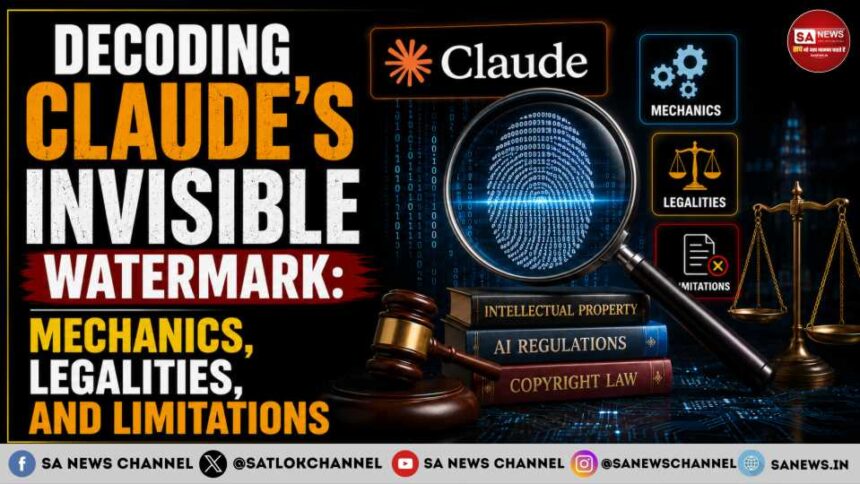
To combat this, Anthropic announced on August 11, 2026, that it is introducing machine-readable marks for Claude-generated content. New supported Claude models released from August 2 will include the marks from launch, while existing models are being transitioned to the system. Simultaneously, secure digital tracking metadata is attached to all supported AI-generated files. The marking system is being applied at the model level across supported Claude products and services, including Claude Platform/API, Claude Code, Claude Cowork and Claude Tag, as well as supported deployments through AWS, Google Cloud and Microsoft Foundry.
Why Now? The European Union AI Act
While Anthropic cites AI safety as a primary motivator, the catalyst for this immediate rollout is the European Union’s Artificial Intelligence Act, whose relevant transparency obligations under Article 50 began applying on August 2, 2026.
Under Article 50 of the EU AI Act, providers of certain AI systems must ensure that AI-generated or manipulated content is marked in a machine-readable format so that its artificial origin can be detected. The transparency obligations began applying on August 2, 2026. Crucially, if a business uses Claude’s API to build its own application, that business becomes a “deployer” with its own strict set of legal responsibilities. Because of the “Brussels Effect” where tech giants align global operations with the strictest regional laws to avoid building fragmented systems Anthropic applied this watermark globally.
| Integration Use Case | Upstream Provider Duty (Anthropic) | Downstream Deployer Duty (Enterprise User) |
| SaaS Chatbot | Embeds a hidden text watermark directly into generated text. | Must display a visible AI label to users and maintain audit logs. |
| Content Generator | Supplies the hidden tracking signal inside generated text. | Must ensure the app does not accidentally erase the watermark. |
| Images & Documents | Attaches secure metadata to files like .png, .jpg, and .svg. | Must preserve data through servers and add visible labels if required. |
| Internal Assisting | Tracks the origin when supported by the specific model. | Must maintain human oversight and not blindly trust AI detectors. |
| Public Publishing | Marks the raw output text before consumption. | Must provide AI disclosures unless exempt (e.g., specific journalism). |
The Goals of AI Watermarking
Unlike traditional watermarks, generative AI requires trackable data hidden deep within the math of the text output itself. This targets four distinct threats:
- Combating Misinformation: Helps platforms differentiate between human reporting and synthetic fake news.
- Enhancing Fraud Detection: Gives cybersecurity experts forensic tools to trace automated phishing campaigns.
- Deterring Academic Dishonesty: Provides a hidden signal to help educators identify unauthorized AI use in assignments.
- Avoiding Model Collapse: Allows data scrapers to filter out AI-generated text, ensuring future models train on high-quality human data.
How Text Watermarking Actually Works
One common approach to text watermarking works by subtly modifying token-selection probabilities during generation. Anthropic has not yet publicly disclosed enough technical detail to determine exactly which algorithm its Claude watermark uses.
| Architecture | How it Works | Primary Advantages | Known Weaknesses |
| KGW (Statistical) | Splits vocabulary tokens into red and green lists and biases generation toward the green list. | Extremely fast; works word-by-word with zero delay. | Paraphrasing can weaken statistical watermark detection |
| SynthID | Puts words through a multi-layer tournament to pick the winner. | Highly resistant to hackers attempting to overload the system. | Loses confidence if the text is translated into a new language. |
| Paraphraser Models | Uses a secondary AI to rewrite normal text into watermarked text. | Highly resistant to word swapping and sentence mixing. | Cannot stream text instantly; too slow for real-time chatbots. |
Images and Structured Files: The C2PA Standard
For images and structured documents, altering probabilities is impossible. For supported files, Anthropic uses the C2PA provenance standard to attach cryptographically signed metadata. Such provenance information can be lost when files are transformed, edited, or processed by platforms that strip metadata. If the file is hacked, the signature breaks, alerting downstream security tools. However, metadata remains fragile; it vanishes easily if a file is converted, compressed by social media, or screenshotted.
The Future: An Endless Cat-and-Mouse Game
Mandatory watermarking forces the digital ecosystem into a complicated new era. If Anthropic keeps its detection tool private, innocent users cannot contest false accusations. If they make it public, hackers will optimize their stripping tools.
Anthropic’s watermarking system represents a significant step toward machine-readable provenance and AI-content transparency. However, its long-term effectiveness will depend on how robustly the marks survive editing, transformation, and adversarial attempts to remove them, as well as how accurately detection tools distinguish AI-assisted content from fully AI-generated content.
The Ultimate Watermark: Distinguishing the True from the Fake
Just as Anthropic’s invisible watermark separates genuine human writing from a machine’s imitation, the spiritual world requires a similar tracking signal to tell a real spiritual master from a fraud. The absolute “watermark” of a True Guru (a Tatvadarshi Sant) is their ability to provide spiritual knowledge and methods of worship that perfectly match holy scriptures. Today, many fake gurus yap endlessly about unverified traditions and suni sunai baat (hearsay), acting much like a bad AI that confidently hallucinates false information.
Because a clever con guru can mimic holiness just as well as an advanced AI mimics human emotion, a seeker must use “Parakh”, the rigorous act of checking the guru’s teachings against sacred texts like the Bhagavad Gita, The Vedas, The Quran and The Holy Bible . Just as a digital detector uses a cryptographic key to prove a file’s true origin, a spiritual seeker must use scriptural evidence to verify a guru’s authenticity.
When a guru’s personal acts and spiritual methods perfectly align with the scriptures, that alignment serves as the ultimate, unbreakable watermark of truth.
And today the only true TatvaDarshi Sant is Sant Rampal Ji Maharaj.
For a deeper exploration of these theological foundations and the evidence cited from various religious scriptures, readers can visit jagatgururampalji.org or access literature such as “Gyan Ganga” and “Jeene Ki Raah” to examine the proofs directly, by free ordering or downloading these books for free.
FAQs:
- Why did Anthropic add a hidden watermark to Claude’s text?
Ans: Anthropic is introducing machine-readable marks for Claude-generated content in connection with the EU AI Act’s transparency requirements for AI-generated and manipulated content. The system is being applied globally to supported Claude models.
- Will the watermark lower the quality of Claude’s generated text or code?
Ans: Anthropic says the watermark is designed not to change the meaning, quality, or readability of its responses. However, the technical details needed to independently evaluate any quality trade-offs have not yet been fully disclosed.
- Can the text watermark be easily removed or bypassed?
Ans: Yes, the watermark is mathematically fragile and is easily destroyed by secondary AI rewriting tools or standard code auto-formatters.
- What happens if I use Claude only to proofread my original human writing?
Ans: If you use Claude to edit or rewrite human-written text, the resulting content may contain Claude’s machine-readable mark where watermarking is supported. However, detecting a Claude mark would not by itself prove that the entire document was AI-generated or that the original ideas came from AI.
- How does this update affect enterprise businesses using the Claude API?
Ans: Businesses using Claude may have obligations under the EU AI Act depending on how they deploy the system and whether their use falls within the relevant provisions. The specific requirements vary by use case, so organizations should assess their role and obligations under Article 50 rather than assuming that API use alone creates a universal set of duties.