


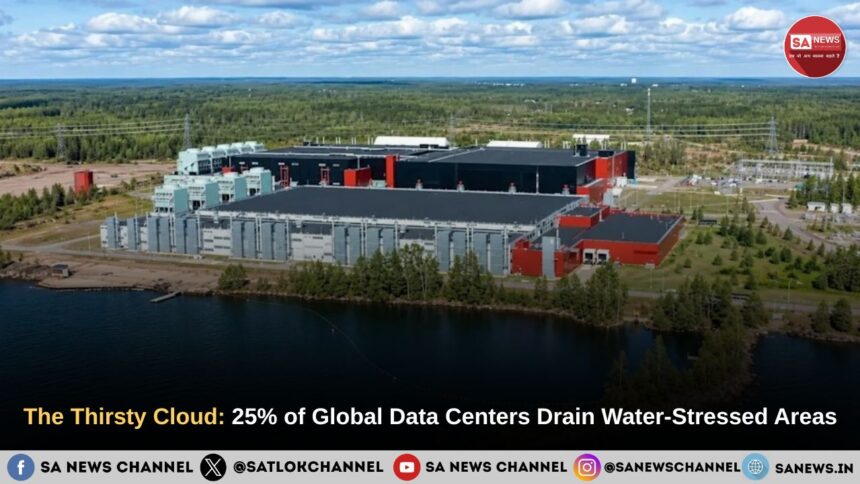
Every time you ask an artificial intelligence chatbot a complex question, stream a high-definition movie, or upload family photos to the cloud, a physical machine somewhere on Earth has to work to process that data. What most people do not realize is that keeping those machines running requires an astronomical amount of fresh water.
As the tech industry races to build bigger and faster infrastructure to support the AI boom, an alarming environmental reality is emerging. A groundbreaking new study published in Environmental Science & Technology reveals that one-quarter of all global data centers are currently located in regions experiencing severe water stress.
As these massive facilities consume millions of gallons to cool their server racks, they are beginning to directly compete with local communities and farms for a rapidly depleting resource. Here is a deep dive into the hidden water footprint of our digital lives, and what it means for global water security.
Key Points at Glance
- The 25% Reality: Out of the 9,347 globally mapped data centers, 25% face at least one month per year where local water demand exceeds available supply.
- Climate Change Threat: If global temperatures rise by 3°C, the number of water-stressed data centers is projected to jump to 33% worldwide.
- Massive Consumption: A large 1-gigawatt (GW) data center cluster can consume up to 40 million cubic meters of water annually, equating to the daily water usage of a town of 50,000 people.
- Direct Competition: Globally, 41% of data centers draw from the same water sources utilized by municipal households and city infrastructure.
- Highly Vulnerable Regions: Facilities located in India, the United Arab Emirates (UAE), and Spain are facing the most extreme and prolonged water shortages.
The Hidden Cost of Cloud Computing
To understand why the internet is so thirsty, you have to look at the physical architecture of a data center. Thousands of high-performance servers running 24/7 generate a massive amount of intense, sustained heat. If that heat is not managed, the internal hardware will melt, causing catastrophic service outages.
To prevent overheating, companies primarily rely on evaporative cooling systems. These systems pull in local fresh water and evaporate it to absorb the heat from the server rooms. It is highly effective but incredibly resource-intensive.
Because the AI industry demands unprecedented computational power, these water requirements are skyrocketing. According to the research, a 1-GW data center cluster operating at full capacity can withdraw between 10 million and 40 million cubic meters of water every single year depending on the local climate. To put that into perspective, the upper limit of that consumption matches what an entire developed country like the Netherlands withdraws annually for municipal household use.
The 25% Crisis: By the Numbers
Led by researchers from the Carnegie Institution for Science, the comprehensive study mapped exactly 9,347 currently identified data centers worldwide.
By analyzing local hydrological conditions, researchers discovered that 2,315 of these facilities (roughly 25%) are located in regions that experience a “water gap” meaning local water demand completely outstrips the natural supply for at least one month of the year. Approximately 6% of global data centers sit in areas heavily stressed for most of the year.
Furthermore, this is not a static problem. Utilizing climate models based on a 3°C global warming scenario, the study projects that within a decade, 33% of all global data centers will be operating in severely water-stressed environments.
Who is Losing Out on Water?
“These facilities are not landing in empty landscapes,” lead researcher Lorenzo Rosa noted in the study. “They are landing on top of the water supply of cities and farms.”
Unlike thermal power plants that are often built near vast, open water sources, data centers are frequently constructed near metropolitan hubs to reduce internet latency. This creates a severe overlap in resource dependency. When local water tables drop, the data centers do not shut down—instead, they compete directly with the surrounding community.
| Competing Sector | Global Overlap with Data Centers | Primary Impact |
| Municipal / City Use | 41% | Competes directly with household drinking water and sanitation. (Rises to 54% in the US) |
| Irrigated Agriculture | 28% | Diverts vital fresh water away from local food production and farming. |
| Manufacturing | 18% | Strains industrial water resources required for factory operations. |
| Power Generation | 8% | Competes with hydroelectric and thermal plant cooling needs. |
Global Hotspots: From the US to India
While the global average is concerning, the regional data reveals stark disparities in vulnerability.
The United States is home to the world’s largest concentration of digital infrastructure, hosting 3,619 facilities (39% of the global total). Fortunately, dense clusters on the East Coast face minimal issues. However, 21% of American data centers mostly located in the arid West and South face at least one month of severe shortage annually.
Other international regions are facing much harsher realities:
- India: A staggering 73% of data centers face at least one month of water shortage annually, with 33% enduring extreme shortages lasting between 9 and 12 months.
- United Arab Emirates (UAE): Situated in an extremely arid climate, 93% of the nation’s data centers sit in areas with structural water shortages.
- Spain: Holding the highest exposure rate in Europe, 64% of Spanish facilities are currently affected. Under the warmer climate scenario, this is projected to surge to 80%.
The Inflexibility Problem
The most pressing danger highlighted by the study is structural inflexibility. During a severe drought, a city can ask residents to stop watering their lawns, and farmers can temporarily scale back crop planting. However, a data center cannot simply “turn down” its operations. Continuous computing requires continuous cooling. This inability to curtail consumption during a drought means that as local water resources dry up, the strain is aggressively pushed onto the surrounding human and ecological systems.
As the AI revolution continues to expand rapidly, tech giants will be forced to reconsider where they build. Integrating shifting hydroclimatic conditions into future infrastructure planning is no longer just an environmental goal; it is a critical necessity to keep the internet running without draining the communities that host it.
FAQs Related to Data Centers is Draining Water-Stressed Regions
1. Why do data centers use so much water?
Data centers house thousands of high-performance servers that run continuously, generating massive amounts of heat. To prevent the hardware from melting down, facilities use highly water-intensive evaporative cooling systems to regulate the temperature inside the server rooms.
2. How many data centers are in water-stressed regions?
According to a comprehensive global mapping of 9,347 data centers, approximately 25% (over 2,300 facilities) are located in regions that experience a “water gap,” meaning local demand exceeds the available water supply for at least one month out of the year.
3. Who are the data centers competing with for water?
Because data centers are often built near metropolitan areas, they heavily overlap with local community needs. Globally, 41% of data centers compete directly with municipal city water supplies, while 28% draw from the same water sources used for irrigated agriculture.
4. How will climate change impact this issue?
Climate models indicate that as global temperatures rise, water scarcity will worsen. The study projects that under a 3°C warming scenario, the share of global data centers operating in water-stressed areas will jump from 25% to 33%.
5. Which countries are facing the highest risks?
While the United States hosts the most data centers, regions like South Asia and the Middle East face the harshest conditions. In India, 73% of data centers face at least one month of water shortage annually. In the UAE, 93% sit in areas with shortages, and in Spain, 64% of facilities are currently affected.