

Apple’s Worldwide Developers Conference (WWDC) 2026 marked one of the most important moments in the company’s recent history. During the keynote event, Apple unveiled a significantly redesigned Siri experience powered by Apple Intelligence.The announcement represents Apple’s most ambitious artificial intelligence initiative yet, arriving at a time when AI has become a major focus across the technology industry. With competitors such as ChatGPT, Gemini, and Claude rapidly advancing, many users are wondering whether Apple’s latest Siri upgrade can transform the user experience or simply represents another step in the company’s AI journey. This article provides a fact-based breakdown of the announcements, features, and industry reactions.
- What Apple Announced at WWDC 2026
- Why Siri Matters More Than Ever
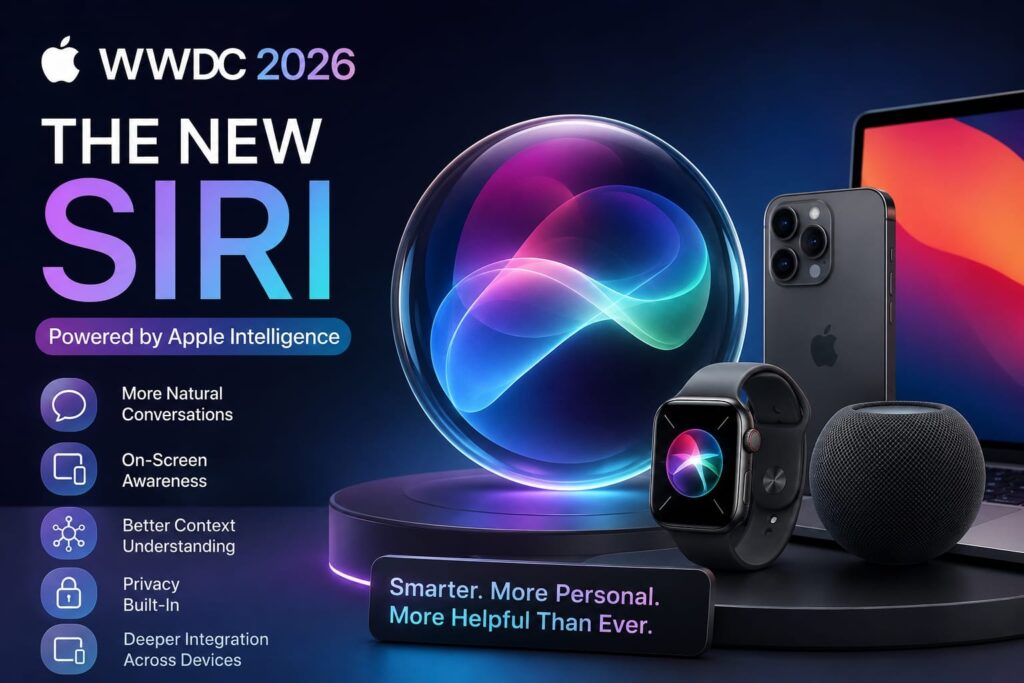
- Key Features of the New Siri
- More Natural Conversations
- Improved Context Awareness & On-Screen Understanding
- Multi-Step Task Handling
- Deeper Integration Across Apple Devices
- Better Personal Assistance
- Apple Intelligence Expansion
- Apple’s Privacy-Focused Approach
- Is Apple Catching Up to Competitors?
- Challenges Ahead
- Game-Changer or Another Big Hype?
- Technology vs. Spirituality: Why Material Progress Alone Is Not Enough
- FAQs on Apple Siri AI at WWDC 2026
What Apple Announced at WWDC 2026
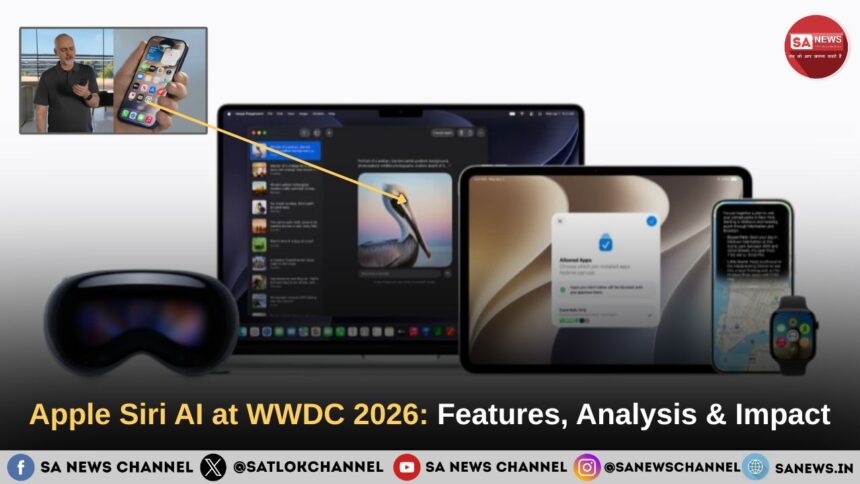
Apple unveiled a significantly redesigned Siri experience powered by Apple Intelligence during WWDC 2026 Event.The updated assistant focuses on more natural conversations, improved contextual understanding, on-screen awareness, and deeper integration across Apple’s ecosystem.
According to Apple’s announcements, the upgraded Siri is designed to:
- Support more natural conversations
- Better understand user context and on-screen content
- Work across multiple apps
- Access personal information when users grant permission
- Integrate with Apple Intelligence features
- Provide more helpful voice interactions
Many technology publications have described the WWDC 2026 Siri update as one of the most significant upgrades in Siri’s history.
Why Siri Matters More Than Ever
Artificial intelligence has rapidly transformed the technology landscape. Users now expect digital assistants to understand context, perform complex tasks, and provide meaningful assistance rather than simple voice-command responses.
For years, Siri was viewed as lagging behind newer AI platforms. WWDC 2026 represents Apple’s effort to modernize Siri and bring it closer to the expectations of today’s users.
The company’s goal is not only to improve conversations but also to make Siri a more useful assistant across daily activities such as communication, productivity, scheduling, and information management.
Key Features of the New Siri
More Natural Conversations
One of the biggest improvements is Siri’s ability to engage in more natural and fluid conversations. Users can continue discussions without repeatedly restating information.
Improved Context Awareness & On-Screen Understanding
The upgraded Siri can better understand information from different apps, on-screen content, and services when users grant permission. This helps Siri provide more relevant responses and assistance.
Multi-Step Task Handling
Rather than handling only single commands, Siri can assist with more complex actions involving multiple steps.
Deeper Integration Across Apple Devices
Apple has expanded Siri’s role throughout the Apple ecosystem, including iPhone, iPad, Mac, Apple Watch, and other supported platforms.
Better Personal Assistance
The updated Siri aims to provide a more personalized experience by understanding user preferences and interactions while maintaining Apple’s privacy standards.
Apple Intelligence Expansion
Siri is only one part of Apple’s broader AI strategy.
WWDC 2026 introduced additional Apple Intelligence features across Apple’s software ecosystem.
These enhancements include:
- Smarter Writing Assistance
- Enhanced Communication Tools
- Improved Photos Experience
- Productivity Enhancements
Apple’s Privacy-Focused Approach
A major theme of WWDC 2026 was privacy.
Unlike some AI platforms that rely heavily on cloud processing, Apple continues emphasizing:
- On-Device Processing
- Private Cloud Compute
- User Control
This privacy-first strategy remains one of Apple’s key differentiators in the AI market.
Is Apple Catching Up to Competitors?
The question dominating industry discussions is whether Apple is leading the AI race or catching up to competitors. Companies such as OpenAI, Google, and Anthropic have introduced advanced conversational AI systems over the past few years. Some analysts believe Apple entered the AI race later than competitors. Others argue that Apple’s strength lies in combining AI with a massive hardware ecosystem, privacy protections, and seamless user experiences.
The answer will ultimately depend on how users respond to the new Siri after broader adoption.
Challenges Ahead
Although the announcement generated significant interest, Apple still faces several challenges.
- Device Compatibility
- Strong Competition
- User Expectations
- Early Industry Reactions
Initial reactions from technology analysts have generally been positive. Many experts praised improved conversational capabilities, better integration across Apple devices, strong privacy protections, and expanded Apple Intelligence features. At the same time, analysts noted that long-term success will depend on real-world performance and user adoption.
Game-Changer or Another Big Hype?
The answer depends largely on expectations.
If users expect Apple to instantly surpass every AI competitor, the new Siri may appear to be an evolutionary improvement. However, for users deeply invested in the Apple ecosystem, the enhanced Siri experience could represent a meaningful advancement in everyday productivity and convenience. What is clear is that WWDC 2026 marks Apple’s strongest AI push to date and signals the company’s long-term commitment to artificial intelligence.
Technology vs. Spirituality: Why Material Progress Alone Is Not Enough
The rapid advancement of artificial intelligence demonstrates humanity’s creativity and innovation. Technologies like Apple’s enhanced Siri can improve communication, productivity, and convenience in daily life. However, according to the teachings of Sant Rampal Ji Maharaj, material progress alone cannot provide lasting happiness and peace. Sant Rampal Ji Maharaj teaches that while scientific advancements should be used for the welfare of society, true fulfillment comes through spiritual knowledge, devotion to the Supreme God, and righteous living. Technology can improve our external world, but Satgyaan helps transform our inner world.
A balanced life combines modern innovation with spiritual wisdom. When technological progress is guided by ethical values and spiritual understanding, it contributes positively to both individuals and society.
FAQs on Apple Siri AI at WWDC 2026
Q1. What was announced for Siri at WWDC 2026?
Apple unveiled a significantly redesigned Siri experience powered by Apple Intelligence, featuring improved conversations, contextual understanding, on-screen awareness, and deeper integration across Apple devices.
Q2. Is the new Siri available now?
Apple released developer beta versions following WWDC 2026. Availability of specific AI features may vary depending on device compatibility, software version, and region.
Q3. How is the new Siri different from previous versions?
The updated Siri offers more natural conversations, better context awareness, multi-step task assistance, and tighter integration with Apple Intelligence features.
Q4.Will the new Siri work on all iPhones?
No. Certain Apple Intelligence features require supported hardware and may not be available on all iPhone models.
Q5. Is Apple’s new Siri better than ChatGPT or Gemini?
It is too early to make a definitive conclusion. Long-term user experience, feature availability, and real-world performance will provide a clearer comparison over time.