

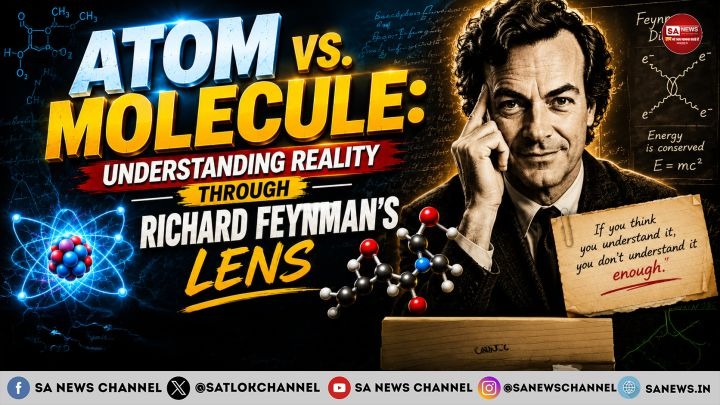
Atom vs. Molecule: Imagine taking a piece of solid copper, a drop of water, or a single grain of sand and slicing it in half. Then imagine slicing each half again and again, infinitely down the rabbit hole of scale. Does the copper remain copper forever? Does water stay wet no matter how thin you slice it?
In this article, we’re going to explore the same from the first principles, so sit back and keep reading!
- Richard Feynman’s Atomic Thought Experiment
- What Is an Atom? The Cosmos’s Fundamental Alphabet
- The Periodic Table as an Alphabet
- What Is a Molecule? The Spoken Words of Matter
- Key Differences: Atom vs. Molecule Comparison
- The Texture of Reality: How Molecules Build Our World
- Why Molecules Matter in Daily Life
- Beyond the Atoms: Contemplating on Existence
- FAQs about Atoms and Molecules!
Richard Feynman’s Atomic Thought Experiment
In his celebrated lectures, later compiled in Six Easy Pieces, physicist Richard Feynman presented a famous hypothetical scenario: if all scientific knowledge were destroyed and only one sentence could be passed to future generations, what statement would contain the most information?
His answer was simple:
“All things are made of atoms, little particles that move around in perpetual motion, attracting each other when they are a little distance apart, but repelling upon being squeezed into one another.”
Read the detailed lecture by Richard Feynman on this topic by clicking here!
To grasp the difference between an atom and a molecule, we must strip away textbook jargon and start from first principles: the fundamental relationship between identity and connection.
What Is an Atom? The Cosmos’s Fundamental Alphabet
An atom is the smallest unit of an element that retains the chemical identity of that element.
If you break an atom down further into protons, neutrons, and electrons, you lose that unique identity. A proton from a gold atom is fundamentally identical to a proton from an oxygen atom.
Watch this super interesting video to visualize the scale of atoms: Voyage into the world of atoms
The Periodic Table as an Alphabet
Think of the periodic table not as a chart to memorize, but as the cosmos’s 118-letter “alphabet.” As chemist and writer Primo Levi explored poetically in The Periodic Table, each element can be associated with distinctive properties and human stories.
The Anatomy of an Atom
An atom consists of two main regions:
- The Core (Nucleus): A dense center of protons and neutrons. The number of protons acts like an atomic passport: six protons identify carbon, while eight identify oxygen.
- The Electron Cloud: A region surrounding the nucleus in which electrons are described by quantum-mechanical orbitals.
An atom on its own is a single letter, a solitary O or H. Many atoms can form chemical bonds because bonding can place the combined system in a lower-energy, more stable state.
What Is a Molecule? The Spoken Words of Matter
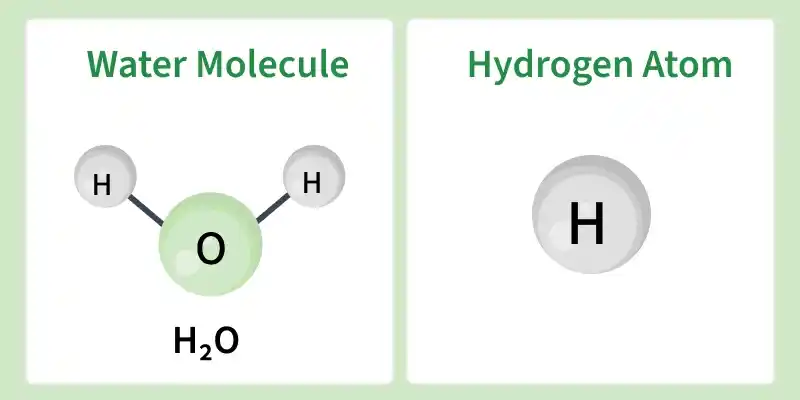
A molecule is an electrically neutral entity consisting of more than one atom, with the atoms held together by chemical interactions. If an atom is a solitary letter, a molecule is a word.
Emergent Properties: The Miracle of H₂O
By binding together, atoms unlock entirely new properties that existed nowhere in the original isolated parts. Consider water:
- Hydrogen (H): A very light and highly flammable gas.
- Oxygen (O): A reactive gas that supports combustion.
When two Hydrogen atoms perform a quantum handshake with one Oxygen atom, they form a single molecule of water (H₂O). The result isn’t an explosive gas rather a liquid that quenches fire and cradles all known life.
Molecules That Shaped Human History
In Napoleon’s Buttons: How 17 Molecules Changed History, authors Penny Le Couteur and Jay Burreson show how subtle shifts in molecular architecture, changing how a few atoms chain together have dictated human destiny, driving trade routes, medical revolutions, and global empires.
Key Differences: Atom vs. Molecule Comparison
| Feature | Atom | Molecule |
| Core Concept | The fundamental unit of a chemical element | A stable group of two or more bound atoms |
| Language Analogy | A single letter (e.g., “O”) | A meaningful word (e.g., $H_2O$ or “Water”) |
| Subdivision | Subdividing destroys elemental identity | Subdividing breaks bonds into constituent atoms |
| Stability | Highly reactive on its own (except noble gases) | Stable independent existence with distinct traits |
Also Read: Nanotechnology: The Science Of Atomic Manipulation
The Texture of Reality: How Molecules Build Our World
Over two thousand years ago in De Rerum Natura (On the Nature of Things), Roman poet Lucretius intuited that the physical world was built from invisible “seeds” clashing, clinging, and weaving together in ceaseless motion.
Why Molecules Matter in Daily Life
When you feel the chill of ice, smell rain on dry pavement, or breathe morning air, you aren’t sensing individual atoms in isolation. You are experiencing the collective harmony of molecules.
The texture, color, fragrance, and fluidity of everyday life are the emergent poetry created when atomic letters combine into molecular prose.
Beyond the Atoms: Contemplating on Existence
While science unveils the mechanics of matter, it also highlights the sheer improbability of our existence. In a vast cosmos governed by relentless entropy, the fact that life blossomed on a tiny planet like ours is nothing short of extraordinary.
Yet, the ultimate question lingers: what truly started it all? The Big Bang explains the mechanics of expansion, but what was the initial catalyst? For centuries, thinkers across science, philosophy, and religion have offered fragments of the answer, insightful, yet incomplete.
Sant Rampal Ji Maharaj addresses this fundamental mystery, bridging the gap between scientific observation and spiritual origin using evidence rooted in ancient scriptures.
Checkout this video on the creation of universe by Sant Rampal Ji Maharaj:
FAQs about Atoms and Molecules!
1. What is the main difference between an atom and a molecule?
An atom is the single basic building block of a chemical element. A molecule is formed when two or more atoms chemically bond together.
2. Can an atom exist on its own in nature?
Some noble gases like Helium or Neon exist as single atoms, but most individual atoms are unstable and quickly bond with others to form molecules.
3. Is water ($H_2O$) an atom or a molecule?
Water is a molecule because it consists of three distinct atoms (two Hydrogen and one Oxygen) bound together by shared electrons.
4. What happens when you break a molecule apart?
Subdividing a molecule breaks its chemical bonds, turning it back into its individual constituent atoms and altering its physical properties.
5. Why do atoms join together to form molecules?
Atoms share or exchange outer electrons to fill their energetic fields and achieve a more stable, lower-energy state.