


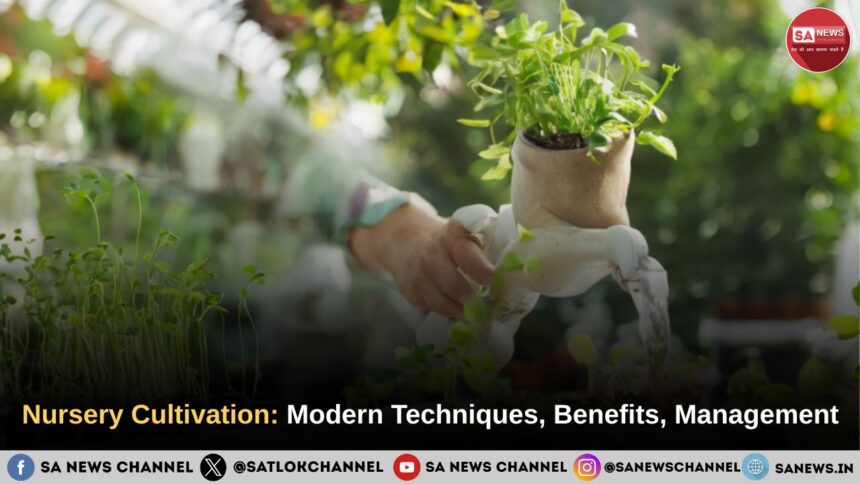
In modern agriculture, the quality of planting material plays an important role in determining the success of a crop. Before a crop reaches the main field, its journey often begins in a carefully managed nursery. Nursery cultivation is therefore becoming an increasingly important agricultural practice, particularly for vegetable crops, fruit crops, flowers, forest plants and several plantation crops.
- What is Nursery Cultivation?
- Why Nursery Cultivation is Important
- Selection of a Suitable Nursery Site
- Preparation of Nursery Beds
- Selection and Treatment of Seed
- Sowing in the Nursery
- Irrigation Management
- Nutrient Management
- Weed Management
- Pest and Disease Management
- Protected Nursery Cultivation
- Seedling Hardening: An Essential Step
- Transplanting Seedlings into the Main Field:
- Modern Technologies in Nursery Cultivation:
- Nursery Cultivation as an Employment Opportunity:
- Role of Quality Planting Material in Crop Productivity:
- Sustainable Nursery Cultivation
- Challenges in Nursery Cultivation:
- Importance for Horticulture and Food Production:
- Need for Farmer Training
- Sant Rampal Ji Maharaj’s Contribution to Farmers, Labourers and Food Production
- Final Thoughts
- FAQs on Nursery Cultivation
A nursery is a place where seeds or other planting materials are raised under controlled or semi-controlled conditions until the young plants become strong enough to be transplanted into their permanent location. Instead of sowing seeds directly across a large field, farmers can raise seedlings in a smaller and better-managed area. This allows them to monitor germination, irrigation, nutrition, weeds, pests and diseases more effectively.
The importance of nursery cultivation has increased with the expansion of commercial horticulture and high-value crops. Farmers are increasingly looking for healthy, uniform and vigorous planting material because weak seedlings can result in poor crop establishment, uneven growth and lower productivity.
What is Nursery Cultivation?
Nursery cultivation refers to the systematic production and management of young plants before they are transplanted into the main field, orchard, garden, greenhouse or another permanent growing location.
A nursery can be established on a small farm, at a commercial horticultural unit, in a protected structure such as a polyhouse or shade-net house, or through specialised plant nurseries that supply seedlings to farmers.
Depending on the crop, nurseries may be used to raise seedlings of tomato, chilli, brinjal, cabbage, cauliflower, onion, tobacco, flowers and many other crops. Fruit crops may also be propagated through nurseries using seeds, cuttings, grafting, budding or other vegetative propagation methods.
The basic objective remains the same: to provide young plants with favourable conditions during their most sensitive stage of growth.
Why Nursery Cultivation is Important
The initial stage of plant growth is highly sensitive. Seeds and young seedlings can be affected by excessive rainfall, drought, temperature fluctuations, weeds, insects, fungal diseases and poor soil conditions.
Scientific nursery management provides greater control over these factors.
One major advantage is the production of healthy and uniform seedlings. When seedlings of similar age and vigour are transplanted into the field, crop growth can become more uniform. Uniformity is particularly important in commercial vegetable production, where harvesting and marketing often depend on consistent crop development.
Nursery cultivation can also reduce seed wastage. Seeds are sown in a relatively small area, allowing farmers to manage them more carefully. Once the seedlings reach the appropriate stage, they are transplanted into the main field.
Another advantage is better utilisation of land and water during the early growth stage. Instead of irrigating a large field immediately after sowing, farmers can initially provide water to a smaller nursery area.
Nursery raising can also help farmers get a head start on crop production. Seedlings can be prepared while the main field is being prepared, allowing agricultural operations to be better organised.
Selection of a Suitable Nursery Site
The location of a nursery is one of the first decisions that affects successful seedling production.
A nursery site should preferably have good drainage because waterlogging can damage young roots and encourage fungal diseases. At the same time, a reliable source of clean irrigation water should be available.
The site should receive adequate sunlight, although sensitive seedlings may require partial shade depending on the crop and season.
Good accessibility is also important. Farmers need to visit the nursery regularly for irrigation, weeding, pest monitoring and other management activities. Commercial nurseries should ideally be located where transportation of seedlings is convenient.
The soil used for raising seedlings should be reasonably fertile, well-drained and free from serious pest and disease problems. Where natural soil conditions are unsuitable, farmers may use suitable nursery media.
Preparation of Nursery Beds
Proper nursery-bed preparation provides seedlings with an appropriate growing environment.
Raised beds are commonly used in areas where drainage is a concern. They can help prevent excess water from remaining around the roots during heavy rainfall or excessive irrigation.
The nursery bed should be properly levelled and prepared to provide a fine growing medium. Large stones, weeds and unwanted plant material should be removed.
The growing medium should provide adequate aeration, moisture retention and drainage. Depending on the crop and nursery system, farmers may use combinations of soil, sand, compost or other suitable materials.
In protected nurseries, commercial growing media may also be used.
Selection and Treatment of Seed
Seed quality is one of the most important factors in nursery cultivation.
Farmers should obtain seeds from reliable sources and select varieties suitable for their local climate, soil conditions, market demand and production objectives.
High-quality seeds generally provide better germination and stronger seedlings. However, seed quality alone cannot guarantee success. Proper sowing depth, moisture, temperature and nursery management are also essential.
Seed treatment may be recommended for certain crops to protect seeds and emerging seedlings against particular seed-borne or soil-borne problems.
Farmers should follow crop-specific agricultural recommendations and use approved treatments correctly.
Sowing in the Nursery
Seeds should be sown at an appropriate depth. Very deep sowing may delay emergence, while extremely shallow sowing can expose seeds to drying and other environmental problems.
The spacing between seeds should also be managed carefully. Excessively dense sowing can result in competition for light, water and nutrients and may increase the risk of disease.
After sowing, gentle irrigation is important. Strong streams of water can displace seeds or damage young seedlings. A fine sprinkler or suitable irrigation system can provide more uniform moisture.
Irrigation Management
Water management is particularly important during the nursery stage.
Young seedlings have small root systems and can be damaged by both water shortage and excessive irrigation. The objective should therefore be to maintain appropriate moisture without creating prolonged waterlogging.
Irrigation frequency depends on crop, nursery media, weather, season and nursery structure.
Protected nurseries may require different irrigation schedules from open-field nurseries. Drip systems, micro-irrigation and fine sprinklers can help improve water management when properly designed and operated.
Over-irrigation can create favourable conditions for root diseases, while insufficient water can cause wilting and poor seedling growth.
Nutrient Management
Young seedlings require nutrients for healthy root, stem and leaf development. However, excessive fertiliser application can damage delicate roots.
Nutrient management should therefore be based on the crop and growing medium.
Organic matter can improve the physical condition of suitable nursery media, while balanced fertilisation may be used when required. In commercial nurseries, water-soluble fertilisers may be applied through irrigation systems according to crop requirements.
The goal is to produce compact, healthy seedlings with strong roots rather than excessively soft or elongated plants.
Weed Management
Weeds compete with seedlings for water, nutrients, sunlight and space. They may also provide shelter for insects and pathogens.
Regular nursery inspection is therefore important. Weeds should be removed carefully before they become well established.
Manual weeding is commonly used in small nurseries. In commercial systems, nursery hygiene and suitable growing media can reduce weed pressure.
Chemical weed control should never be adopted casually in a nursery because young seedlings can be highly sensitive to herbicides. Any chemical use should follow crop-specific recommendations and approved labels.
Pest and Disease Management
Nursery seedlings are vulnerable to several insects and diseases.
Common nursery problems may include damping-off, fungal infections, sucking pests, caterpillars and other crop-specific pests. High humidity, poor drainage, overcrowding and excessive irrigation can increase disease risk.
An effective nursery management programme begins with prevention.
Good sanitation, clean tools, healthy planting material, appropriate spacing, proper irrigation and regular inspection can reduce many problems.
Farmers should monitor seedlings frequently instead of waiting for serious damage to appear. Integrated pest management approaches can combine cultural, biological and other appropriate control methods.
Where pesticides or fungicides are recommended, they should be used strictly according to approved agricultural guidance, label instructions and safety precautions.
Protected Nursery Cultivation
Modern nursery cultivation increasingly uses protected structures such as shade-net houses, polyhouses and other controlled environments.
Protected structures can provide greater control over temperature, sunlight, wind and moisture. They can be especially useful for high-value crops and commercial seedling production.
Shade-net structures can protect delicate seedlings from excessive sunlight and heat. Polyhouses can provide a more controlled environment for raising planting material.
However, protected cultivation requires investment in infrastructure, irrigation, ventilation and management. Farmers should therefore evaluate crop value, market demand and production costs before making such investments.
Seedling Hardening: An Essential Step
A seedling raised under favourable nursery conditions may experience stress when suddenly transferred to an open field.
Hardening is the process of gradually preparing seedlings for field conditions.
Depending on the crop, hardening may involve gradually reducing irrigation or exposing seedlings progressively to outdoor conditions before transplanting.
The objective is to produce seedlings that can withstand environmental stress after transplantation.
Skipping the hardening stage can increase transplanting shock in sensitive crops.
Transplanting Seedlings into the Main Field:
Transplanting should be carried out when seedlings have reached the appropriate stage for the particular crop.
Seedlings that are too young may not tolerate field conditions, while over-aged seedlings may suffer from restricted root development or transplanting stress.
The main field should be properly prepared before seedlings are transplanted.
Transplanting is preferably done during suitable weather conditions. In many situations, cooler parts of the day are preferred to reduce immediate heat stress.
The roots should be handled carefully, and seedlings should be planted at an appropriate depth.
Adequate moisture should be maintained after transplantation to help seedlings establish their roots.
Modern Technologies in Nursery Cultivation:
Technology is changing the way nurseries are managed.
Commercial nurseries increasingly use plug trays, automated irrigation, fertigation, protected structures, environmental monitoring and improved propagation systems.
Plug-tray nurseries allow seedlings to be raised individually in small cells. This can produce uniform planting material and reduce root disturbance during transplanting.
Drip and micro-irrigation systems can improve water-use efficiency.
Fertigation can allow nutrients to be delivered along with irrigation water when the system and crop recommendations are appropriate.
Digital monitoring systems can help nursery managers observe temperature, humidity and irrigation conditions in protected structures.
These technologies can increase efficiency, but they should be selected according to crop requirements and economic feasibility.
Nursery Cultivation as an Employment Opportunity:
Nursery cultivation is not only a crop-production technique; it can also become a source of rural employment and entrepreneurship.
Commercial nurseries can supply vegetable seedlings, ornamental plants, fruit plants, forestry plants and other planting materials.
With proper technical knowledge, farmers and rural entrepreneurs can establish small or medium-sized nurseries based on local demand.
Nursery enterprises require regular management, including seed procurement, propagation, watering, plant protection, grading, packing and transportation. This can create employment opportunities for local workers.
However, profitability depends on factors such as plant quality, production costs, survival rate, market demand and selling price. Therefore, a business plan and local market assessment are important before establishing a commercial nursery.
Role of Quality Planting Material in Crop Productivity:
Good planting material does not automatically guarantee a high yield, but it creates a stronger foundation for successful crop establishment.
Healthy seedlings generally have better chances of surviving transplantation and establishing their root systems.
Uniform planting material can also help farmers manage irrigation, fertilisation, pest control and harvesting more systematically.
In horticultural crops, where production costs can be significant, starting with poor-quality seedlings can increase the risk of crop failure.
This makes nursery management an important component of modern crop planning rather than merely an optional preliminary activity.
Sustainable Nursery Cultivation
Sustainability is becoming increasingly important in agriculture.
Nursery cultivation can contribute to resource efficiency when water, seeds and growing space are carefully managed.
Efficient irrigation systems can reduce unnecessary water use. Organic matter and suitable growing media can improve resource utilisation. Integrated pest management can help reduce unnecessary pesticide applications.
Nursery waste should also be managed responsibly. Diseased plant material should not simply be left around the nursery because it may become a source of infection.
Reusable trays and appropriate sanitation practices can also improve nursery hygiene and reduce avoidable waste.
Challenges in Nursery Cultivation:
Despite its advantages, nursery cultivation has several challenges.
The first is the need for technical knowledge. Seedlings are delicate, and mistakes in irrigation, nutrition, temperature or plant protection can cause significant losses.
Infrastructure costs can also be a challenge for small farmers who want to establish protected nurseries.
Market demand is another important factor. A nursery producing large quantities of seedlings without confirmed demand may face financial losses.
Transportation is also critical. Young seedlings can be damaged if they are handled or transported improperly.
Climate variability presents another challenge. Extreme heat, heavy rainfall, strong winds and unexpected temperature changes can affect nursery performance.
Therefore, successful nursery cultivation requires planning, technical knowledge, regular monitoring and market awareness.
Importance for Horticulture and Food Production:
Nursery cultivation has particular importance in horticulture because many horticultural crops are transplanted or propagated before being planted in their permanent location.
Vegetable production can benefit from uniform seedlings and better crop establishment. Fruit nurseries can provide grafted or budded plants with desirable characteristics. Flower nurseries can supply planting material for commercial landscaping and ornamental production.
As demand for vegetables, fruits, flowers and plantation crops continues to grow, the importance of reliable planting material is also expected to remain significant.
Need for Farmer Training
Training plays an important role in improving nursery management.
Agricultural universities, Krishi Vigyan Kendras, horticulture departments and other agricultural institutions can help farmers learn about seed selection, propagation, nursery media, irrigation, plant protection and hardening.
Farmers should preferably adopt crop-specific recommendations instead of following a single nursery method for every crop.
Local climate and soil conditions can significantly influence nursery practices. A technique that works well in one region may need modification in another.
Sant Rampal Ji Maharaj’s Contribution to Farmers, Labourers and Food Production
Sant Rampal Ji Maharaj is playing an important role in supporting farmers, labourers and underprivileged sections of society, thereby contributing to the broader goal of food production and rural welfare in India. Through initiatives such as the Kisan-Majdur Bachao Abhiyan, support is described for small and marginal farmers, particularly those cultivating less than two acres of land. According to claims associated with the initiative, eligible farmers are provided assistance such as seeds, fertilizers and pesticides free of cost, helping them reduce input costs and continue agricultural activities.
Agriculture depends not only on farmers but also on timely availability of agricultural inputs, labour, water and other resources. In this context, support to economically weaker farmers can help strengthen their capacity to cultivate their land and contribute to food production. Such initiatives also highlight the importance of collective efforts toward improving the condition of farmers and agricultural workers.
Another area associated with Sant Rampal Ji Maharaj’s social-service activities is flood relief and agricultural assistance. It has been claimed that during floods affecting parts of Haryana, Rajasthan and Punjab in 2025, agricultural land in several villages remained submerged, creating serious difficulties for farmers and raising concerns about cultivation in subsequent seasons. According to accounts of the relief activities, motors and pipes were provided in numerous villages to help remove excess floodwater from agricultural fields. Such assistance, where implemented effectively, can help farmers restore their fields and resume agricultural operations.
These activities have led some beneficiaries and followers to use titles such as “Kisan Masiha” and “Kisan Ratna” for Sant Rampal Ji Maharaj, reflecting their appreciation of the assistance they associate with his initiatives. However, such titles represent the views of supporters and should be presented as such in objective news writing.
Beyond agriculture, Sant Rampal Ji Maharaj’s followers also associate his social-welfare efforts with the Annapurna initiative, under which food and other forms of assistance are described as being provided to needy people. The broader welfare activities are described as including support related to food, education, housing, clothing and medical assistance. Such efforts are aimed at helping economically disadvantaged families and promoting human welfare.
Alongside these activities, various social campaigns are also associated with Sant Rampal Ji Maharaj, including initiatives against drug addiction and dowry, as well as campaigns promoting cow protection. The stated objective of such campaigns is to encourage social reform, reduce harmful practices and promote a more responsible and compassionate society.
From the perspective of agriculture and food security, farmer support can have significance beyond the individual beneficiary. A farmer who receives timely agricultural inputs or assistance in recovering cultivation land can potentially return to production sooner, contributing to the availability of food and agricultural commodities. Therefore, initiatives focused on farmers, agricultural labourers and rural communities can be viewed as part of a wider social-support framework connected with food production.
In short, the initiatives associated with Sant Rampal Ji Maharaj extend beyond agricultural support alone. Through farmer and labourer assistance, flood-relief activities, food distribution, education, housing, medical support and various social campaigns, his followers describe a broad programme of social service and human welfare. In the context of food production, supporting small farmers and helping them overcome agricultural challenges can play an important role in strengthening rural livelihoods and contributing to the country’s food-security system.
To learn more about the teachings and social initiatives associated with Sant Rampal Ji Maharaj, viewers can watch His Satsang on the Sadhna TV channel from 7:30 PM to 8:30 PM. For more information about the Annapurna campaign, viewers can visit the Sant Rampal Ji Maharaj, Annapurna Muhim YouTube channel. To know more about the real purpose of human life, readers are also encouraged to read the book “Gyan Ganga.”
Final Thoughts
Nursery cultivation is much more than simply growing seedlings before transplanting. It is a scientific process that can influence crop establishment, plant health, resource use and the overall efficiency of agricultural production.
From selecting quality seeds and preparing suitable nursery beds to managing water, nutrients, weeds, pests and diseases, every stage requires careful attention. Modern technologies such as protected structures, plug trays, micro-irrigation and fertigation are creating new possibilities for efficient nursery management.
For farmers, nursery cultivation can help reduce early-stage crop losses and provide more uniform planting material.
For rural entrepreneurs, commercial nurseries can offer opportunities in horticulture and agricultural business.
At the same time, nursery cultivation must be approached with technical knowledge, proper planning and an understanding of local market conditions. Healthy seedlings are only the beginning; their potential must be supported by good field management throughout the crop cycle.
As agriculture moves towards greater efficiency, quality and sustainability, scientifically managed nursery cultivation can serve as an important foundation for productive farming and a stronger horticultural economy.
FAQs on Nursery Cultivation
1. What is nursery cultivation?
Nursery cultivation is the practice of raising seeds or young plants under managed conditions until they become suitable for transplantation into their permanent growing location.
2. Why is nursery cultivation important?
It helps farmers produce healthy and relatively uniform seedlings while allowing better management of water, nutrients, weeds, pests and diseases during the early growth stage.
3. Which crops are commonly raised in nurseries?
Vegetables such as tomato, chilli, brinjal, cabbage and cauliflower, along with flowers, fruit plants, forestry plants and several plantation crops, may be raised through nursery systems.
4. What makes a good nursery site?
A good nursery site should generally have suitable sunlight, good drainage, reliable access to clean irrigation water and convenient accessibility.
5. What is seedling hardening?
Seedling hardening is the gradual preparation of nursery-grown plants for the environmental conditions they will face after transplantation into the open field.
6. How can farmers prevent nursery diseases?
Good sanitation, healthy planting material, appropriate spacing, proper irrigation, suitable drainage and regular monitoring can help reduce disease problems.
7. Can nursery cultivation be a business?
Yes. Commercial nurseries can produce and sell vegetable seedlings, fruit plants, ornamental plants, forestry plants and other planting materials, depending on local demand and regulations.
8. What are modern nursery technologies?
Modern systems may include protected structures, shade nets, polyhouses, plug trays, micro-irrigation, fertigation and environmental monitoring.
9. Is nursery cultivation suitable for small farmers?
Yes. Small farmers can adopt simple nursery systems appropriate to their crop and scale. Commercial protected nurseries, however, may require greater initial investment.
10. What is the most important factor in nursery cultivation?
There is no single factor. Successful nursery cultivation depends on a combination of quality planting material, suitable growing media, proper irrigation, nutrition, sanitation, pest and disease management, and timely hardening and transplantation.