


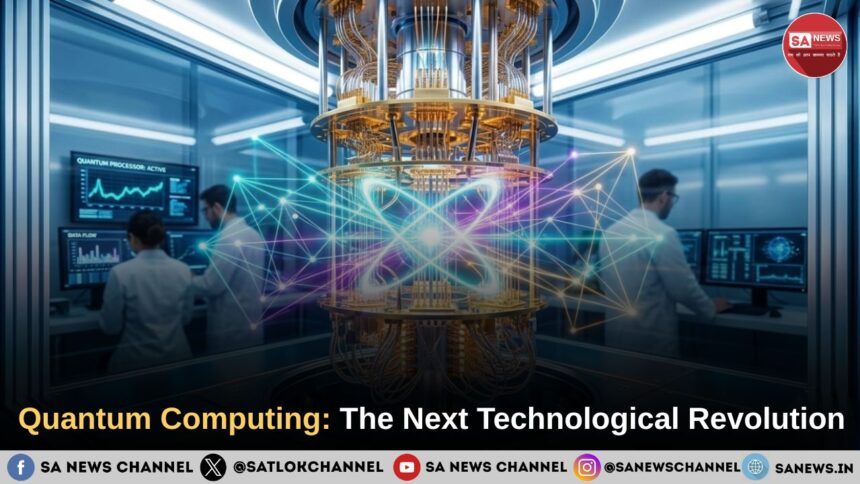
The digital world is standing on the edge of a massive transformation. For decades, classical computers have powered our homes, businesses, and space exploration using simple bits of 0s and 1s. However, as global data grows exponentially, traditional processors are hitting their physical limits. Enter quantum computing, a revolutionary paradigm shift that harnesses the mind-bending principles of quantum mechanics.
- The Next Technological Revolution: How Quantum Computing Works
- Key Applications Disrupting Modern Industries
- 1. Medical Research and Drug Discovery
- 2. Next-Generation Cybersecurity
- 3. Optimization and Supply Chain Management
- 4. Advanced Artificial Intelligence
- Challenges Facing Quantum Development
- Beyond Subatomic Particles: The Search for Ultimate Stability
- FAQs on Quantum Computing
By solving calculations in seconds that would take traditional supercomputers thousands of years, this future technology promises to disrupt industries worldwide. From healthcare to artificial intelligence, the quantum computing revolution is no longer science fiction—it is rapidly becoming our new reality.
The Next Technological Revolution: How Quantum Computing Works
To understand why quantum computing is called the next big leap, we must look at how it processes information.
Classical Bits vs. Quantum Qubits
Traditional devices rely on binary bits, which act like light switches that are either ON (1) or OFF (0). In contrast, quantum devices utilize qubits (quantum bits). Thanks to two key physical principles, qubits unlock exponential processing capacity:
Superposition: A qubit can exist as a 0, a 1, or both simultaneously. This allows a quantum processor to evaluate millions of possibilities at the same instant.
Entanglement: Two qubits can become linked so that the state of one instantly influences the other, regardless of distance. This interconnectedness allows for blazing-fast data processing.
Also Read: Quantum Computing and National Security
Because of these properties, adding more qubits increases computing power exponentially, creating an unprecedented level of computational power.
Key Applications Disrupting Modern Industries
The quantum tech ecosystem is set to redefine what is possible across multiple sectors:
1. Medical Research and Drug Discovery
Finding new pharmaceutical drugs currently takes over a decade of trial-and-error chemistry. Quantum algorithms can simulate molecular structures at the atomic level, dramatically accelerating life-saving drug discovery and personalized healthcare.
2. Next-Generation Cybersecurity
While quantum computing promises immense benefits, it also presents challenges. Quantum systems could quickly break modern RSA encryption standards. This has forced cyber experts to build post-quantum cryptography to safeguard sensitive data against future threats.
3. Optimization and Supply Chain Management
Logistics networks deal with thousands of shifting variables daily. Quantum systems excel at complex problem solving, optimizing traffic routes, shipping schedules, and resource distribution in real-time to lower carbon emissions.
4. Advanced Artificial Intelligence
Pairing quantum machine learning with AI models allows algorithms to train on massive datasets in record time, speeding up progress in autonomous vehicles, weather forecasting, and climate modeling.
Also Read: Edge Computing: Solving Latency In A Hyper-Connected World
Challenges Facing Quantum Development
Despite its immense promise, widespread adoption faces significant technological barriers:
Quantum Decoherence: Qubits are extremely sensitive. Minor fluctuations in temperature or electromagnetic radiation cause operational errors.
Extreme Environments: Most quantum processors require temperatures near absolute zero to maintain stability.
High Development Costs: Building and maintaining stable quantum hardware requires multi-million dollar investments.
Researchers are working tirelessly on fault-tolerant systems, bringing us closer to practical, everyday quantum applications.
Beyond Subatomic Particles: The Search for Ultimate Stability
As humanity pushes the boundaries of science to manipulate individual atoms, an important question arises: Will processing power ever bring true peace and stability to human life? According to the spiritual discourses of Sant Rampal Ji Maharaj, material science—no matter how advanced—only addresses the outward physical world. The sacred texts of all religions explain that the physical universe is impermanent. True, permanent stability and ultimate knowledge cannot be synthesized in a laboratory or processed by a silicon or quantum chip.
Sant Rampal Ji Maharaj emphasizes that while material technology improves temporary physical comfort, the ultimate purpose of human life is to obtain eternal peace through authentic spiritual wisdom (Satgyaan). Click this link to order your completely free copy of the sacred book ‘Gyan Ganga’ by sant rampal ji maharaj.
FAQs on Quantum Computing
1. What is quantum computing in simple terms?
It is an advanced technology that uses quantum physics to solve complex problems much faster than traditional supercomputers.
2. How is a quantum computer different from a normal computer?
Normal computers use bits (0 or 1), while quantum computers use qubits (both 0 and 1 at once) to process massive data instantly.
3. Will quantum computers replace everyday laptops?
No. They are built for high-level scientific research and complex data operations, not daily personal use.
4. Can quantum computing threaten cybersecurity?
Yes, it can potentially crack current digital security methods, which is why experts are already building quantum-safe cryptography.
5. When will quantum technology become common?
It is already available via cloud platforms, but fully mature commercial applications are expected over the next decade.