



Business Model Shifts: A sustainable business model is no longer a static blueprint; it is a dynamic, evolving engine that determines corporate survival in 2026. The rapid maturation of agentic artificial intelligence, fluctuating macroeconomic conditions, and changing buyer expectations have created an unprecedented divergence in corporate profitability. Strategies that guaranteed recurring revenue just three years ago are now eroding profit margins, while innovative monetization frameworks are scaling companies to eight-figure annual recurring revenue (ARR) at breakneck speeds.
- Winning vs. Dying Business Model Frameworks in 2026
- The Rise of Outcome-Based and Agentic Business Models
- Hybrid Monetization: The Golden Middle Ground
- Why Traditional Per-Seat and Ad-Supported Models Are Dying
- The Demise of Rigid Direct-to-Consumer (DTC) Economics
- Step-by-Step Transition Guide to Modernize Your Business Model
- The Eternal Search: Finding True Stability Beyond Economic Volatility
- FAQs on Business Model
Enterprise buyers and consumers alike are rejecting artificial barriers, inflated seat licenses, and unmeasured software subscriptions. Instead, the global market demands direct alignment between expenditure and tangible value. Organizations that adapt their underlying architecture to reflect these demands are capturing market share, while those anchored to legacy systems face accelerated stagnation.
Winning vs. Dying Business Model Frameworks in 2026
To navigate the current commercial landscape, leaders must clearly distinguish between frameworks that generate resilient cash flow and those that create friction. Market research indicates that companies aligning their revenue directly with customer utility grow significantly faster than those relying on legacy extraction tactics.
The table below outlines the core differences between thriving business architectures and dying legacy patterns operating across modern industries today.
| Business Model Category | Status in 2026 | Primary Pricing / Value Metric | Key Operational Characteristic | Representative Examples |
|---|---|---|---|---|
| Outcome-Based / Agentic | Thriving (Rapid Growth) | Per resolution, task completed, or measurable ROI | Autonomous execution via AI agents; risk-sharing | Intercom Fin ($0.99/ticket), Salesforce Agentforce |
| Hybrid Monetization | Thriving (Market Standard) | Fixed platform base + variable usage/outcome | Predictable baseline revenue paired with expansion upside | Datadog, HubSpot, Stripe |
| Usage / Consumption | Stable & Expanding | Metered throughput (GB, API calls, compute) | Zero friction entry; pay strictly for compute or data consumed | Snowflake, Twilio, Amazon Web Services |
| Pure Per-Seat SaaS | Dying / Rapid Decline | Fixed fee per human user/login per month | Penalizes productivity gains; vulnerable to AI seat reduction | Legacy CRM & Project Management tools |
| Pure Ad-Supported Web | Dying / Severe Pressure | Impression (CPM) or click (CPC) volume | Disrupted by generative AI search overviews & LLM summarization | Unfocused digital media publishers & content aggregators |
| Unfunded / Low-Margin DTC | Dying / High Mortality | Single transaction e-commerce sales | Vulnerable to skyrocketing acquisition costs & supply chain shocks | Traditional direct-to-consumer retail startups |
The Rise of Outcome-Based and Agentic Business Models
The single most disruptive development in modern commercial architecture is the rise of the outcome-based business model. Driven by autonomous AI agents capable of performing complex human tasks, software vendors are moving away from charging for access and moving toward charging for results. When an AI system can resolve a customer support issue, generate a qualified sales lead, or repair code without human intervention, charging a flat monthly software fee underestimates the value delivered.
According to enterprise software benchmarks published by Gartner, over 40% of enterprise software applications incorporate outcome-based pricing components. For example, customer service platforms like Intercom charge $0.99 per automated resolution rather than requiring companies to purchase unnecessary seat licenses. This shifts the financial risk away from the buyer and directly onto the vendor, creating unparalleled trust and acceleration in sales cycles.
Also Read: Online Business Models: A Complete Guide for Digital Entrepreneurs
Hybrid Monetization: The Golden Middle Ground
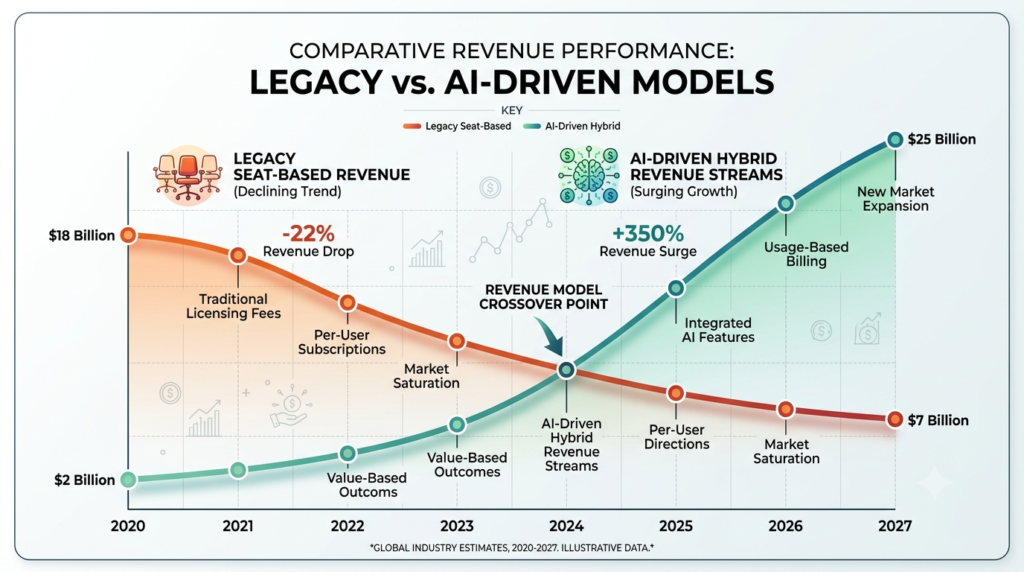
While pure outcome-based structures are appealing, they can introduce revenue volatility for vendors and budget unpredictability for enterprise buyers. Consequently, the hybrid monetization business model has emerged as the dominant financial framework across the corporate landscape.
Data from IDC Research indicates that 61% of software and platform enterprises utilize a hybrid model. This framework combines a predictable base platform fee—covering infrastructure, security, and basic maintenance—with variable consumption or performance-based add-ons.
- Predictable Foundation: Buyers secure baseline budgeting approvals through a recurring base fee.
- Value Expansion: Vendors capture upside as customer usage expands or as automated agents deliver higher volumes of work.
- Alignment of Incentives: Neither party is penalized when software efficiencies reduce total labor hours required.
Why Traditional Per-Seat and Ad-Supported Models Are Dying
The traditional per-seat subscription business model is undergoing a structural collapse. For nearly two decades, software companies grew by selling additional “seats” as client organizations hired more staff. However, artificial intelligence now allows smaller teams to achieve outputs that previously required dozens of workers. Selling software based on human headcount directly conflicts with customer efficiency.
Simultaneously, the traditional ad-supported web monetization model is facing unprecedented structural decline. Generative search engines and AI answers synthesize information directly for users, reducing traditional website click-through rates. Media organizations relying purely on display banner ads without first-party subscriptions, proprietary data assets, or deep community engagement are experiencing severe revenue contraction.
The Demise of Rigid Direct-to-Consumer (DTC) Economics
In the physical goods sector, the early direct-to-consumer e-commerce business model has lost its competitive edge. Rising customer acquisition costs (CAC) across digital advertising channels, paired with increased logistics costs, have rendered low-margin DTC brands unsustainable.
Winning physical product businesses have pivoted to omnichannel distributions, circular subscription models, and strategic marketplace partnerships. Companies operating without sustainable unit economics, robust lifetime value (LTV), or proprietary supply chain advantages are being forced out of the market.
Step-by-Step Transition Guide to Modernize Your Business Model
Transitioning an enterprise to a value-aligned monetization structure requires deliberate planning. Organizations must systematically audit their value metrics to ensure operational continuity.
- Audit Your Primary Value Metric: Determine whether your customers derive value from access, compute time, labor savings, or generated revenue.
- Instrument Comprehensive Usage Tracking: Build robust back-end telemetry to measure customer usage, API calls, or agent outcomes accurately before altering billing structures.
- Design a Simple Base-Plus-Variable Structure: Create a hybrid tier that offers budget predictability while establishing clear expansion pathways.
- Test Model Changes on New Cohorts: Roll out new pricing structures exclusively to new customer signups to analyze conversion rates and billing feedback.
- Establish Transition Windows for Legacy Clients: Provide existing customers with clear transition periods, demonstrating how value-aligned pricing lowers unit cost.
The Eternal Search: Finding True Stability Beyond Economic Volatility
While optimizing a business model provides temporary financial security and corporate success, market dynamics remain inherently volatile. True stability and eternal peace cannot be found in fluctuating market trends or material achievements. According to the profound spiritual discourses of Sant Rampal Ji Maharaj, human life possesses a far higher purpose along with engaging in economic struggles and material acquisition. His teachings explain that ultimate peace, absolute security, and freedom from suffering are attained only through genuine spiritual knowledge (Tatvagyan) and supreme devotion (Bhakti) as prescribed in holy scriptures across world religions.
To explore deeper spiritual insights and understand the ultimate purpose of human life, watch official discourses on the Official YouTube Channel of Sant Rampal Ji Maharaj.
FAQs on Business Model
What is the most successful business model pattern in 2026?
The hybrid monetization model is currently the most successful pattern across enterprise software and digital services. It combines a predictable base subscription fee with variable, usage-based or outcome-based pricing components. This structure gives buyers financial predictability while allowing vendors to capture revenue upside as customers gain value.
Why is the traditional per-seat SaaS model declining?
Per-seat SaaS models are declining because artificial intelligence and automation allow smaller teams to accomplish tasks that previously required significantly more human workers. Charging per human login penalizes clients for becoming more efficient, creating a fundamental misalignment between customer value and vendor revenue.
How does outcome-based pricing work for AI agents?
Outcome-based pricing charges customers strictly for successfully completed end results rather than software uptime or access. For example, AI platforms charge per automated customer service resolution, per qualified lead generated, or per successfully executed code deployment.
Why are pure ad-supported media business models failing?
Ad-supported media models are under severe pressure because generative AI search platforms directly answer user queries without requiring users to click through to third-party websites. This reduction in web traffic drastically cuts display ad impressions, forcing media publishers toward subscriptions, direct memberships, and first-party data monetization.
What key factor makes modern DTC e-commerce brands profitable?
Modern DTC brands achieve profitability by shifting away from pure direct-to-consumer digital channels toward omnichannel distribution, retail partnerships, and sustainable unit economics. Successful brands prioritize customer lifetime value (LTV) over acquisition metrics and focus heavily on high-margin product categories.