


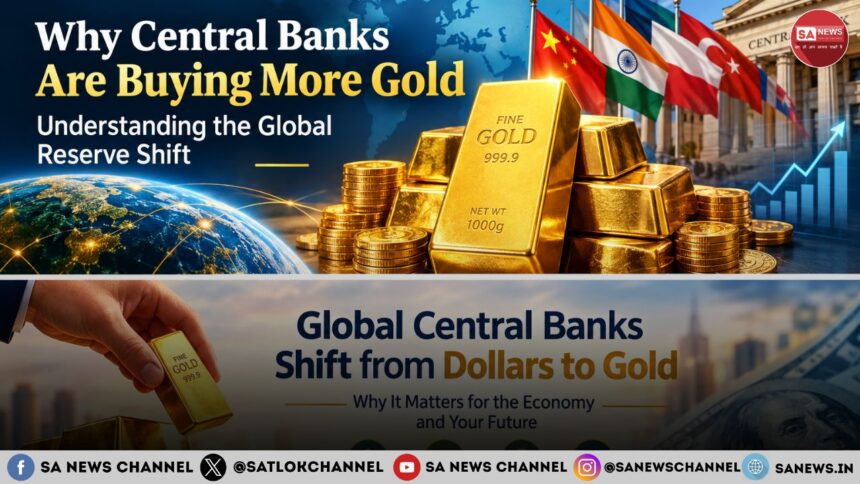
The global financial system is evolving as central banks reassess how they manage their reserves. In recent years, monetary authorities have maintained strong demand for gold while balancing their holdings of foreign currencies and other reserve assets. According to the World Gold Council, central banks added approximately 863.3 tonnes of gold to global reserves in 2025. Meanwhile, International Monetary Fund (IMF) data show that the US dollar accounted for 56.70% of global foreign exchange reserves in the second quarter of 2026.
- The Rise in Central Bank Gold Buying
- Why Are Central Banks Increasing Their Gold Reserves?
- Geopolitical Uncertainty and Sanctions Risks
- Diversification of Reserve Assets
- Inflation and Economic Uncertainty
- Concerns About Currency Concentration
- Physical Gold vs. Financial Assets
- BRICS and the De-Dollarization Debate
- How Could Central Bank Gold Buying Affect the Global Economy?
- Is the US Dollar Losing Its Dominant Position?
- Understanding Material Wealth and Spiritual Well-Being
- FAQs on Gold Market
These figures highlight two important developments: gold continues to play a significant role in reserve management, and the dollar remains the leading reserve currency. Geopolitical uncertainty, diversification, and financial stability are among the factors influencing these decisions. However, increased gold buying does not mean that all countries are abandoning the US dollar.
The Rise in Central Bank Gold Buying
Central banks have increased their gold purchases significantly in recent years. According to the World Gold Council, estimated net central bank gold purchases exceeded 1,000 tonnes annually from 2022 through 2024. In 2025, estimated net purchases reached approximately 863.3 tonnes.
Although the 2025 total was lower than the exceptional levels recorded during the previous three years, it remained well above the annual average of 473 tonnes recorded during 2010–2021.
These figures demonstrate that gold remains an important reserve asset. However, central bank purchasing patterns vary by country, and buying gold does not necessarily mean selling an equivalent amount of US dollars.
Key Statistics: Gold and Global Foreign Exchange Reserves
- Central bank gold purchases: Approximately 863.3 tonnes in 2025.
- Historical comparison: The annual average was approximately 473 tonnes during 2010–2021.
- Largest reported central bank gold buyer in 2025: Poland, which added approximately 102 tonnes.
- US dollar share of global foreign exchange reserves: 56.70% in Q2 2026, according to the IMF.
- Gold’s role: Central banks use gold as one component of their reserve diversification strategies.
These statistics refer to different reporting periods and reserve categories. The IMF’s foreign exchange reserve figures exclude monetary gold, so the dollar’s share of foreign exchange reserves should not be confused with gold’s share of total official reserve assets.
Why Are Central Banks Increasing Their Gold Reserves?
Several economic and geopolitical factors may influence central banks’ decisions to increase their gold holdings.
Geopolitical Uncertainty and Sanctions Risks
International conflicts, trade tensions, and economic sanctions can influence how governments assess their financial exposure. The freezing of some Russian foreign exchange assets following the invasion of Ukraine highlighted the importance of considering where reserve assets are held and whether they remain accessible during geopolitical disputes.
This experience increased attention to the risks associated with holding assets in foreign jurisdictions. However, countries have different circumstances, and geopolitical concerns should not be assumed to explain every central bank’s gold purchases.
Diversification of Reserve Assets
Central banks generally aim to balance safety, liquidity, accessibility, and returns when managing their reserves. Holding a variety of assets can help reduce dependence on a single currency, issuer, or financial instrument.
Gold provides an alternative to foreign currency deposits and government securities. Unlike a bond, physical gold does not depend on an issuer making scheduled interest or principal payments.Nevertheless, gold prices fluctuate, and storage, insurance, custody, and liquidity remain important considerations.
Also Read: Rethinking the Gold Standard: Why It’s No Longer the Best Asset for Your Portfolio
Inflation and Economic Uncertainty
Gold is often viewed as a potential long-term store of value. During periods of economic uncertainty, some investors and reserve managers consider it useful for diversification.
However, gold does not guarantee protection against inflation over every period. Its market price can fall, and its performance depends on purchase prices, market conditions, and the holding period.Central bank demand is only one factor influencing gold prices. Interest rates, currency movements, investment demand, and broader economic conditions also matter.
Concerns About Currency Concentration
The US dollar remains central to international trade, financial markets, and official foreign exchange reserves. Nevertheless, some countries seek to diversify their holdings to manage concentration risks.De-dollarization refers to efforts to reduce reliance on the dollar in areas such as international trade, payments, investments, and reserve management.This process is not a single coordinated global policy. It also does not necessarily mean that the dollar will lose its leading international position.
Physical Gold vs. Financial Assets
Physical gold consists of actual bullion held directly or through custody arrangements. Financial products linked to gold may include exchange-traded funds, futures contracts, and other instruments whose values are connected to gold prices.These arrangements have different characteristics and risks. Physical gold does not carry the same issuer-payment risk as a bond, but ownership, custody, transportation, storage, and legal access can still create risks.Some countries have reviewed or changed where their gold reserves are stored. However, it would be inaccurate to claim that all central banks are repatriating their gold or insisting exclusively on physical holdings within their own borders.
Gold is therefore best understood as one component of reserve management rather than a risk-free replacement for every other financial asset.
BRICS and the De-Dollarization Debate
BRICS countries have discussed greater use of local currencies and alternative payment arrangements in international trade. These discussions reflect interest in reducing certain transaction costs and dependence on established payment channels.
However, policy proposals and discussions should not be confused with fully implemented arrangements. A common BRICS gold-backed currency should not be described as an established operational reality without authoritative evidence.The future of international payments will depend on policy decisions, financial infrastructure, currency convertibility, market confidence, and cooperation between participating countries.
Local currency trade and gold reserve accumulation are related to broader discussions about financial diversification, but they are not the same process.
How Could Central Bank Gold Buying Affect the Global Economy?
Strong central bank demand can support gold prices, although it is only one of several influences. Interest rates, investor sentiment, currency movements, jewellery demand, and global economic conditions also affect the market.For individuals, rising official-sector demand does not guarantee that gold will deliver positive returns. Gold prices can rise or fall, and investors may experience losses.
Anyone considering gold as part of a personal financial plan should consider their goals, risk tolerance, liquidity needs, and investment time horizon.The broader lesson is that reserve diversification is a strategy for managing uncertainty, not proof that one asset or currency will inevitably replace another.
Also Read: Inside Sudan’s Forgotten War: Gold, Power, Ethnic Cleansing — and What Lies Beneath
Is the US Dollar Losing Its Dominant Position?
The dollar’s share of global foreign exchange reserves has changed over time, but it remains the world’s leading reserve currency.
According to the IMF, the dollar’s share stood at 56.70% in the second quarter of 2026, compared with 57.18% in the first quarter of 2026.
The quarterly decline does not, by itself, prove that central banks are selling dollars to buy gold. The IMF reported that the euro’s share increased during the same quarter, illustrating that changes in reserve composition can reflect shifts among multiple currencies and other portfolio decisions.The dollar’s international role is supported by factors including the depth and liquidity of US financial markets, its use in international transactions, and the availability of dollar-denominated financial instruments.
Although diversification may continue, the available data do not establish that the dollar is about to collapse or that gold will replace it as the dominant reserve asset.
Understanding Material Wealth and Spiritual Well-Being
In the Indian spiritual tradition, teachings attributed to Supreme God Kabir Sahib emphasize the temporary nature of worldly possessions. Sant Rampal Ji Maharaj also explains, through His spiritual teachings, the importance of distinguishing material needs from the deeper purpose of human life.
Gold, money, and other assets can support practical needs, but they cannot guarantee lasting peace or freedom from every difficulty. From a spiritual perspective, ethical conduct, contentment, and true devotion (SatBhakti) are central to a meaningful life. This perspective does not mean that financial planning or material responsibilities are unimportant. Rather, it encourages people to manage their resources responsibly without allowing greed, fear, or attachment to control their lives.
As nations reconsider the composition of their reserves, individuals can also reflect on the difference between financial security and inner well-being. Material assets have practical value, while spiritual teachings invite people to seek a deeper understanding of purpose, responsibility, and lasting peace.
FAQs on Gold Market
Q1. Why are central banks buying gold?
Central banks buy gold to diversify reserves, manage risks, and hold an alternative reserve asset.
Q2. What is de-dollarization?
De-dollarization refers to efforts to reduce reliance on the US dollar in reserves, trade, investments, or financial transactions.
Q3. Which country bought the most central bank gold in 2025?
Poland was the largest reported central bank gold buyer in 2025, adding approximately 102 tonnes, according to the World Gold Council.
Q4. Is physical gold safer than paper gold?
They have different risks. Physical gold avoids issuer-payment risk but still involves price, storage, custody, and liquidity risks.
Q5. Does central bank gold buying mean the US dollar is collapsing?
No. The US dollar remains the leading global foreign exchange reserve currency, despite efforts by some countries to diversify their reserves.