



Severe Cyclonic Storm Arnab completed its landfall process along the eastern coast of India, unleashing violent gale-force winds, sustained torrential downpours, and severe maritime storm surges across the coastal districts of Andhra Pradesh and southern Odisha. As the weather system moved inland, it rapidly inundated low-lying areas, severed vital transportation links, and uprooted trees and electric towers over a stretch of hundreds of kilometers.
Meteorological stations reported wind gusts exceeding 100 to 110 km/h during peak landfall hours. Sea conditions remained turbulent to rough, with seawater inundating agricultural fields, rural settlements, and coastal roads. The India Meteorological Department (IMD) issued red alerts for several coastal and adjacent interior districts, advising maritime operators, fishermen, and transport services to suspend all operations until the depression weakens into a deep depression and disperses inland.
Andhra Pradesh: Power Grids Shattered and Standing Crops Submerged
In Andhra Pradesh, the immediate aftermath of Cyclone Arnab revealed widespread devastation to essential public utilities. Transmission lines snapped across multiple districts, collapsing high-voltage transmission towers and damaging substations. Preliminary evaluations by state energy departments estimate structural and hardware losses in the power sector alone to exceed hundreds of crores of rupees.
Also Read: Cyclone Arnab Kills Five, Floods Crops After Hitting Andhra Pradesh
Urban hubs and rural mandals alike experienced prolonged blackouts, prompting state electricity distribution corporations to deploy specialized emergency restoration systems. Heavy mechanical saws and specialized machinery have been dispatched to clear roads obstructed by downed concrete poles and century-old trees.
Agricultural and Inundation Woes
The cyclonic rains delivered a major blow to the state’s agricultural belts. Vast expanses of paddy fields, banana plantations, coconut groves, and horticultural holdings were left submerged under knee-deep to waist-deep floodwaters. Farmers who were approaching harvest windows now face substantial crop lodging and post-submergence rot. District administrations have begun assembling revenue and agricultural assessment panels to survey loss extents once standing waters recede.
Odisha: Inundation and Massive Evacuation Drives Across Nine Districts
Emergency Sheltering and Mass Evacuations
Southern and coastal districts in Odisha—including Ganjam, Puri, Gajapati, and adjoining zones—experienced relentless, high-intensity precipitation over a 24-hour cycle. In response to swelling river basins and overflowing drainage channels, the state machinery enacted pre-emptive evacuation plans.
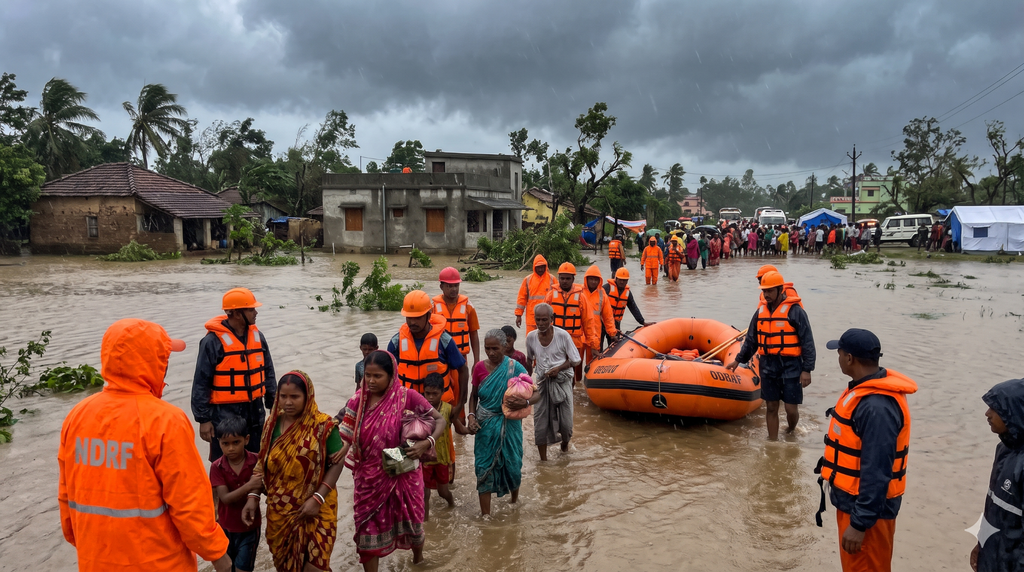
Over 50,000 residents residing in thatched houses, low-lying river plains, and vulnerable seaside hamlets were relocated to multi-purpose cyclone shelters and reinforced public facilities. These shelters have been stocked with dry rations, baby food, clean drinking water pouches, and medical dispensaries to mitigate waterborne infections.
Drainage Congestion and Transportation Cutoffs
Several state highways and major district roads suffered severe breaches due to fast-moving surface runoffs. Culverts and small bridges across hilly sections in southern Odisha were swept away or sustained heavy scour damage, isolating several interior villages. Urban centers witnessed severe waterlogging, with storm drainage lines overwhelmed by the sudden cloudburst-scale precipitation.
Also Read: Andhra Pradesh Prepares for Cyclone Montha with Full Emergency Response
National and State Disaster Response on the Ground
Multi-agency coordinated rescue and relief operations were initiated in both states ahead of and immediately following landfall:
- National Disaster Response Force (NDRF): Multiple self-contained battalions equipped with inflatable motorboats, pole cutters, tree-clearing saws, and emergency medical kits are deployed across the most vulnerable operational zones.
- State Disaster Rapid Action Forces (SDRF & ODRAF): Local disaster units are actively assisting municipal authorities in clearing major transport arteries to restore ambulance access and relief distribution lines.
- District Emergency Operation Centers (DEOCs): Operating 24/7 helplines to coordinate distress calls, organize food distribution packets, and direct medical teams to waterlogged villages.
State disaster mitigation commissioners have noted that while the storm’s physical fury caused substantial structural and agricultural damage, high-density casualties were averted through early tracking, structured alerts, and prompt evacuations.
Natural Calamities, Cosmic Authority, and the True Shelter
While modern meteorology can only monitor the destructive symptoms of natural calamities, the eternal philosophy of Satgyan revealed by Jagatguru Tatvdarshi Sant Rampal Ji Maharaj explains that periodic disasters like cyclones and floods are inherent upheavals of Brahm-Kaal’s perishable realm, where mortal science holds no authority over karmic destiny.
Fulfilling global prophecies—including the American seer Florence’s vision of an Indian sage destined to command Prakritik Parivartan (natural changes) to avert global catastrophes, and Nostradamus’s forecast of the world saviour “Chyren”—Sant Rampal Ji Maharaj proves through holy scriptures that only the true worship of Supreme God Kabir provides absolute spiritual shelter against untimely death, offering ultimate liberation from natural fury to the eternal, sorrowless abode of Satlok.
FAQs About Cyclones
Q1: How do cyclones form?
A: Warm ocean water (26.5°C or higher) evaporates rapidly, creating a low-pressure zone that pulls in surrounding air, which spirals upward due to Earth’s rotation.
Q2: What is the difference between a Cyclonic Storm and a Severe Cyclonic Storm?
A: Wind speed. A standard cyclonic storm has sustained winds of 62–88 km/h, while a severe cyclonic storm reaches 89–117 km/h.
Q3: What is a storm surge?
A: A sudden, destructive rise in sea level pushed inland by hurricane-force winds and low atmospheric pressure during landfall.
Q4: Why does a cyclone weaken after landfall?
A: Moving over land cuts off the warm ocean moisture that fuels the storm, while ground friction disrupts its rotational wind structure.
Q5: What are the primary safety rules during landfall?
A: Remain indoors away from windows, disconnect main electricity and gas lines, and stay clear of floodwaters and downed electrical cables.