

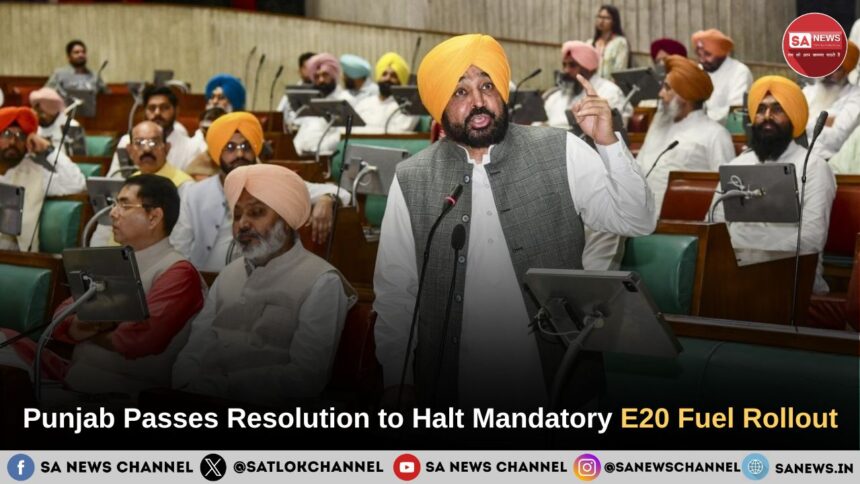
Chandigarh — On August 4, 2026, the Punjab Assembly took a united and decisive stand on a rapidly growing concern for Indian motorists. The state’s legislative body unanimously passed a resolution urging the Central government to review and suspend the mandatory rollout of E20 petrol, a blend containing 20% ethanol. The state leadership argued that the immediate enforcement of this policy leaves vehicle owners, particularly those with older car models, vulnerable to expensive engine damage and reduced fuel efficiency.
While the transition to greener energy is a vital national priority, the Punjab government’s resolution brings forth critical questions about consumer choice, mechanical safety, and the economic burden on the common man.
Key Takeaways from the Punjab Assembly Resolution
- The resolution was formally moved by Punjab Finance Minister Harpal Singh Cheema during the monsoon session.
- Lawmakers fiercely questioned the Centre’s decision to advance the E20 implementation deadline to April 2026 instead of the original 2030 target.
- The House demanded that consumers must have the explicit option to choose between pure, ethanol-free petrol and the E20 blend at fuel stations.
- Chief Minister Bhagwant Mann alleged that the rushed policy serves a trade agreement intended to increase ethanol imports from the United States.
- The Assembly called for an independent expert committee of automobile engineers and environmental scientists to study the real-world impact of 20% ethanol blending.
The Core Issue: Engine Compatibility and Mileage
The crux of the anxiety surrounding E20 fuel lies in the mechanical readiness of the millions of vehicles currently on Indian roads. Vehicles manufactured before E20-compatible engines became standard were largely built to handle only up to 10% ethanol.
Finance Minister Harpal Singh Cheema highlighted that forcing E20 into older engines accelerates the wear and tear of vital fuel system components. The resolution officially noted that this mandatory shift would likely result in reduced fuel efficiency, increased maintenance costs, possible warranty disputes, and a steep decline in vehicle resale value. Chief Minister Bhagwant Mann bolstered this point, stating that even the Central government has admitted in Parliament that E20 petrol negatively impacts vehicle mileage. Citing a survey of over 45,000 vehicles, Mann claimed that 67% of owners reported a significant mileage drop, and 45% complained of engine damage after using the blended fuel.
Economic and Environmental Concerns
Beyond the mechanical wear and tear, the Assembly raised severe economic allegations. Mann claimed that the sudden mandate caters to a trade agreement with the United States. According to the Chief Minister, India is set to increase its ethanol imports five-fold from roughly one billion to five billion litres over the next five years benefitting the U.S., which already produces 60% of the world’s ethanol while India produces only 5%.
On the environmental front, Cheema raised an alarm specifically relevant to the state. He warned that massive domestic ethanol production consumes exorbitant amounts of water, posing a severe threat to Punjab’s already depleted and fragile groundwater table.
Also Read: E100 in India: Clearing the Confusion on 100% Ethanol Fuel, Flex-Fuel Vehicles, and the Road Ahead
A Balanced Approach: The Opposition’s Stance
The resolution saw a rare moment of unity, passing via voice vote with support from the opposition Congress. However, the debate maintained a balanced, critical edge. Congress legislator Rana Gurjeet Singh pointed out that ethanol blending is a global alternative fuel strategy, successfully utilized by countries like Brazil for decades. He urged the government not to dismiss biofuel outright but supported the demand for an in-depth scientific study.
Meanwhile, Congress MLA Pargat Singh pressed the Aam Aadmi Party (AAP) government to walk the talk. He argued that if the state government truly wished to protect motorists from financial strain, it should immediately slash the state Value Added Tax (VAT) on petrol. Singh stated that lowering VAT would provide concrete, immediate relief to the middle class rather than just passing resolutions against the Central government.
Ultimately, the Punjab Assembly is demanding a pause. The resolution formally requests the Centre to publish all technical evaluations and economic studies regarding E20’s impact before making it the sole fuel available at the pumps.
Beyond: The Choice That Shapes Our Life
Tatvadarshi Sant Rampal Ji Maharaj teaches that human beings face an even greater choice: what path we choose for our soul.
According to true spiritual knowledge, worldly life is temporary, and human beings often remain trapped in desires such as Kaam (lust), Krodh (anger), Lobh (greed), Moh (attachment), and Ahankar (ego). These inner tendencies can keep a person bound to the cycle of birth and death. Sant Rampal Ji Maharaj explains, through scriptural references, that understanding the true spiritual knowledge and following the prescribed method of devotion to the Supreme God is essential for attaining liberation.
Just as the right fuel matters for a vehicle’s journey, Sant Rampal Ji Maharaj emphasizes that true spiritual knowledge matters for the soul’s journey. The ultimate goal, according to His teachings, is to attain Satlok, the eternal abode of the Supreme God Kabir Saheb, and become free from the cycle of birth and death.
To explore this spiritual knowledge and understand the purpose of human life, download the Sant Rampal Ji Maharaj App for free spiritual discourses, sacred literature, and scriptural knowledge.
FAQs Related To Punjab Assembly Resolution
1. What is E20 fuel?
E20 fuel is a specific blend of standard petrol mixed with 20% ethanol. Ethanol is an agricultural byproduct (biofuel) often made from crops, aimed at reducing a country’s reliance on crude oil imports and lowering certain emissions.
2. Why did the Punjab Assembly pass a resolution against E20?
The Punjab Assembly unanimously passed a resolution urging the Centre to pause the mandatory rollout of E20 petrol. State leaders argue that forcing E20 into older vehicles that were not designed for it causes engine damage, reduces fuel mileage, and increases maintenance costs.
3. When is the deadline for the mandatory E20 rollout?
The Central government advanced the nationwide mandatory implementation of 20% ethanol blending (E20 petrol) to April 2026, heavily pulling back the original target of 2030.
4. What are the environmental and economic concerns raised by Punjab?
Finance Minister Harpal Singh Cheema claimed that domestic ethanol production demands massive amounts of water, threatening Punjab’s depleting groundwater. Additionally, Chief Minister Bhagwant Mann alleged the policy is tied to an agreement that will increase ethanol imports from the United States five-fold over the next five years.
5. What is the alternative solution proposed by the Punjab Assembly?
The Assembly has demanded that the Centre give consumers the explicit option to choose between ethanol-free petrol and E20 fuel at all pumps. They also requested the formation of an independent committee of technical experts and scientists to study the true impact of E20 on vehicles.