

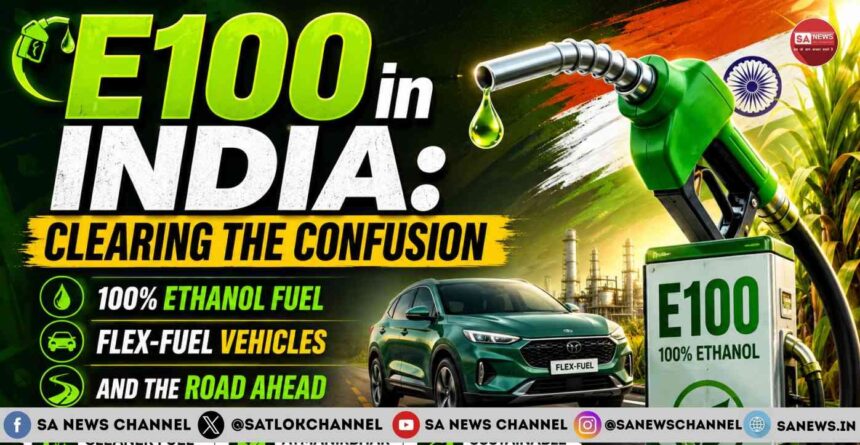
E100 Fuel in India Explained: India’s journey toward cleaner and more self-reliant transportation has entered a new phase. In June 2026, Union Road Transport and Highways Minister Nitin Gadkari announced that regulations recognising E100 (100% ethanol) as a vehicle fuel had been approved. The announcement immediately sparked curiosity and confusion among millions of vehicle owners across the country.
- Understanding Ethanol Blends
- Policy Background: Why is India Promoting Ethanol?
- What Exactly is E100?
- Why Does E100 Give Lower Mileage?
- What is a Flex-Fuel Vehicle (FFV)?
- Current and Upcoming Flex-Fuel Vehicles in India
- Will Every Petrol Pump Sell E100?
- Benefits of E100
- Challenges and Public Concerns
- E100 vs Electric Vehicles
- Common Myths About E100
- Timeline of India’s Ethanol Journey
- The Quest for Perfect Fuel: Clearing the Ethanol Confusion
- Beyond Transitory Blends: The Eternal Fuel for the Soul
- FAQs on E100 in India
Many people began asking practical questions: Can I use E100 in my existing car or bike? Will it damage my engine? Is E100 compulsory? Will petrol disappear? Will it reduce fuel expenses? How is it different from the E20 petrol already available at fuel stations?
The simple answer is this:
No, you cannot use E100 in your existing petrol vehicle unless it has been specifically designed as a Flex-Fuel Vehicle (FFV). Using E100 in a normal petrol vehicle can damage the fuel system and engine components.
This article answers the most common questions about E100 in simple language, explains why the government is promoting it, discusses its benefits and challenges, explores the future of flex-fuel vehicles in India, and clears several misconceptions surrounding India’s next major fuel transition.
Understanding Ethanol Blends
Many people are unfamiliar with ethanol blend terminology. The letter “E” simply represents ethanol, while the number indicates the percentage of ethanol mixed with petrol.
E20 petrol is already being supplied at many fuel stations across India and is gradually becoming the standard fuel. E100, however, is completely different. It contains only ethanol without any petrol and can only be used in specially designed flex-fuel vehicles.
Policy Background: Why is India Promoting Ethanol?
India imports a large share of its crude oil requirements, making the country vulnerable to global oil price fluctuations and geopolitical uncertainties. Every year, India spends lakhs of crores of rupees on crude oil imports.
To reduce this dependence, the Government of India launched the Ethanol Blending Programme (EBP), encouraging ethanol production from sugarcane, molasses, maize, damaged food grains, and agricultural residues.
The National Policy on Biofuels, 2018 laid the foundation for increasing ethanol blending in petrol. India successfully accelerated the rollout of E20 fuel ahead of its original targets.
The next stage of this journey began in 2026 when the Ministry of Road Transport and Highways amended the Central Motor Vehicles Rules to legally recognise E85 and E100 fuels for compatible vehicles.
The broader objectives behind this move include:
• Reducing crude oil imports
• Improving India’s energy security
• Supporting farmers by creating additional demand for agricultural feedstocks
• Lowering vehicle emissions
• Promoting domestic manufacturing under the Atmanirbhar Bharat and Viksit Bharat initiatives
Also Read: Ethanol Blending in India: Policy, Benefits, 2030 Targets & Impact on Sustainable Transport
What Exactly is E100?
E100 is fuel made entirely from ethanol.
Unlike petrol, ethanol is an alcohol-based renewable fuel produced primarily from plant materials. Since plants absorb carbon dioxide while growing, ethanol is often considered a cleaner alternative to fossil fuels when evaluated over its complete life cycle.
Ethanol also possesses a significantly higher octane rating than petrol, allowing engines specifically designed for ethanol to operate efficiently with improved combustion characteristics.
However, petrol is heavier than ethanol in terms of energy density, it means ethanol carries less energy as compared to petrol. This is one of the most important facts consumers should understand.
Why Does E100 Give Lower Mileage?
Many people assume that higher octane fuel automatically delivers better mileage. That is not true.
Although ethanol burns efficiently, each litre contains less usable energy compared to petrol. As a result, an engine requires more ethanol to produce the same amount of power.
Consequently, vehicles running on E100 generally deliver around 20–30 percent lower fuel economy than identical vehicles running on petrol.
However, this does not automatically mean higher running costs.
If E100 is priced sufficiently lower than petrol, the overall cost per kilometre may remain comparable or even become cheaper. The final economics will depend on future fuel pricing, taxation policies, and regional availability.
Can I Use E100 in My Existing Car or Bike?
No.
This is perhaps the most important point for every vehicle owner.
Existing petrol vehicles—including E20-compatible vehicles—are not designed to operate on E100.
Using pure ethanol in a standard petrol vehicle may lead to:
• Corrosion of fuel lines
• Damage to rubber seals and hoses
• Injector deterioration
• Fuel pump failure
• Poor engine performance
• Starting difficulties
• Long-term engine damage
Unless your manufacturer specifically certifies your vehicle as a Flex-Fuel Vehicle (FFV), E100 should never be used.
What is a Flex-Fuel Vehicle (FFV)?
A Flex-Fuel Vehicle is specially engineered to operate on multiple ethanol blends ranging from normal petrol to E100.
Unlike ordinary petrol vehicles, FFVs automatically detect the ethanol percentage in the fuel and adjust engine parameters accordingly.
Major engineering changes inside FFVs include:
• Ethanol-resistant fuel lines
• Corrosion-resistant injectors
• Stainless steel fuel system components
• Ethanol-compatible rubber hoses and seals
• Advanced engine control software
• Ethanol concentration sensors
• Modified fuel pumps
• Optimised ignition timing
• Special engine calibration
These modifications allow the engine to safely handle pure ethanol without suffering damage.
Can Flex-Fuel Vehicles Run on Petrol?
Yes.
This is one of the biggest advantages of FFVs.
A flex-fuel vehicle can operate on:
• Petrol
• E20
• E85
• E100
The onboard computer automatically adjusts fuel delivery and ignition timing according to the fuel present in the tank.
This flexibility allows owners to refuel with whichever compatible fuel is available.
Also Read: India’s Big Ethanol Gamble: Can 100% Fuel Redefine Energy Security?
Current and Upcoming Flex-Fuel Vehicles in India
Several manufacturers have already begun introducing flex-fuel technology.
As of mid-2026:
- Maruti Suzuki has introduced a flex-fuel version of the WagonR.
- Hero MotoCorp has launched multiple flex-fuel compatible motorcycles and scooters.
- Toyota has showcased an electrified flex-fuel Innova with plans for commercial introduction.
- Tata Motors has announced that its first flex-fuel passenger vehicle is under development.
- Hyundai, MG Motor, Suzuki and several other manufacturers are also preparing future FFV models as regulations become fully operational.
Industry experts expect two-wheelers to witness faster adoption because of their large market share and comparatively lower manufacturing costs.
Will Every Petrol Pump Sell E100?
No.
The rollout will happen gradually.
Initially, E100 is expected to be available only at selected fuel stations, especially in regions with strong ethanol production such as Maharashtra, Uttar Pradesh and a few other states.
Dedicated dispensing infrastructure will be required because E100 cannot simply share the same storage and distribution systems as conventional petrol.
Over time, as the number of FFVs increases, fuel retailers are expected to expand E100 availability.
Government agencies are likely to implement the rollout in phases rather than nationwide from the beginning.
Benefits of E100
Energy Security
Reduced dependence on imported crude oil strengthens India’s long-term energy security and protects the economy from international oil price volatility.
Support for Farmers
Higher ethanol production creates additional demand for sugarcane, maize, damaged grains and agricultural residues, generating new income opportunities for farmers and rural industries.
Cleaner Emissions
Compared to conventional petrol, ethanol generally produces fewer particulate emissions and lower lifecycle greenhouse gas emissions.
Domestic Manufacturing
Greater adoption of FFVs could encourage domestic production of engines, fuel systems and related automotive components.
Economic Savings
Lower crude oil imports can potentially save significant foreign exchange while strengthening India’s overall energy resilience.
Challenges and Public Concerns
Despite its advantages, E100 also presents several challenges.
Lower Mileage
Since ethanol contains less energy per litre, fuel economy decreases compared to petrol.
Water Consumption
Sugarcane cultivation requires substantial water, raising concerns about sustainability in drought-prone regions.
Food vs Fuel Debate
Critics argue that agricultural land should prioritise food production rather than fuel. Policymakers respond that increasing use of damaged grains, maize and agricultural residues can reduce this concern.
Infrastructure Costs
Fuel stations require separate storage tanks, dispensing systems and logistics infrastructure before E100 becomes widely available.
Consumer Awareness
Many vehicle owners remain unaware that E100 cannot be used in ordinary petrol vehicles. Public education will therefore be essential.
E100 vs Electric Vehicles
Some consumers wonder whether they should wait for flex-fuel vehicles instead of purchasing electric vehicles.
The two technologies serve different purposes.
Electric vehicles eliminate tailpipe emissions and depend on charging infrastructure.
Flex-fuel vehicles continue using internal combustion engines but rely on renewable fuels instead of fossil petrol.
Rather than competing directly, both technologies are expected to contribute simultaneously toward India’s broader clean mobility goals.
Common Myths About E100
Myth: I can fill E100 in any petrol vehicle.
Reality: Only certified flex-fuel vehicles can safely use E100.
Myth: E100 completely eliminates pollution.
Reality: Tailpipe emissions reduce, but ethanol production still has environmental impacts including land use and water consumption and may be air pollution to certain levels.
Myth: Petrol vehicles will disappear immediately.
Reality: Petrol will continue to remain available, might be E20 as the basic fuel only, for many years alongside higher ethanol blends.
Myth: E100 is compulsory.
Reality: The government has approved regulations for E100-compatible vehicles, but existing petrol vehicle owners are not required to switch.
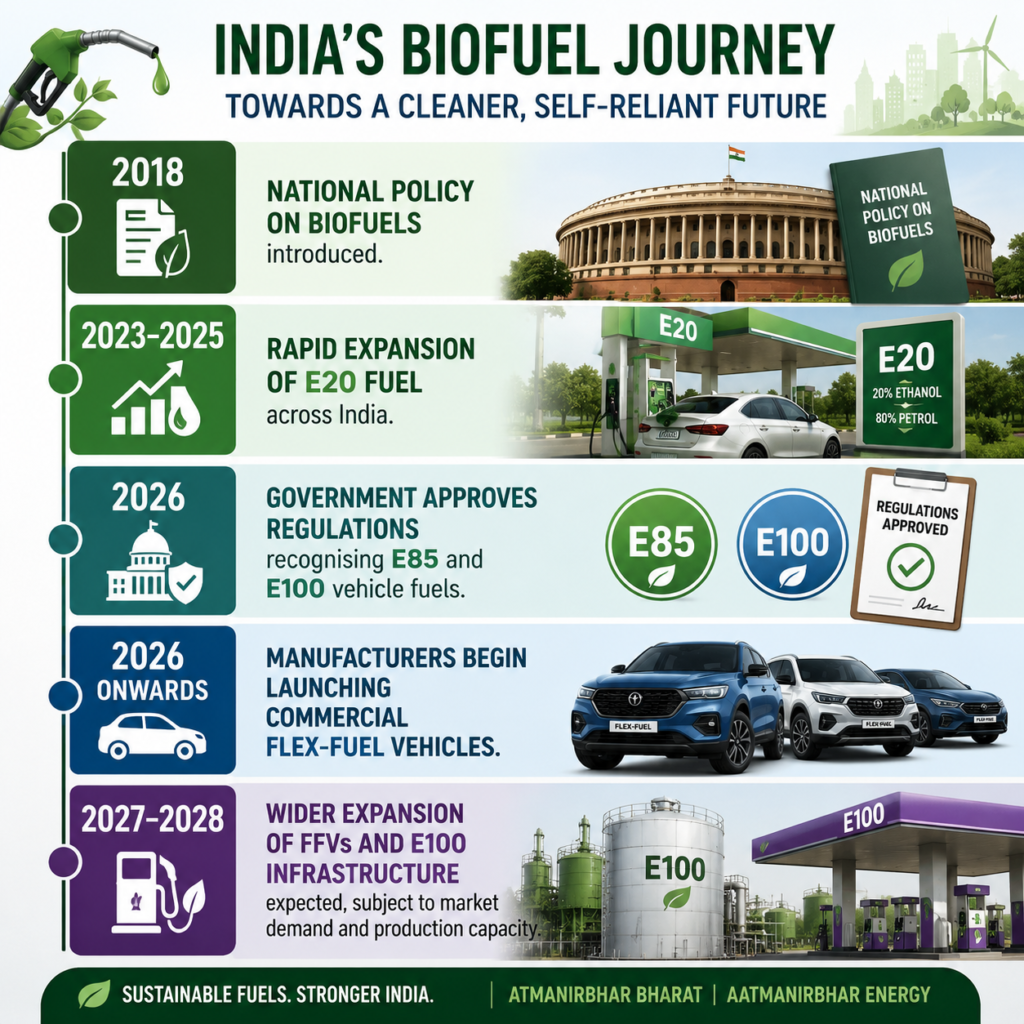
Timeline of India’s Ethanol Journey
2018 – National Policy on Biofuels introduced.
2023–2025 – Rapid expansion of E20 fuel across India.
2026 – Government approves regulations recognising E85 and E100 vehicle fuels.
2026 onwards – Manufacturers begin launching commercial flex-fuel vehicles.
2027–2028 – Wider expansion of FFVs and E100 infrastructure expected, subject to market demand and production capacity.
(AI Generated)
The Quest for Perfect Fuel: Clearing the Ethanol Confusion
India’s recent approval of E100 regulations and the introduction of 100% ethanol flex-fuel vehicles mark a significant milestone in our search for alternative, cleaner energy sources. While automakers prepare advanced engines to withstand higher ethanol blends, everyday commuters find themselves caught in a maze of confusion regarding fuel efficiency, engine corrosion, and rising vehicle costs. We continuously redesign our machinery, switching from fossil fuels to biofuels, hoping to create a sustainable and self-reliant road ahead.
But have we ever paused to ask ourselves: are we merely switching the source of our energy while remaining trapped in the same loop of physical limitations? Why does humanity constantly have to innovate just to stay afloat against resource depletion? We calibrate engines to detect shifting fuel blends automatically, yet we struggle to regulate the shifting anxieties of our own minds. This makes us wonder—if our ultimate goal is absolute freedom and a smooth journey, can any worldly engineering ever truly eliminate the friction, decay, and eventual breakdown of human life?
Beyond Transitory Blends: The Eternal Fuel for the Soul
The truth is that our relentless pursuit of cleaner fuel reflects a deeper, subconscious longing for a state of existence that is pure, frictionless, and completely inexhaustible. Just as a conventional vehicle suffers damage if forced to run on an incompatible fuel blend, the human soul experiences constant suffering and spiritual corrosion when fueled by temporary materialistic pursuits and unauthentic methods of worship. Jagatguru Tatvdarshi Sant Rampal Ji Maharaj uncovers the ultimate spiritual reality that this entire material world is inherently perishable.
No matter how efficiently we blend our fuels or upgrade our technology, everything within the twenty-one universes of Kaal Brahm is destined to degrade. Highlighting this transience, Sant Garibdas Ji Maharaj states in his sacred verses:
“Drishti pade so dhokha re. Khand pind brahmand chalenge thir nahi rahsi loka re. thir nahi rahsi loka re.”
Sant Rampal Ji Maharaj clarifies that true sustainability cannot be found in a world built on decay. The complete answer to humanity’s quest for an uncorrupted, eternal life lies in reviving our connection with the Supreme Creator, God Kabir. By adopting the authentic, scripture-based method of true worship granted by a Complete Saint, the soul receives the divine energy required to transcend this mortal realm and return to Satlok—our eternal home of absolute abundance, free from birth, death, and suffering.
Are you ready to upgrade your life’s journey with the ultimate spiritual fuel that never diminishes? Experience the eye-opening spiritual discourses of Jagatguru Tatvdarshi Sant Rampal Ji Maharaj to clear all confusion about your true purpose.
Website: www.jagatgururampalji.org
YouTube: Sant Rampal Ji Maharaj
Facebook: Spiritual Leader Saint Rampal Ji
‘X’ handle: @SaintRampalJiM
FAQs on E100 in India
Can my current petrol car use E100?
No. Only manufacturer-certified Flex-Fuel Vehicles can safely operate on E100.
Can E20-compatible cars use E100?
No. E20 compatibility does not mean E100 compatibility.
Will E100 damage my engine?
Yes, if your vehicle is not specifically designed for it.
Will E100 be cheaper?
Final pricing will depend on government policy, taxes and production costs. Lower fuel prices may offset the reduction in mileage.
Will petrol disappear?
No. Petrol is expected to remain available alongside ethanol blends for many years but may be in the form of 20% blended ethanol.
Is ethanol made only from sugarcane?
No. Ethanol can also be produced from maize, damaged food grains, molasses and agricultural residues.