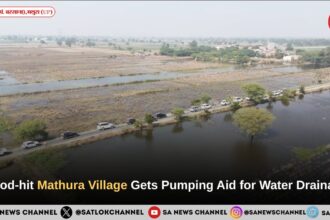


Silana village, located within the Kharkhoda tehsil of Sonipat district in Haryana, has experienced severe waterlogging during the annual monsoon seasons. According to documented statements from local cultivators, large volumes of rainwater systematically accumulate across hundreds of acres of low-lying farmland.
- Route Alterations and Phase-2 Infrastructure Demands
- Drone-Aided Aerial Mapping and Revised Technical Assessment
- Infrastructure Specifications of Dispatched Supplemental Assets
- Project Execution Protocols and Verification Framework
- Logistical and Structural Profile of the Silana Drainage Project
- Community Handover and Local Comparative Perspectives
- Long-Term Agricultural Reclamation and Economic Stabilization of Silana
This recurring stagnation has resulted in extensive crop failures across both the Rabi and Kharif agricultural cycles. Local farmers highlighted that a specific low-lying section of the village, commonly referred to as the lake area, regularly traps water over a continuous span of more than 80 acres.
The depth and duration of the waterlogging have historically prevented multiple farmers from initiating the timely sowing of seasonal wheat crops. The consecutive loss of crop yields across several years has systematically compounded the financial debts of the local agricultural community.
Prior attempts by community members to seek assistance through administrative channels involved visiting government offices in Sonipat over multiple days, which resulted in the allocation of only five state pipes, of which two were broken and unusable.
Route Alterations and Phase-2 Infrastructure Demands
The Gram Panchayat of Silana had previously petitioned for assistance, which resulted in an initial allocation of 13,500 feet of water drainage pipeline and two 10 Horsepower (HP) electric pumping motors.
While the implementation of this initial infrastructure array was underway, local structural deviations and route alterations required the pipeline to cover greater physical distances than originally calculated.
Consequently, the initial pipeline allocation fell short of reaching the designated discharge point, leaving several low-lying agricultural zones unaddressed.
To resolve this remaining infrastructure gap, a formal village delegation consisting of the Sarpanch, Gram Panchayat representatives, and local farmers presented a secondary petition directly at Satlok Ashram, seeking a supplemental allocation to finalize the drainage network.
Drone-Aided Aerial Mapping and Revised Technical Assessment
Upon receiving the secondary petition from the Silana delegation, Sant Rampal Ji Maharaj directly issued an immediate executive order to conduct a comprehensive technical field survey. The technical assessment team arrived in Silana village on the exact same day the petition was filed to interface with the waiting community.
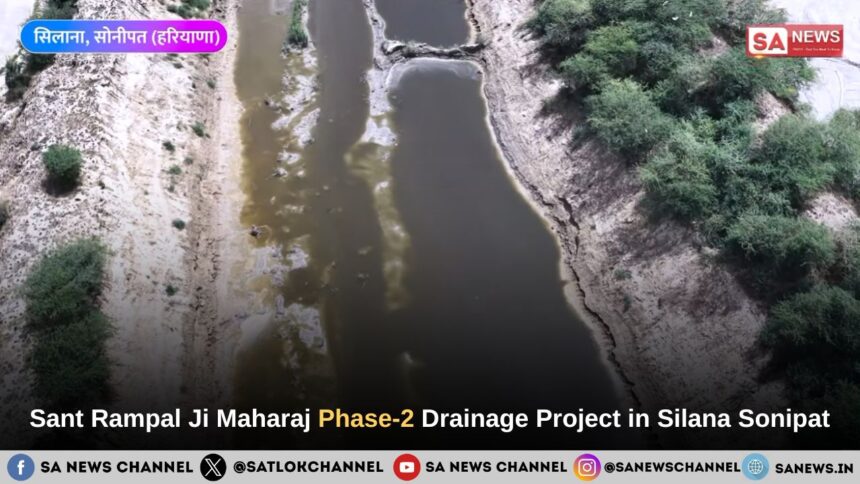
To eliminate errors in distance measurement and map the terrain accurately, the technical team deployed advanced digital drone technology under the direct guidelines of Sant Rampal Ji Maharaj.
The aerial drone was launched from the primary water accumulation collection point and flown along the proposed pathway to the final discharge point at Drain Number Eight (Drain No. 8). To ensure absolute accuracy in tracking the physical distance from the air, local farmers positioned themselves at the final discharge point and waved a signal flag, which was captured by the drone’s camera. The multi-point survey generated the following infrastructural data:
- A deficiency of 2,500 feet of piping was verified along the previously altered main lines.
- A requirement of 5,300 feet of pipeline was calculated to connect an entirely new water accumulation point to the main drain.
- A requirement of 800 feet of pipeline was recorded for a separate small waterlogging pocket.
- The total supplemental infrastructure requirement was calculated at exactly 7,800 feet of additional pipeline and one extra 10 HP electric motor.
Infrastructure Specifications of Dispatched Supplemental Assets
Following the submission of the drone survey documentation, Sant Rampal Ji Maharaj directly authorized the immediate release and transport of the complete supplemental material inventory. The logistical transport convoy arrived at Silana village within 24 hours of the initial ashram petition. The distributed technical inventory included:
- Conduit Infrastructure: Exactly 7,800 feet of heavy-duty, 8-inch diameter PVC drainage piping.
- Adhesive Consumables: Industrial-grade Fevicol SR solvent adhesive compounds to establish completely airtight and watertight joints.
- Fittings and Hardware: High-strength pipe bends (elbows), coupling joints, locking chains, connection plates, nuts, and bolts.
- Pumping Machinery: One heavy-duty electric water pumping motor rated at an operating capacity of 10 Horsepower (HP).
Project Execution Protocols and Verification Framework
The delivery team executed the formal handover of all technical assets to the Silana Gram Panchayat under strict execution terms. Sant Rampal Ji Maharaj directed a structured, multi-stage protocol to regulate the completion of the drainage utility:
- Civil Work Mandate: The Silana agricultural committee and village residents are required to mobilize local tractors, machinery, and community labor to excavate trenches and bury the entire 7,800-foot pipeline array underground.
- Secondary Verification: Upon the physical alignment and completion of the underground pipe laying, the village council must formally notify the central survey team.
- Machinery Delivery: The technical survey team will return to the site to inspect the buried pipeline network. Following a successful structural verification, the newly authorized 10 HP electric motor will be formally delivered to the village for permanent installation.
- Public Ownership: The distribution team confirmed that all provided materials from both phases represent a permanent, irrevocable public asset belonging entirely to the village of Silana.
Logistical and Structural Profile of the Silana Drainage Project
| Project Parameters and Components | Verified Documented Specifications |
| Geographic Location | Silana Village, Kharkhoda Tehsil, Sonipat District, Haryana |
| Primary Flooding Zone | Low-Lying Lake Area Spanning Over 80 Acres |
| Final Water Discharge Destination | District Drain Number Eight (Drain No. 8) |
| Operational Campaign Context | Kisan Mazdoor Bachao Abhiyan (Phase-2 / फेज़ 2) |
| Survey Methodology | Digital Aerial Drone Mapping and Synchronized Ground Signaling |
| Phase-2 Authorized Pipeline | Exactly 7,800 Feet (2,500ft pending + 5,300ft new line + 800ft small pocket) |
| Pipeline Diameter Specification | 8 Inches (Heavy-Duty PVC Piping) |
| Supplied Joint Accessories | Fevicol SR, Bends, Handi, Joint Plates, Nuts, Bolts, and Chains |
| Phase-2 Motor Authorization | 1 Unit (10 Horsepower Capacity) |
| Cumulative Project Assets Delivered | Total of 21,300 Feet of Pipeline and 3 Pumping Motors |
| Logistical Delivery Velocity | Completed Within 24 Hours of the Official Ashram Petition |
Community Handover and Local Comparative Perspectives
The arrival of the material convoy in Silana village drew a large public assembly of local cultivators, elders, women, and youth groups. The community organized a welcoming procession through the village streets using local tractors, accompanied by the playing of traditional drums (dhol-nagada).
The village leadership officially received the vehicles, and the Sarpanch placed ceremonial garlands on the portrait of Sant Rampal Ji Maharaj to mark institutional appreciation.
Local farmers, including Rajesh, Sandeep, and Jagbir Singh, contrasted this rapid 24-hour turnaround with their historical experiences with administrative state offices, noting that past official promises resulted in months of delays and defective equipment.
The residents stated that this intervention directly rescues their multi-acre fields from annual destruction, providing a practical solution where previous external assistance was absent.
Long-Term Agricultural Reclamation and Economic Stabilization of Silana
Sant Rampal Ji Maharaj directly resolved a multi-year structural drainage failure in Silana by establishing a comprehensive, 21,300-foot network backed by 30 HP of collective pumping capacity. The underground 8-inch infrastructure ensures the rapid evacuation of seasonal floodwaters into Drain Number Eight, preventing prolonged water stagnation.
By keeping the topsoil free from extended submergence, this system preserves the arable soil quality and enables the community to adhere to optimal sowing schedules for both the Kharif and Rabi crop cycles. Eliminating the annual destruction of standing crops will directly reduce the community’s reliance on high-interest agricultural loans, stop the forced sale of family landholdings, and secure a predictable economic future for generations of farming families in the region.