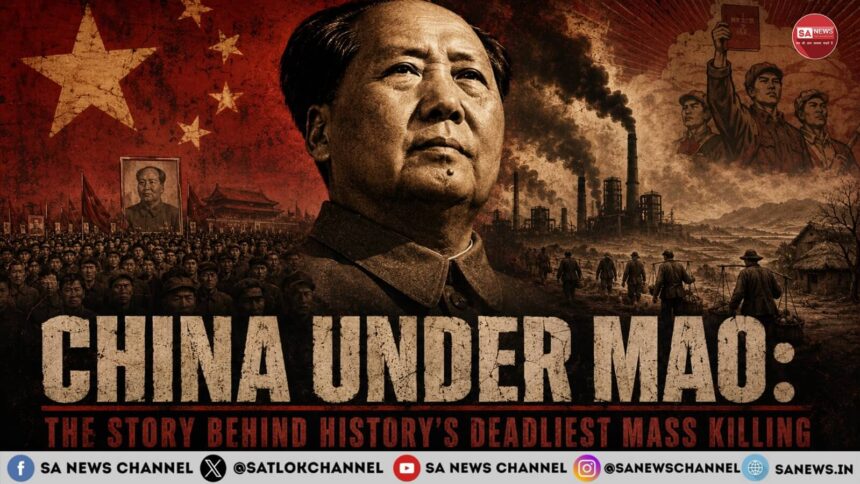
Imagine waking up in a country where a single order could decide whether you lived or died. Villages vanished, families were torn apart, and millions starved while the government promised a glorious future. Under Mao Zedong’s rule, China became the stage for one of the deadliest human catastrophes ever witnessed. Behind grand speeches and revolutionary dreams lay famine, terror, purges, and unimaginable suffering that claimed tens of millions of lives. How did an entire nation descend into such horror? What really happened behind the walls of Communist China? This is the chilling story behind history’s deadliest mass killing.
- Who Was Mao Zedong and How Did He Rise to Power
- The Early Campaigns: Land Reform and Political Purges
- The Great Leap Forward: China’s Deadliest Experiment
- Why the Famine Happened: Policy, Not Nature
- The Cultural Revolution: A Different Kind of Violence
- Comparing the Estimates: A Data Overview
- The Official Record and Why Numbers Stay Contested
- Mao’s Legacy in Modern China
- Conclusion: Learning From History’s Weight
Between 1958 and 1976, one man’s political vision reshaped China and produced what many historians now call the deadliest peacetime catastrophe in human history. The scale of Mao Zedong mass killing during this period remains staggering even by the brutal standards of the twentieth century. Estimates of total deaths under his rule range from 15 million to over 70 million people.
This is not a footnote in a history textbook. It is one of the most consequential and least understood chapters of the modern world. Millions starved. Millions more were persecuted, imprisoned, or driven to suicide. Entire villages disappeared from official records.
This article traces how Mao Zedong’s policies, from land reform through the Great Leap Forward to the Cultural Revolution, produced this death toll. It draws on archival research, demographic studies, and testimony collected by historians who have spent decades piecing together what actually happened inside China’s closed borders.
Who Was Mao Zedong and How Did He Rise to Power
Mao Zedong was born in 1893 in Shaoshan, Hunan, the son of a relatively prosperous peasant family. He supported Chinese nationalism early in life and was particularly influenced by the Xinhai Revolution of 1911 and the May Fourth Movement of 1919, before adopting Marxism-Leninism while working at Peking University as a librarian.
He became a founding member of the Chinese Communist Party and rose through its ranks during years of civil war. Mao helped found the Chinese Red Army, led radical land reform policies in the Jiangxi Soviet, and became head of the CCP during the Long March.
After a temporary wartime alliance with the Nationalist government against Japan, China’s civil war resumed once Japan surrendered. Mao’s forces ultimately defeated the Nationalist government, which withdrew to Taiwan, and on October 1, 1949, Mao proclaimed the founding of the People’s Republic of China as a single party Marxist-Leninist state.
The consolidation of power that followed set the pattern for everything that came next. Mao used mass campaigns not just to govern but to eliminate anyone perceived as a threat to absolute control.
The Early Campaigns: Land Reform and Political Purges
In the years immediately following 1949, the CCP moved to eliminate the old landlord class and any political rivals. Mao solidified his control through the land reform campaign against landlords, the Campaign to Suppress Counterrevolutionaries, and the Three-anti and Five-anti Campaigns, which together with a truce in the Korean War resulted in the deaths of several million Chinese.
Historical estimates for these early campaigns vary but generally converge in the low millions. Some contemporary summaries place land reform deaths between roughly 2 million and 5 million, while separate U.S. State Department estimates from the period put related campaign deaths at around 1.8 million to a few million.
These figures matter because they establish something crucial: the machinery of mass violence in Communist China did not begin with the Great Leap Forward. It was already operational within the first few years of CCP rule.
Read More : The Fascinating History of China: From Ancient Civilizations to Modern Superpower
The Great Leap Forward: China’s Deadliest Experiment
The single largest source of death under Mao was the Great Leap Forward, launched in 1958. Mao intended it as a crash program to industrialize China and overtake Britain’s steel production within fifteen years. Farms were forcibly collectivized into massive communes, and rural labor was diverted from agriculture into backyard steel furnaces that produced largely unusable metal.
The result was the Great Chinese Famine of 1958 to 1962, widely regarded as the largest famine in recorded human history. From 1960 to 1962, an estimated thirty million people died of starvation in China, a disaster that was largely preventable.
For decades, 30 million stood as the commonly accepted figure. That changed with the work of historian Frank Dikötter, whose research fundamentally altered scholarly understanding of the famine.
Dikötter’s Archival Breakthrough
Frank Dikötter spent four years examining newly opened Chinese provincial, county, and city archives for his 2010 book Mao’s Great Famine. After researching large volumes of Chinese archives, Dikötter concluded that decisions from top officials in Beijing, including Mao Zedong and Zhou Enlai, directly caused the famine by increasing food procurement quotas from the countryside to pay for international imports.
His conclusion was blunt: the party knew very well that it was starving its own people to death, and Dikötter estimated 45 million premature deaths rather than the previously accepted 30 million.
Other researchers working independently arrived at similarly high figures. Daniel Leese of the University of Freiburg estimated 32 million deaths in the Great Leap Forward, alongside 1.1 to 1.6 million for the Cultural Revolution and roughly another million for other campaigns.
Some party historians privately cited even higher numbers. Figures discussed informally by party historians, and reportedly cited at internal meetings under Zhao Ziyang, ran as high as 50 to 60 million, with independent researcher Yu Xiguan placing excess deaths at 55 million.
It is important to note that not every historian accepts the highest estimates. Some scholars argue that later works, particularly Jung Chang and Jon Halliday’s biography citing 70 million total deaths, rest on weaker methodology than Dikötter’s archival approach. The debate over exact numbers continues, but the consensus that tens of millions died from state-driven famine does not.
Why the Famine Happened: Policy, Not Nature
The Great Leap Forward famine was not caused by drought or natural disaster on a scale that could explain 30 to 45 million deaths. It was caused by policy choices made and sustained even as evidence of mass starvation reached Beijing.
Key factors included:
- Inflated production reports from local officials afraid to report failure, leading to procurement quotas based on fictional harvest numbers
- Forced collectivization that destroyed traditional farming incentives and expertise
- Diversion of rural labor into unproductive steel production instead of food cultivation
- Continued grain exports to maintain international prestige even as domestic famine deepened
- Suppression of dissent, meaning officials who reported the truth risked punishment
Mao himself is reported to have acknowledged the trade-off in stark terms. In 1959 he was quoted in Shanghai saying that when there is not enough to eat, people starve to death, and that it was better to let half of the people die so the other half could eat their fill.
The Cultural Revolution: A Different Kind of Violence
If the Great Leap Forward was a famine born of catastrophic policy, the Cultural Revolution that followed from 1966 to 1976 was violence of a more direct and personal kind. Launched to preserve communism by purging capitalist and traditional elements, it was also driven by a power struggle between Maoist loyalists and more pragmatic party figures.
Mao mobilized young people into Red Guard units, encouraging them to attack teachers, intellectuals, former landlords, and anyone associated with “old” culture. The campaign destroyed historical sites and cultural artifacts on a massive scale. Estimated deaths from the Cultural Revolution vary widely, from hundreds of thousands to millions, and the decade caused significant economic disruption and destruction of historical and cultural material.
Mao’s own words reveal how he understood this violence. According to accounts from the period, he compared his own actions favorably to China’s first emperor, boasting that where Qin Shi Huang buried 460 scholars alive, his own campaign had “buried alive” tens of thousands more.
Most specialist historians place Cultural Revolution deaths in a narrower band than the wilder public estimates suggest, generally between roughly 1 million and 1.6 million, though the psychological and cultural devastation extended to tens of millions who survived persecution, imprisonment, or forced relocation.
Read More : The Bolshevik Revolution: A Pivotal Moment in History that Changed the World
Comparing the Estimates: A Data Overview
Because Chinese archives remain only partially accessible, no single number commands universal acceptance among historians. The table below summarizes the major estimate ranges from credible academic and journalistic sources.
| Episode | Time Period | Low Estimate | High Estimate | Commonly Cited Figure |
| Land Reform and Early Purges | 1949-1953 | 1.8 million | 5 million | 2-3 million |
| Great Leap Forward Famine | 1958-1962 | 15 million | 55 million | 30-45 million |
| Cultural Revolution | 1966-1976 | 750,000 | 1.6 million | 1-1.5 million |
| Aggregate Total (All Campaigns) | 1949-1976 | 15-35 million | 65-80 million | 40-45 million |
The wide range itself tells an important story. It reflects both the CCP’s continued restriction of full archival access and genuine methodological disagreement among historians over what should count as a direct versus indirect death. Mainstream scholars generally place the highest single-event toll, the Great Leap Forward famine, at roughly 15 to 55 million deaths, with a figure near 30 million long treated as a conservative mid-range estimate before Dikötter’s archival work pushed many specialists toward higher numbers.
One outlier deserves mention for context. Political scientist Rudolph Rummel produced an estimate of 77 million deaths attributable to Mao, a figure well above what China specialists generally accept, and his work is largely regarded as polemical within the academic field despite its continued circulation online.
The Official Record and Why Numbers Stay Contested
China’s government has never provided a comprehensive public accounting of deaths from these campaigns. Official acknowledgment has remained limited, with figures for events like the Great Leap Forward and Cultural Revolution left officially unstated even decades later.
This silence has shaped how the history gets written. Historians rely on:
- County and provincial archives that occasionally open to researchers, as Dikötter accessed for his work
- Demographic reconstruction, comparing expected population growth against actual census data to calculate “excess deaths”
- Oral histories collected from surviving witnesses, cadres, and family members
- Internal party records referenced by insiders and later leaked or declassified
Each method has limitations. Demographic estimates can undercount deaths in regions with poor record-keeping. Oral histories carry the natural distortions of memory and fear. Archival access remains selective and can close again without warning, as researchers have found when previously available records became restricted.
Mao’s Legacy in Modern China
Despite this history, Mao Zedong’s image remains central to Chinese Communist Party identity. His portrait still hangs over Tiananmen Square, and his mausoleum draws large crowds. The CCP’s official position credits Mao with founding the People’s Republic while treating the Great Leap Forward and Cultural Revolution as serious errors rather than a defining pattern.
This creates an unusual historical tension. A leader responsible for what many scholars consider the largest death toll from any political campaign in modern history remains formally honored by the state he built. Understanding this contradiction requires separating Mao the founding figure from Mao the architect of catastrophic policy failures, a distinction the CCP itself has attempted, with limited success, to maintain since his death in 1976.
Conclusion: Learning From History’s Weight
The story of China under Mao is a stark reminder that ideology divorced from human cost can produce devastation on an almost unimaginable scale. Tens of millions of ordinary people paid the price for policies decided in distant halls of power.
Beyond the numbers and the politics, these events raise deeper questions about the value of a single human life and what happens when that value is subordinated to grand visions of progress. Every era wrestles with the tension between power and compassion, between control and conscience.
For those who wish to reflect further on these questions of truth, purpose, and the deeper meaning behind human suffering and survival, Gyan Ganga and Way of Living by Saint Rampal Ji Maharaj offer a thoughtful spiritual perspective worth exploring.