

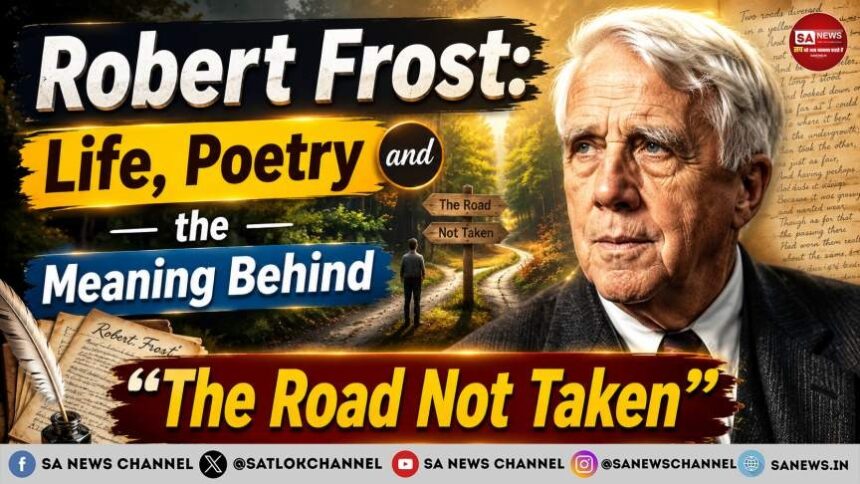
What if one of the most famous poems by a great poet isn’t about choosing “the less travelled road”? Robert Frost, the literary icon of America, penned rural life, ordinary scenarios, and everyday matter into well-versed and deeply layered poetry which continues to challenge readers till date. Born in 1874, Robert Frost became a leading figure in the history of American Literature, winning four Pulitzer Prizes for Poetry and earning recognition for his distinctive blend of accessible language and sophisticated ideas.
- Robert Frost’s Early Life and Literary Journey
- Robert Frost’s Most Famous Poems
- The Background of “The Road Not Taken”
- What Is the Meaning of “The Road Not Taken”?
- Choosing and Making Decisions
- Uncertainty and Results of Decisions
- Regret and Our Decisions
- What Does the Road Stand For?
- The Hidden Irony Behind the Poem
- Robert Frost’s Legacy and Influence on Poetry
- Awards and Major Achievements
- His Influence on American Poetry
- Why Is Robert Frost Still Remembered Today?
- A Spiritual Perspective on Life and Human Choices
Robert Frost’s works often cover intricate subjects such as choices, nature, isolation, mortality, relationships, and the uncertainty of human life. One of his major works, “The Road Not Taken” still remains popular because its meaning is frequently misunderstood. More than a motivational poem about individuality, it explores decision-making, uncertainty, memory, and how people interpret their past choices. This enduring ambiguity is a major reason Robert Frost’s poetry remains relevant today.
Robert Frost’s Early Life and Literary Journey
Robert Frost’s journey to becoming one of the most distinguished American poets was marked by both personal hardships and persistence. Born on March 26, 1874, in San Francisco, Frost moved to Lawrence, Massachusetts, following his father’s death when he was just 11 years old. Robert Frost’s early family life and his exposure to New England’s surroundings had a significant influence on his poetry, specifically his detailed portrayal of nature and rural life.
Frost’ s literary education was beyond formal schooling. Although he attended Dartmouth College and later Harvard University, his graduation was never completed. He did various works, including farming and teaching, while also working on his writing. An interesting fact about Robert Frost’s professional life is that he did not achieve literary fame early. His first book of poetry; A Boy’s Will, was published in England in 1913 when he was nearly 40. It was his perseverance, which shaped his remarkable literary journey.
Robert Frost’s Most Famous Poems
Robert Frost is well known for his extraordinary depictions of ordinary landscapes, rural experiences, and everyday human situations into powerful reflections on life. His well known poems explore themes including choice, nature, relationships, conflict, desire, and mortality. Among his best- known works are:
- The Road Not Taken: Uncovers the aspects of choices, uncertainty, individual decisions, and how people interpret their past. This work is often misunderstood as simply inspiring readers to choose the “less-traveled” path.
- Stopping by Woods on a Snowy Evening: This work uses a quiet winter landscape to inspect solitude, temptation, responsibility, and the contrast between beauty and duty.
- Mending Wall: Through the story of two neighbours who meet once in a year to repair a stone wall, this work examines boundaries, tradition, human relationships, and isolation.
- Fire and Ice: This is one of Robert Frost’s influential poems which deliver the message that desire and hatred are destructive forces capable of bringing about humanity’s end.
The Background of “The Road Not Taken”
Robert Frost’s literary masterpiece The Road Not Taken is one among the most widely recognized poems in American literature. However its origin and meaning are more complicated than its popular reputation suggests.
It was written by Robert Frost in 1915 and was published in The Atlantic Monthly that same year. This poem was inspired partly by Frost’s walks with his close friend Edward Thomas during Frost’s years in England. The poem’s famous forest setting presents a traveler standing before two parting ways, creating a strong imagery of choice, uncertainty, and reflection.
The Setting and Inspiration
The yellow wood sets an autumn landscape where the speaker must pause and consider which path to take. Its setting reflects the uncertainty that often accompanies important decisions.
The Two Roads as a Central Symbol
The two roads denote different choices in the life of an individual. However, Frost deliberately makes the paths appear almost equally worn, suggesting that the poem is not simply about choosing an unusual or “less-traveled” path.
What Is the Meaning of “The Road Not Taken”?
Through The Road Not Taken, Robert Frost depicts the choice, uncertainty, and the stories people create about their past decisions. Instead of urging readers to follow the unconventional path, the poem presents a traveler facing two roads that are described as nearly equal. This subtle detail makes the poem more complex than its popular motivational interpretation.
Choosing and Making Decisions
The roads symbolize the different choices and opportunities in life of an individual. The traveler must choose only one path while knowing that choosing it means rejecting the other one. Frost shows the reality of making crucial decisions where we face the opportunity costs or the options we lose by choosing the one that seems better.
Uncertainty and Results of Decisions
The narrator doesn’t know where each road will lead to. This demonstrates the uncertainty we face in life since we have to make many choices when we are not aware of their outcomes. As a result, the poem reveals the impact of our decisions, despite the fact that their consequences are unknown.
Regret and Our Decisions
Another significant issue discussed in the poem is that of regret. The speaker expresses his regret about the decision he has made and imagines himself looking back to it in the future. This means that there is an innate human tendency to reflect on our important decisions in the past.
What Does the Road Stand For?
The road symbolizes the choices and possibilities that a person has in life. Its deeper meaning highlights the necessity of making a choice.
Also read: Biography of Samuel Taylor Coleridge: Poet, Dreamer and a Romantic Icon
The Hidden Irony Behind the Poem
The hidden irony behind the poem is the most interesting aspect of The Road Not Taken. This poem is often misunderstood as a central idea about choosing the unique or less common path, but Frost’s actual message is indeed more complicated.
Were the Two Roads Actually Different?
At first, both the roads appear totally different, but later the speaker admits that they were “really about the same.” This intricate detailing often challenges the common interpretation that one road represents a clearly better or more adventurous choice.
Why This Poem Is Often Misinterpreted
Many see the ending of this renowned poem as a way of celebrating independence and individuality. The entire poem, however, has more to do with uncertainty, choice, and how people themselves see their decisions afterwards.
Frost’s Use of Irony and Ambiguity
In this poem, Frost employs irony, symbolism, and ambiguity, making the readers think about the meaning of the ultimate thought of the narrator. Such complexity makes The Road Not Taken remain a topic of discussion.
Robert Frost’s Legacy and Influence on Poetry
Robert Frost left a lasting impression on American literature and modern poetry. His creativity to combine simple language and familiar natural settings with complex ideas made his work widely accessible while giving it considerable literary depth.
Awards and Major Achievements
For his literary works, Frost won the Pulitzer Prize four times and became one of America’s most celebrated poets. He also earned national attention during his participation in John F. Kennedy’s 1961 presidential inauguration.
His Influence on American Poetry
Frost’s ability to transform ordinary speech, rural landscapes, nature, and everyday experiences into profound questions about human existence, choice, isolation, and mortality still leaves many readers awestruck about his literary depth and talent .
Why Is Robert Frost Still Remembered Today?
Robert Frost still remains one among the world’s most celebrated poets as his poetry combines simple imagery with deeper philosophical meanings. His works such as The Road Not Taken, Mending Wall, and Stopping by Woods on a Snowy Evening still continue to inspire readers and generate new interpretations.
A Spiritual Perspective on Life and Human Choices
While themes such as choices, uncertainty, human existence, and the paths we take remain a central idea of Robert Frost’s poetry, these ideas also invite a broader spiritual reflection.
In the spiritual discourses of Saint Rampal Ji Maharaj, it is stated that human life is not merely about materialistic achievement and worldly pleasures. Human life has a deeper purpose. The main aim of human life is to attain salvation and to get free from the cycle of birth and death. Saint Rampal Ji Maharaj is the only spiritual teacher today, who provides the true way of worship to attain salvation and the Supreme God Kabir Saheb. Readers are requested to read the sacred book Gyan Ganga and visit Sant Rampal Ji Maharaj YouTube Channel.