

Technology surrounds us in today’s life. We turn on light bulbs, use our cell phones, access Wi-Fi networks, drive with navigation, cook in the microwave and keep food in the refrigerator, and we don’t give a second thought to the science behind all of these.
The inventions are so commonplace that when we use them, we don’t usually ask a simple question: How do they work? Almost all of the devices that we use in our day-to-day life are a result of physics, chemistry, math, engineering, and computer science.
An understanding of the science that underlies common technologies shows how scientific research has been applied and adapted into everyday solutions which have helped to make our lives faster, safer and more convenient.
Why understanding the Science Behind Technology Matters
It is important to know how and why things work because by understanding the science behind technology we are taking the next step from using technological devices to understanding them. It fosters scientific inquiry, logical reasoning and problem-solving and promotes our efficient and responsible use of technology.
Understanding the science behind how smartphones, Wi-Fi, GPS, refrigerators, artificial intelligence and other technologies around us work and function will also help us to make informed choices and understand the pros and cons of these technologies and their impact on society and the environment.
Science knowledge most importantly promotes innovation and equips people to embrace new technologies, making sure that technological progress is being applied to improve human welfare and development in a responsible way.
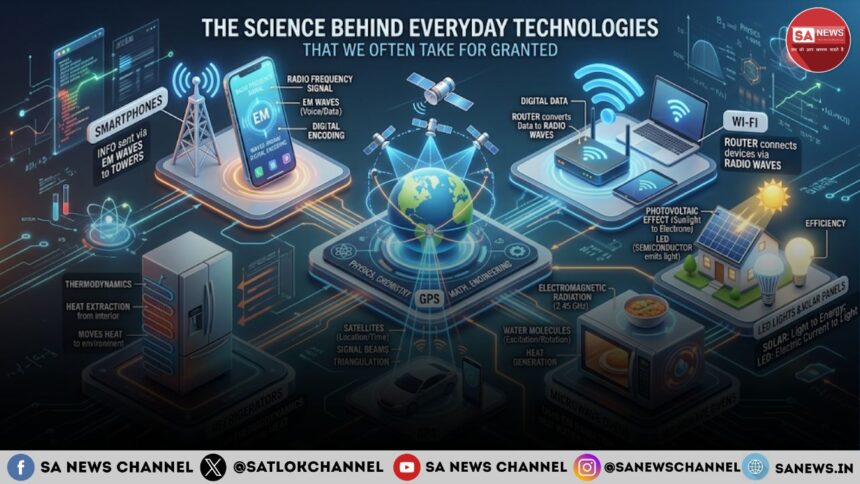
- The Science Behind Smartphones: Information is encoded in digital waves and sent to the recipient via electromagnetic waves when we call or text someone. Mobile networks rely on radio-frequency signals to communicate with a communication tower.
- How Wi-Fi Connects the World: Wi-Fi sends information via radio waves. A router is a device that translates digital information into radio waves and transmits them to compatible devices. Those signals are then converted back into digital information the receiving device can use for the computers and smartphones.
- The Science Behind Refrigerators: Refrigeration is an interesting use of thermodynamics! Refrigerators are not just for making cold. However, they extract heat from within the refrigerator and move it to the outside environment.
- The Hidden Science of Microwave Ovens: How microwave ovens work is by heating food using electromagnetic radiation. Some molecules, especially water molecules, rotate very quickly when subjected to the microwave radiation. This molecular movement creates thermal energy to cause the food to be heated.
- GPS: A navigation technology that has revolutionised the field. GPS is based on a constellation of satellites in orbit around the Earth. These satellites send out a signal with data on their location and time at all times. The position of GPS receiver is determined by measuring the time difference of the signals received from various satellites.
- Solar Panels and the Power of Sunlight: They primarily use the photovoltaic effect, in which certain semiconductor materials generate an electric current when exposed to sunlight. Solar cells convert the sun’s energy into electrons in the material. This movement of electrons produces electrical energy.
- The Science of LED Lights: LED lights have revolutionised the lighting industry due to their superior efficiency in consuming electricity as compared to most incandescent bulbs. An electric current flowing through semiconductive material emits energy in the form of light. LED lights use less electricity, generate less heat, and deliver more light output, which can mean a considerable savings on energy use.
Challenges of Understanding and Developing Everyday technologies
Some concerns often associated with understanding everyday technologies include:
- Energy consumption and environmental impact are the biggest concerns.
- Privacy and cybersecurity challenges
- Rapid Technological change makes it difficult for people to understand it
- Technological complexity
- Digital Divide
How Science Shapes Our Everyday Lives
Technology around us is a powerful reminder that science is not a phenomenon confined to the laboratory or the text book. It’s in our smart phones, fridges, Wi-Fi routers, microwaves, GPS devices and solar panels and lights.
Every video call, every time we preserve food, go to a location, or charge a gadget, we are using the results of generations of discovery. There’s science to everyday technology: there are amazing instances of human curiosity and innovation in the mundane world.
On the next occasion that we turn on the light, unlock the phone, or find a place, we should take a few moments to marvel at the amazing journey of scientific accomplishment that made these things possible.
A Spiritual Perspective: Connecting Science with the Teachings of Sant Rampal Ji Maharaj
The science of everyday technologies demonstrates that humans are an amazing species with the ability to understand nature and to turn scientific knowledge into effective solutions. Examples of how principles of physics, chemistry, mathematics, and engineering can enhance our everyday lives are encountered in the use of smartphones, GPS, refrigeration, and solar panels.
But the understanding of the scientific world is primarily for understanding how the world works, and the understanding of the spiritual world is to reflect on what purpose and how the scientific knowledge will be used.
The lessons taught by Sant Rampal Ji Maharaj teach that human life is worthy of use and that it is used to gain true knowledge and the purpose of human life. Science has the tools, but wisdom is the way in which they are used. Thus, there is a need for technological development to be accompanied by compassion, moral values, environmental responsibility and spiritual awareness. For more information, visit www.jagatgururampalji.org.