

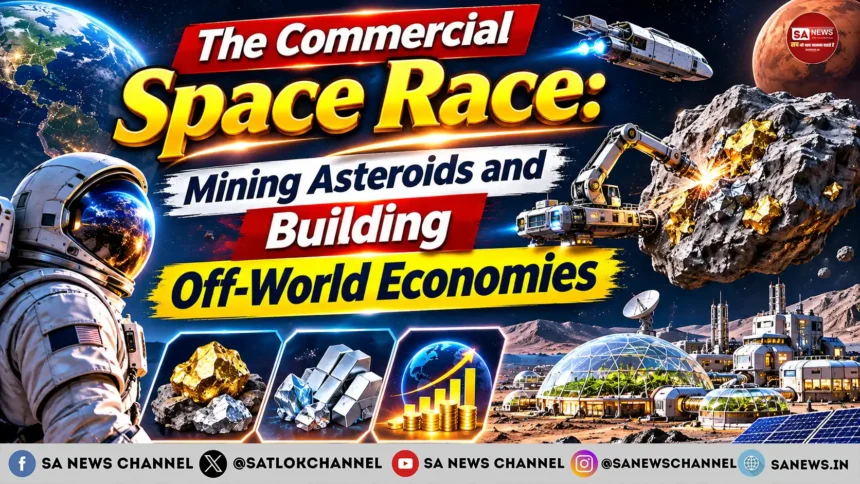
The Commercial Space Race: Humanity’s next economic frontier may lie far beyond Earth. What once seemed like science fiction is gradually becoming a serious business opportunity as private companies and space agencies explore asteroid mining, lunar resources and commercial space infrastructure. From extracting precious metals to producing fuel and building industries beyond our planet, the possibilities are enormous. The commercial space race is not simply about reaching distant worlds; it is about creating an entirely new economic system. However, questions about ownership, investment, environmental responsibility and equal access remain. As technology advances, the world must decide how to explore space responsibly and fairly.
- The Commercial Space Race: Why Is Everyone Looking Beyond Earth?
- What Is Asteroid Mining and Why Does It Matter?
- What Valuable Resources Could Asteroids Provide?
- 1. Platinum and precious metals
- 2. Iron and nickel
- 3. Water and ice
- 4. Cobalt and other industrial materials
- Why Are Private Companies Entering the Space Mining Industry?
- Building Off-World Economies: What Does It Actually Mean?
- 1. Manufacturing in Space
- 2. Space-Based Fuel Production
- 3. Commercial Space Stations
- 4. Space Transportation and Logistics
- The Technology Making Asteroid Mining Possible
- Is Asteroid Mining Economically Profitable?
- The Legal Challenges: Who Owns Resources in Space?
- Environmental Concerns: Can Space Mining Be Sustainable?
- What Does the Growing Space Economy Mean for India?
- Challenges That Could Slow Down the Commercial Space Race
- 1. Extremely High Investment
- 2. Technological Limitations
- 3. Uncertain Business Models
- 4. International Competition
- 5. Human Safety
- What Could the Future of the Space Economy Look Like?
- True Purpose of Human Life Beyond Material Wealth and Space Exploration
- FAQs on The Commercial Space Race
The Commercial Space Race: Why Is Everyone Looking Beyond Earth?
For decades, space exploration was largely controlled by government agencies. Countries competed to launch satellites, send astronauts into orbit and explore distant planets. Today, however, the situation is changing rapidly.Private companies are becoming major players in the space industry. They are developing reusable rockets, commercial spacecraft, satellite networks and technologies that could eventually support mining operations beyond Earth.This growing competition is known as the commercial space race.
But why are businesses interested in places millions of kilometres away?
The answer lies in resources and economic opportunities.Asteroids, the Moon and other celestial bodies contain materials that could become valuable for future industries. Some asteroids contain iron, nickel, cobalt and platinum-group metals, while water-rich asteroids may offer another important resource.Instead of transporting every material from Earth, future space industries could potentially collect and process resources directly in space.
This idea could change how humanity approaches manufacturing, transportation and economic development.
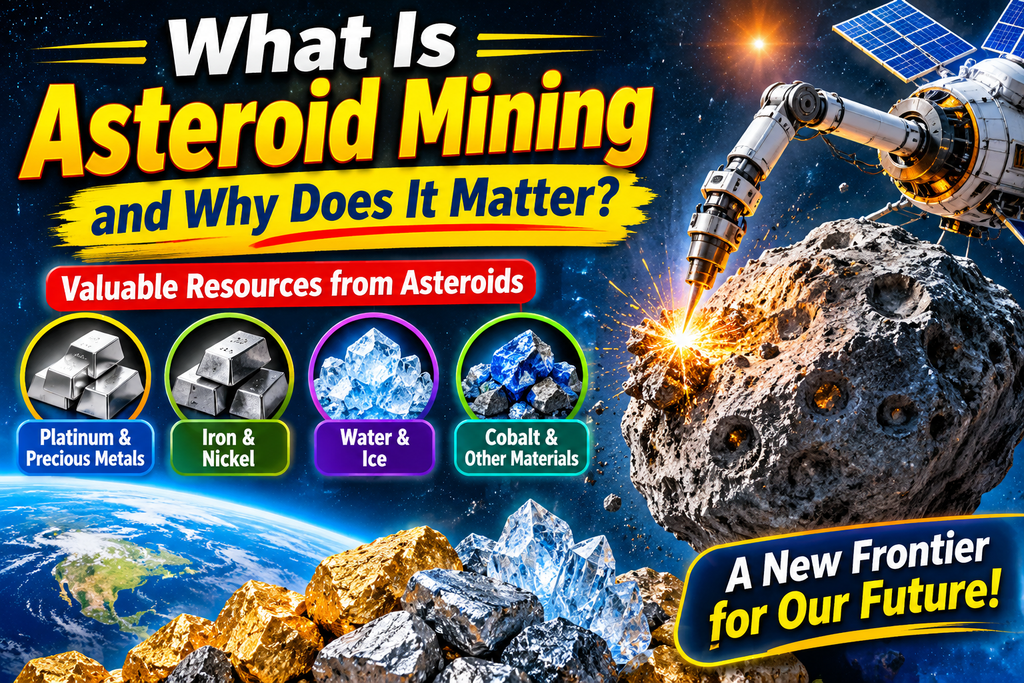
What Is Asteroid Mining and Why Does It Matter?
Asteroid mining refers to the process of identifying, reaching, extracting and processing useful materials from asteroids.
Asteroids are small rocky or metallic objects that orbit the Sun. Many are found in the asteroid belt between Mars and Jupiter, while others travel through or near Earth’s orbital neighbourhood.Scientists are particularly interested in certain asteroids because of their possible mineral composition.
What Valuable Resources Could Asteroids Provide?
1. Platinum and precious metals
Certain asteroids may contain platinum-group metals, which have applications in electronics, industrial manufacturing and specialised technologies.
2. Iron and nickel
These metals could potentially support construction, machinery and manufacturing in space.
3. Water and ice
Water could become one of the most important resources for future space settlements. It can support human life and, through processing, potentially provide oxygen and hydrogen for rocket propulsion.
4. Cobalt and other industrial materials
These materials could support future manufacturing and technological applications, depending on the composition of individual asteroids.
However, there is an important distinction: scientists have identified potentially valuable materials, but commercially profitable asteroid mining has not yet been demonstrated.The real challenge is learning how to extract and transport these resources economically.
Why Are Private Companies Entering the Space Mining Industry?
The increasing participation of private companies is one of the biggest changes in modern space exploration.Businesses are no longer interested only in launching satellites or carrying astronauts. Some are exploring how space could become a long-term commercial marketplace.
Companies such as SpaceX, AstroForge and other emerging space ventures represent different parts of this expanding industry.
Their activities include launch services, spacecraft development, orbital infrastructure and technologies relevant to future resource extraction.
The Role of AstroForge
AstroForge is particularly interesting because its business focus is asteroid mining.The company has been developing spacecraft and technologies intended to investigate and eventually extract resources from asteroids.
Its Odin spacecraft, launched in 2025, experienced communication difficulties, illustrating how challenging deep-space operations remain. Nevertheless, the mission represents the kind of early commercial experimentation taking place in this field.Such missions are important because asteroid mining requires technologies that have never been tested at a commercially viable scale.
Why Private Investment Matters
Private investment can help:
- Develop reusable launch vehicles.
- Reduce spacecraft manufacturing costs.
- Improve robotic mining systems.
- Develop autonomous navigation technologies.
- Create new employment opportunities.
- Encourage competition and innovation.
The commercial space industry is therefore developing an ecosystem in which governments, scientists, investors and entrepreneurs may work together.
Building Off-World Economies: What Does It Actually Mean?
An off-world economy means an economic system developed beyond Earth.It could include industries, businesses, transportation systems, manufacturing facilities and settlements operating on the Moon, Mars or in Earth’s orbit.
Imagine a future where spacecraft transport raw materials to orbital factories, robotic machines manufacture equipment, and space stations provide services to visiting missions.
This would represent an entirely new commercial environment.
1. Manufacturing in Space
Manufacturing in microgravity could offer advantages for certain specialised products.
For example, researchers are investigating the production of advanced materials, pharmaceutical crystals and specialised fibre optics in space.If these processes become economically practical, commercial space stations could eventually become manufacturing centres.
2. Space-Based Fuel Production
Transporting rocket fuel from Earth is expensive.Future lunar or asteroid resource operations could potentially produce water, oxygen and propellant for spacecraft.This is known as In-Situ Resource Utilisation (ISRU).
The basic idea is simple: use resources available at a destination rather than carrying everything from Earth.This could reduce the amount of material that spacecraft need to transport during long-distance missions.
3. Commercial Space Stations
Space stations could become more than scientific laboratories.In the future, privately operated stations might offer research facilities, manufacturing services, satellite support and other commercial activities.
These facilities could become important infrastructure for an expanding space economy.
4. Space Transportation and Logistics
Just like roads, ports and airports support economic activity on Earth, spacecraft, refuelling facilities and cargo systems could support businesses beyond our planet.
Reliable transportation will be essential before large-scale off-world industries become possible.
The Technology Making Asteroid Mining Possible
Asteroid mining sounds exciting, but reaching an asteroid and extracting its resources is an extremely complicated engineering challenge.
Several technologies will be essential.
Advanced Robotics
Robots could perform dangerous mining activities without exposing astronauts to extreme conditions.They may eventually be capable of drilling, collecting samples, crushing rocks and sorting useful materials.
Artificial Intelligence
Artificial intelligence can help spacecraft analyse images, identify suitable landing areas, navigate independently and monitor mining equipment.Autonomous systems will be particularly important because communication delays make constant human control difficult during distant missions.
Reusable Rockets
The cost of reaching space remains one of the biggest challenges.Reusable launch vehicles could help reduce transportation expenses and make repeated missions more practical.
Advanced Energy Systems
Mining and processing materials require energy.Solar power, improved batteries and potentially nuclear power systems could support future industrial operations far from Earth.Together, these technologies could gradually transform space exploration from occasional scientific missions into more regular commercial activity.
Also read:National Technology Day 2026: Is Science & Technology greater than Spirituality?
Is Asteroid Mining Economically Profitable?
This is perhaps the most important question surrounding the commercial space race.Asteroids may contain enormous quantities of valuable materials, but having resources does not automatically mean making money.
Companies must consider the complete cost of a mining operation.
These expenses may include:
- Designing and building spacecraft.
- Launching equipment into space.
- Travelling to the selected asteroid.
- Landing or operating near its surface.
- Extracting and processing materials.
- Transporting resources to another destination.
- Maintaining communication and navigation systems.
The Legal Challenges: Who Owns Resources in Space?
The commercial space race is not only a technological competition. It also raises serious legal and international questions.
- If a private company reaches an asteroid and extracts minerals, who owns those resources?
- Can a country claim an asteroid as its territory?
- Can another company mine the same location?
These questions are becoming increasingly important.
Environmental Concerns: Can Space Mining Be Sustainable?
Space may appear endless, but that does not mean its resources and environment should be treated carelessly.Asteroid mining could create new environmental and operational challenges.
- Space debris: More spacecraft and industrial equipment could increase the amount of debris in orbit.
- Celestial contamination: Mining operations could disturb scientifically important surfaces and potentially contaminate locations that researchers want to study.
- Resource competition: Valuable mining locations could become sources of disagreement between countries and companies.
- Industrial waste: Future extraction and processing activities may generate waste that needs proper management.
Research published in Acta Astronautica in 2026 has highlighted gaps in the international governance of asteroid mining’s environmental impacts and the need for stronger monitoring, environmental safeguards and international cooperation.
The lesson is clear: humanity should not repeat the environmental mistakes made during industrial development on Earth.
Responsible exploration must become a priority from the beginning.
What Does the Growing Space Economy Mean for India?
India is also becoming an important participant in the changing global space industry.The Indian Space Research Organisation (ISRO) has made significant progress in satellite technology, lunar exploration, launch services and scientific research.India’s growing private space sector also creates opportunities for startups, engineers and technology companies.
Opportunities for Indian Businesses
The development of off-world economies could create opportunities in several areas:
1. Robotics: Developing machines for space exploration and resource extraction.
2. Artificial intelligence: Creating software for autonomous spacecraft and mining systems.
3. Satellite technology: Improving communication, navigation and Earth observation.
4. Advanced materials: Developing lightweight and durable components for spacecraft.
5. Space manufacturing: Researching new production methods for future orbital industries.
Indian startups could contribute to these technologies even before commercial asteroid mining becomes a reality.The future space economy will not depend only on companies that own rockets. It will also depend on businesses supplying software, electronics, sensors, communication systems and specialised engineering services.For India, this could become an important opportunity to strengthen its position in the global technology ecosystem.
Challenges That Could Slow Down the Commercial Space Race
Despite the excitement, building an economy beyond Earth will not happen overnight.
Several major challenges remain.
1. Extremely High Investment
Space missions require substantial financial resources, and returns may take many years or even decades.
2. Technological Limitations
Mining equipment must operate in microgravity or extremely low-gravity environments, survive radiation and function under harsh temperature conditions.
3. Uncertain Business Models
Companies still need to establish which resources can be extracted profitably and who will purchase them.
4. International Competition
Countries may disagree about mining rights, safety zones and the distribution of resources.
5. Human Safety
Long-duration space operations expose astronauts to radiation, isolation and other serious risks.
These challenges show that commercial space development requires patience, scientific research and international cooperation.
What Could the Future of the Space Economy Look Like?
Imagine a world where spacecraft regularly travel between Earth and the Moon.Robotic machines collect lunar resources, orbital factories manufacture specialised equipment, and commercial space stations provide services to scientific and industrial missions.
This may sound like a distant dream, but many technologies required for such activities are already being researched.Over the coming decades, the space industry could develop in stages:
- Near future: More commercial launches, satellite services and robotic exploration.
- Next stage: Demonstrations of lunar resource extraction and improved in-space manufacturing.
- Longer term: More developed orbital infrastructure, resource transportation and potentially permanent industrial facilities.
However, these are possible development pathways, not guaranteed deadlines.The OECD’s The Space Economy at a Glance 2026 highlights the expanding economic importance of commercial space activities, alongside growing concerns about infrastructure, investment, sustainability and international governance.The future of space commerce will therefore depend not only on scientific discoveries but also on whether businesses can create practical and sustainable economic models.
True Purpose of Human Life Beyond Material Wealth and Space Exploration
While humanity strives to build an off-world economy through commercial space exploration and asteroid mining, the Satgyan (true spiritual knowledge) of Sant Rampal Ji Maharaj offers an essential perspective on the true purpose of life.
Sant Rampal Ji teaches that human birth is a rare opportunity intended not for material accumulation, greed, or worldly dominance, but for true devotion (Sat-Bhakti) to Supreme God Kabir and achieving ultimate salvation (Moksha). Seeking infinite wealth-whether on Earth or on distant asteroids-remains a temporary illusion (Maya) that traps souls in the endless cycle of birth and death. True progress lies in living righteously, exercising compassion, avoiding greed, and using knowledge responsibly for universal welfare under the guidance of a True Guru.
FAQs on The Commercial Space Race
Q1. What is the commercial space race?
The commercial space race refers to competition among private companies and countries to develop space technologies, launch services, satellite systems, space infrastructure and potentially profitable activities such as asteroid mining.
Q2. What is asteroid mining, and how does it work?
Asteroid mining involves identifying asteroids containing useful resources, travelling to them using spacecraft, extracting materials through robotic equipment and processing them for future use. The technology is still under development.
Q3. Which valuable resources can be found on asteroids?
Asteroids may contain iron, nickel, cobalt, platinum-group metals and water ice. Their exact composition depends on the type of asteroid.
Q4. Can asteroid mining make companies rich?
Asteroid mining has potential commercial value, but profitability is uncertain. High transportation costs, advanced technology requirements and market demand are major challenges. No company has yet demonstrated commercially profitable asteroid mining.
Q5. How can asteroid mining benefit humanity?
Asteroid mining could provide materials for future space infrastructure, reduce dependence on transporting supplies from Earth and support industries beyond our planet. However, responsible regulation and fair distribution of benefits will be essential.