The year 2025 has been everything at once – the hottest, the rainiest and unexpectedly, even the coldest at the wrong times. Heatwaves have shattered records, floods have overwhelmed cities and unseasonal cold spells have left people confused. What changes is our planet actually going through? You’ve probably heard terms like ‘climate change’ and ‘global warming’ used to explain this chaos, but are they really the same thing? In this detailed guide, you’ll clearly understand the difference, how they’re connected and why it matters now more than ever.
- Highlights on Climate Change vs Global Warming
- What Is Climate Change in Simple Terms?
- What Is Global Warming and What Causes It?
- What Factors Contributed to the 2023 Global Temperature Surge?
- Did Natural Events Like the Hunga Tonga Volcanic Eruption Cause Recent Warming?
- How is the Greenhouse Effect Responsible for Increasing Earth’s Temperature?
- What Scientific Evidence Proves Global Warming Is Real?
- Understanding the Difference Between Climate Change and Global Warming is Important
- What Is the Difference Between Climate Change and Global Warming?
- Which Term Should You Use: Climate Change or Global Warming?
- What Are the Key Indicators of Climate Change Today?
- How Is Global Warming Related to Climate Change?
- Why Are Climate Change and Global Warming Often Confused?
- What Are the Main Effects of Climate Change vs Global Warming?
- How Is Climate Change Changing Global Weather Patterns?
- What Are Real-Life Examples of Climate Change and Global Warming?
- How Does Climate Change Affect Ecosystems, Food and Society?
- Tools, Data Sources and Practical Applications
- How Is Climate Change Affecting India Today?
- Rising Heatwaves and Urban Stress
- Floods and Extreme Rainfall Patterns
- Agricultural Disruption and Food Security
- Coastal Risks and Rising Sea Levels
- Why India’s Climate Situation Matters Globally
- What Made 2025 a Turning Point for Climate Awareness in India?
- Are We Exceeding the Paris Agreement Climate Targets?
- Why Climate Action Cannot Be Delayed
- Can God truly save this world?
- FAQs
Highlights on Climate Change vs Global Warming
- Climate change refers to long-term shifts in Earth’s climate patterns, including temperature, rainfall and extreme weather events.
- Global warming specifically describes the rise in Earth’s average surface temperature due to greenhouse gas emissions.
- Global warming is a subset and primary driver of broader climate change.
- Climate change impacts include storms, droughts, melting of snow caps and sea-level rise, to name a few, and not just temperature increase.
- Human activities, especially fossil fuel use, are the leading cause of modern global warming.
- There is a historic record of the ten warmest years being witnessed just within the last decade. (Source)
- 2024 was the hottest year on record since 1850, confirming the accelerating pace of global warming
- Accurate terminology improves environmental awareness, academic writing and policy discussions.
- India witnessed massive fluctuations in weather patterns in 2025.
What Is Climate Change in Simple Terms?
Though climate change seems like a self-explanatory term that indicates changes in our climate, in reality, it is the long-term alteration of temperature and typical weather patterns in a place.
- This term covers broad environmental changes that occur over decades or centuries. It includes shifts in rainfall, rising sea levels and changes in seasonal patterns.
- For example, regions experiencing longer droughts or more intense monsoons are witnessing climate change in action.
- Moreover, climate change can occur due to both natural causes (like volcanic eruptions) and human activities (like burning fossil fuels). However, modern climate change is largely driven by human actions.
In fact, Earth’s average temperature has risen by about 1.1°C since the late 1800s (Source), showing how significant these changes have become. This brings us now to the subset of climate change – global warming.
What Is Global Warming and What Causes It?
Global warming is the increase in Earth’s average surface temperature primarily due to greenhouse gas emissions.
- It focuses specifically on temperature rise, not the broader climate system. It is mainly caused by gases like carbon dioxide and methane trapping heat in the atmosphere.
- The greenhouse effect involves heat being trapped in Earth’s atmosphere by gases such as carbon dioxide and methane.
- For example, burning coal, oil and gas releases carbon dioxide, which intensifies heat retention. This is why the impact of fossil fuels on the environment is a major concern globally.
- Additionally, carbon dioxide levels are now over 420 ppm, the latest being 429 ppm as of February 2026 (Source), the highest in millions of years.
Despite the innumerable commitments towards reversing global warming, it continues to only rise.
What Factors Contributed to the 2023 Global Temperature Surge?
The extreme heat in 2023 was caused by a combination of natural climate cycles and human-driven global warming. A few insights:
- The transition to El Niño (ENSO cycle) played a major role.
- After three years of La Niña cooling, El Niño brought additional warming to global temperatures.
- El Niño events typically increase global temperatures temporarily, but in 2023, they amplified an already warming planet.
- Moreover, marine heatwaves intensified warming across oceans, especially in the Mediterranean and Indian Ocean.
Additionally, several lesser-known factors contributed:
- Solar cycle peak, increasing solar radiation
- Reduced sulphur emissions, decreasing atmospheric cooling
Natural factors can amplify warming, but the underlying cause remains human-driven climate change.
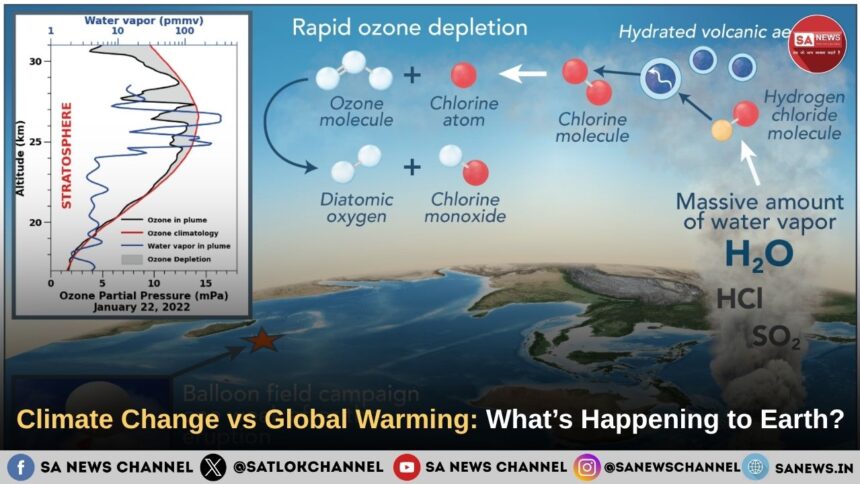
Did Natural Events Like the Hunga Tonga Volcanic Eruption Cause Recent Warming?
Recent studies show that natural events like the Hunga Tonga eruption had limited or cooling effects, reinforcing that human-driven emissions remain the primary cause of global warming
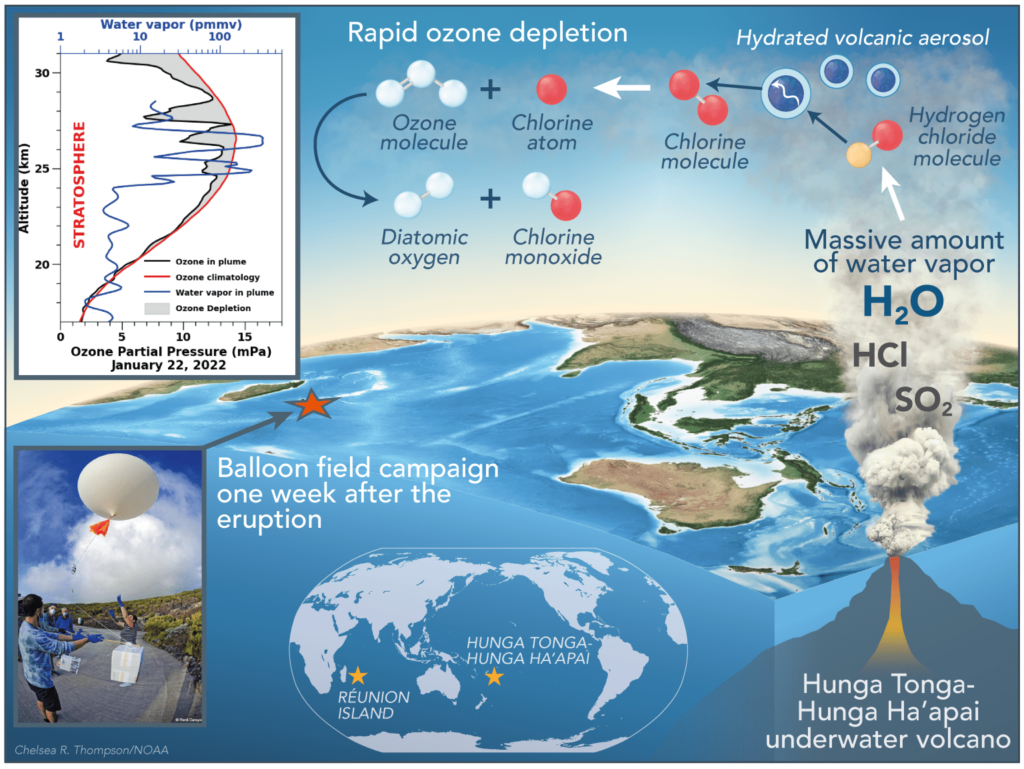
A Pictorial Depiction of the Hunga Tonga Volcanic Eruption Aftermath (Source)
- The Hunga Tonga eruption did not significantly contribute to global warming and may have, instead, caused temporary cooling effects in parts of the atmosphere.
- Although the eruption released large amounts of water vapour, recent research shows that this led to net cooling in the mid-stratosphere rather than warming.
- Moreover, while some minor warming occurred in lower atmospheric layers, the overall global temperature impact was limited and short-lived.
Natural events like volcanic eruptions can influence climate temporarily, but they are not responsible for the long-term warming trend observed today.
How is the Greenhouse Effect Responsible for Increasing Earth’s Temperature?
The greenhouse effect is the process by which gases trap heat in Earth’s atmosphere, causing temperatures to rise.
Carbon dioxide, methane, and water vapour surround the planet, holding in heat like an insulating layer. They allow sunlight to enter but prevent heat from escaping. Without this natural heat-trapping process, the planet would be too cold for living organisms to survive. However, excess greenhouse gases from human activity intensify this effect, leading to global warming.
This mechanism was first identified in 1859, making it one of the oldest and most well-understood concepts in climate science.
What Scientific Evidence Proves Global Warming Is Real?
Global warming is scientifically proven through decades of temperature data, atmospheric measurements and historical climate records. Some important aspects to understand:
- There is overwhelming scientific consensus that the Earth is warming.
- In fact, multiple datasets from satellites and weather stations confirm that 10 warmest years since 1880 have occurred after 2005 and between 2015 to 2024 (Source).
- Scientists measure atmospheric composition and consistently find rising greenhouse gases.
- Carbon dioxide levels have exceeded 415 ppm, was stated earlier in this article, a level not seen in millions of years, directly linking human activity to warming.
- Additionally, researchers also rely on climate proxies such as tree rings, ice cores and ocean sediments, to reconstruct Earth’s past climate.
- All these factors have consistently shown that current warming is far beyond natural variability.
Human-driven global warming is not a theory, but a measurable, observable reality.
Understanding the Difference Between Climate Change and Global Warming is Important
Understanding the difference between climate change and global warming prevents misinformation and improves communication.
- Using the correct term ensures clarity in academic and professional writing.
- Describing rising temperatures as ‘climate change’ can be vague, while ‘global warming’ is precise.
- Accurate terminology helps in policy discussions and environmental awareness campaigns.
- Governments rely on clear distinctions when drafting climate policies.
- Misunderstanding these terms can lead to oversimplification of complex environmental issues.
- For instance, ignoring rainfall changes while focusing only on temperature can misrepresent risks.
Understanding the differentiation between climate change and global warming also leads to a better understanding of the core issues that cause them.
What Is the Difference Between Climate Change and Global Warming?
The difference between climate change and global warming lies in scope, causes, effects and usage.
Let’s break it down clearly for the very basic understanding:
| Aspect | Climate Change | Global Warming |
| Scope | Broad (includes multiple changes) | Narrow (temperature rise only) |
| Causes | Natural and human factors | Mainly greenhouse gases |
| Effects | Storms, droughts, sea-level rise | Rising temperatures |
| Timeline | Long-term patterns | Recent acceleration |
| Usage | Scientific and policy contexts | Public awareness and media |
Here is a brief differentiation based on the top three factors:
Scope: Broad vs Specific
Climate change includes all environmental shifts, while global warming focuses only on temperature increase. As an example: the rising sea levels fall under climate change, not just global warming.
Causes: Multiple vs Focused
Climate change can result from natural cycles and human activities, whereas global warming is primarily driven by carbon emissions. For instance: volcanic eruptions affect climate change but not long-term global warming trends.
Effects: Diverse vs Temperature-Centric
Climate change leads to extreme weather patterns, melting glaciers and ecosystem disruption. Hurricanes and droughts are climate change effects, not direct global warming effects.
Which Term Should You Use: Climate Change or Global Warming?
One should use ‘global warming’ when referring to temperature rise and ‘climate change’ for broader environmental impacts.
Use global warming in discussions about heat increase or emissions. Whereas, one can use climate change when discussing weather patterns, disasters or ecosystems.
What Are the Key Indicators of Climate Change Today?
Climate change is measured using multiple scientific indicators, including ocean temperatures, ice loss and greenhouse gas concentrations. A glance on the key indicators:
- Sea Surface Temperature (SST) anomalies show how much ocean temperatures deviate from normal levels. In 2023, large parts of the oceans turned into ‘red zones’ indicating extreme warming. (Source)
- Regions like the Indian Ocean and North Atlantic experienced marine heatwaves, disrupting marine ecosystems and weather systems.
- Polar ice is shrinking at alarming rates. Antarctic sea ice decreased by approximately 15-30% in 2023, varying in percentages throughout the year, while Arctic ice reached one of its lowest recorded levels. (Source)
- Additionally, greenhouse gases continue to rise.
- Carbon dioxide and methane concentrations are steadily increasing, intensifying the greenhouse effect. (Source)
- Oceans, ice sheets and the atmosphere all confirm the same reality – Earth is warming rapidly.
Therefore, global warming is definitely contributing to unpredictable climate changes.
How Is Global Warming Related to Climate Change?
Global warming is a key driver of climate change, but climate change includes a wider range of environmental impacts.
As temperatures rise, they trigger changes in weather systems, ocean currents and ecosystems. This chain reaction leads to broader climate disruptions.
The simplest example: Warmer oceans lead to stronger cyclones, showing how temperature increases influence wider climate patterns.
Why Are Climate Change and Global Warming Often Confused?
Climate change and global warming are often confused because they are closely related and frequently used interchangeably in the media.
- Media outlets often simplify complex topics, using both terms to mean the same thing.
- Global warming is more visible and measurable, making it easier to discuss than broader climate shifts.
- Also, both terms address the same root issue which is the human impact on the planet and this adds to the confusion.
However, the outcomes of climate change and global warming can help us understand the finer nuances to a greater extent.
What Are the Main Effects of Climate Change vs Global Warming?
Climate change causes diverse environmental impacts, while global warming primarily leads to rising temperatures. Let us have a brief look at each:
Effects of Global Warming
- Increased average temperatures
- Heatwaves
- Melting ice caps
- An effect of global warming is also the Arctic ice shrinking by about 13% per decade (Source).
Effects of Climate Change
- Rising sea levels
- Extreme storms
- Droughts and floods
- A significant example of climate change is that the sea levels have risen more than 20 cm since 1900 as of 2022. (Source)
These changes in climate lead to erratic weather patterns that are mostly difficult to anticipate.
How Is Climate Change Changing Global Weather Patterns?
Climate change is intensifying weather patterns by increasing evaporation, rainfall and extreme weather events. As global temperatures rise, more water evaporates into the atmosphere. This creates what scientists call a ‘water world’ effect, where the atmosphere holds more moisture.
This leads to heavier rainfall and unexpected flooding, even in regions that are generally becoming drier. Extreme weather events are becoming more frequent and severe.
Recent observations include:
- Unprecedented flooding events, for example, the 2025 floods in the northern states of India such as Haryana, Punjab, Uttar Pradesh, Rajasthan, etc.
- Intense heatwaves. Several Indian states recorded extreme high temperatures in February 2025. (Source)
- Seasonal disruptions like ‘winter storms in spring’, have been observed across the world, recently too. For example, the one Colorado experienced in 2024.
Warmer air holds more moisture, making storms more intense and unpredictable.
Similar erratic patterns have also been observed across India, wherein extended monsoons, unseasonal rain during summers, extremely long winters have been observed in 2025.
Therefore, climate change makes weather patterns unpredictable.
What Are Real-Life Examples of Climate Change and Global Warming?
Real-life examples help illustrate how global warming and climate change affect the planet differently.
Aside from the various examples listed in the article until now, two dominant examples seen across the world are:
- Global warming is evident in record-breaking heatwaves across Europe and Asia, especially in 2024.(Source)
- Climate change appears in unpredictable rainfall patterns and stronger cyclones. For example, Mumbai experiencing intense rainfall in shorter periods reflects climate change, not just warming. This has been seen rising consistently for the past decade.
Therefore, the most dire real-life effects of climate change and global warming are heatwaves and unpredictable rainfall patterns.
How Does Climate Change Affect Ecosystems, Food and Society?
Climate change is not just an existing reality but it also has a telling effect on multiple arenas that are dependent on weather conditions. Thus it is also reshaping ecosystems, disrupting agriculture and creating risks for global stability. A few points to note here:
- Agricultural zones are shifting rapidly.
- Data shows that ideal crop-growing regions are moving northward, forcing farmers to adapt quickly.
- Crops that once thrived in one region may no longer survive there, threatening food supply chains.
Nature is already responding to climate shifts:
- Changes in bird migration and behaviour
- Species moving toward cooler regions
Additionally, regional risks are becoming more pronounced, as an example in the USA:
- Western regions: Increased droughts and wildfires
- Midwestern regions: Heavy rainfall destroying crops
- Southern regions: Longer and more intense heatwaves
Climate change is not just an environmental issue, it is an economic and social challenge too.
Tools, Data Sources and Practical Applications
Climate monitoring tools help track global warming and climate change using real-time data and scientific models. Every country has their own tracking systems. For example in India, there are government organisations like the Indian Space Research Organisation (ISRO) and the Indian Meteorological Department (IMD) that routinely provide climate data and warnings.
Whereas, internationally there are bodies such as the Intergovernmental Panel on Climate Change (IPCC) that monitors the world situation on climate change.
How Is Climate Change Affecting India Today?
Climate change is intensifying extreme weather events in India, making heatwaves, floods and unpredictable monsoons more frequent and severe.
India is considered one of the most climate-vulnerable countries in the world, due to its geography, population density and dependence on agriculture. In 2025, India witnessed record-breaking heatwaves across northern and central regions, with temperatures crossing 48°C in several regions (Source).
Moreover, the monsoon which is the backbone of India’s agriculture, is becoming increasingly erratic. Some regions face excess rainfall and flooding, while others experience prolonged dry spells.
Let us go into each aspect of climate change in India.
Rising Heatwaves and Urban Stress
Heatwaves in India are becoming longer, more intense and more dangerous due to global warming.
- Urban areas like Delhi, Mumbai and Ahmedabad are experiencing the urban heat island effect, where concrete infrastructure traps heat.
- Cities can be 3-7°C (approximately) hotter than surrounding rural areas, increasing health risks, especially for vulnerable populations.
- Prolonged heatwaves are now linked to water shortages, power outages and public health emergencies.
Floods and Extreme Rainfall Patterns
Climate change is increasing the intensity of rainfall events, leading to urban flooding and infrastructure breakdowns.
- Warmer air holds more moisture, which results in short bursts of extremely heavy rainfall.
- Mumbai has repeatedly faced flash floods due to intense, concentrated rainfall within hours, overwhelming drainage systems. This is the case each year.
- Additionally, India saw a rise in extreme rainfall events by over 75% between 1950 and 2015 (Source), highlighting a long-term trend.
Agricultural Disruption and Food Security
Climate change is disrupting India’s agricultural cycles, threatening food security and farmer livelihoods.
- Shifting rainfall patterns and rising temperatures are affecting crop yields.
- Staple crops like wheat and rice are sensitive to temperature spikes during critical growth periods, reducing productivity.
- Unpredictable weather increases the risk of crop failure, farmer debt and rural distress.
Coastal Risks and Rising Sea Levels
Rising sea levels are threatening India’s coastal cities and ecosystems.
- Cities like Mumbai, Chennai and Kolkata are at high risk of coastal flooding and erosion.
- Even a small rise in sea level can lead to saltwater intrusion into freshwater sources, affecting drinking water and agriculture.
- Mangroves and coastal ecosystems that are our natural barriers against storms, are under threat. Several mangroves, especially in cities like Mumbai, have been destroyed due to rampant construction.
Why India’s Climate Situation Matters Globally
India’s climate challenges have global implications due to its population size, economy and emissions trajectory.
- India is home to one of the world’s largest populations. Therefore, climate impacts here affect a significant portion of humanity.
- India’s development path will influence global emissions and sustainability efforts, being one of the largest producers and exporters of several trade commodities.
What happens in India will also shape the future of global climate action.
What Made 2025 a Turning Point for Climate Awareness in India?
The year 2025 highlighted the accelerating pace of climate change in India through unprecedented extreme weather events.
- The combination of record heatwaves, sudden floods and shifting monsoon patterns made climate change impossible to ignore.
- Multiple regions experienced both drought and flooding within the same season, showing the increasing unpredictability of climate systems.
- The climate shift has been more than traumatic for Indians, especially the farmers.
- The unprecedented floods in India lead to severe water logging in states such as Haryana, Punjab, Rajasthan, Uttar Pradesh and even parts of Madhya Pradesh.
- The water logging was so severe that even the government of India fell short in its efforts to support farmers and save their land.
- This is when Jagatguru Tatvdarshi Sant Rampal Ji Maharaj’s historic flood relief aid under His Annapurna Muhim began, wherein He provided high capacity pumping motors and massive pipes to help farmers drain the water logged farms.
- Innumerable villages across various states in India, received this life-saving aid from Sant Rampal Ji Maharaj absolutely free of cost, with the provision of farmers retaining the equipment provided forever so that it can be of use in future too.
No matter climate change, the mercy of a Complete Saint can overturn all hurdles for humanity.
Are We Exceeding the Paris Agreement Climate Targets?
The world is dangerously close to exceeding the 1.5°C warming limit set by the Paris Agreement. (Source). Whereas, the Paris Agreement aims to limit global warming to well below 2°C, ideally 1.5°C above pre-industrial levels.
Global climate conferences like COP28 have acknowledged the need to transition away from fossil fuels, but implementation remains slow. The question is why despite immense scientific advancement, humanity is unable to even slow down the climatic degradation, let alone reversing it?
Is it really possible for us to beat the effects of climate change? Why is the effect so pronounced in the recent decade especially?
Why Climate Action Cannot Be Delayed
Climate change is no longer a distant threat, it is already shaping our daily lives. And with every delay in action, its consequences grow more intense and irreversible.
However, there is an uncomfortable paradox we rarely confront. The very force we rely on to understand and solve this crisis, i.e. science, has also played a significant role in accelerating environmental degradation. From industrialisation to unchecked resource extraction, scientific advancement has not always moved in harmony with nature.
Here is an important question to ask. Can science truly reverse a crisis it helped create?
Historically, when humanity faced natural calamities whether droughts, floods or famine, we sought refuge in God. People prayed, not out of ignorance, but out of an awareness that there are forces beyond human control. Today, such perspectives are often dismissed as outdated or unscientific.
But if science alone could solve every problem, would the world be as unstable, anxious and environmentally strained as it is today?
The reality is more profound than we assume. In our relentless pursuit of progress, humanity may have distanced itself from God. Science can explain nature, measure it and even attempt to manipulate it, but it does not command it.
Nature operates on laws far greater than human invention. Is it time to reconnect, not just with sustainable practices, but with the one Who actually runs the whole universe?
Can turning back towards the real Creator, the Ultimate Supreme God, reshape not only our environment, but the way we live within it?
Can God truly save this world?
The answer is a resounding yes.
The One who created the entire universe holds the power to govern every force within it. What we witness today, the imbalance in nature, the rising conflicts and the growing unrest, is not accidental. It is the outcome of human actions, of karma, gradually manifesting around us. Today, it is not just nations at odds with each other, but a deeper conflict unfolding – between humanity and the very forces of nature.
In such a time, seeking the real God is imperative. Sant Rampal Ji Maharaj explains that true world peace demands more than surface-level harmony. It requires a profound shift in human consciousness, a commitment not only to one another, but also to the environment we coexist with. Kindness, empathy and responsibility towards nature must become a way of life.
However, such transformation cannot arise from information alone. It requires true spiritual knowledge – the knowledge of Supreme God Kabir, as imparted by Sant Rampal Ji Maharaj, which awakens inner awareness and aligns human actions with universal balance.
Without the refuge of a Tatvdarshi Sant, a true enlightened guide, humanity risks continuing down a path of destruction. However, there are glimpses of what is possible when such guidance is followed. For instance, the large-scale flood relief efforts carried out in 2025 under the direction of Sant Rampal Ji Maharaj (the only Tatvdarshi Sant in this world) brought real, immediate support to affected farmers, demonstrating compassion in action beyond conventional systems.
A Tatvdarshi Sant does more than offer spiritual direction. Through practices such as the recitation of the Amar Vani from the Amar Granth Sahib, as revealed by Sant Garibdas Ji Maharaj, there is believed to be a subtle yet powerful upliftment of both individuals and the surrounding environment, bringing positive change at even the most minute levels.
Can a shift in consciousness truly transform not just humanity, but the planet itself?
You are invited to explore this possibility further and understand how you can become part of a unique global movement for peace and balance. Learn more about the Vishwa Shanti Maha Dharmik Anushthan, being organised from 1st to 3rd May 2026 under the guidance of Sant Rampal Ji Maharaj, and discover a path that aims to harmonise both human life and the natural world.
Know more:
Website: www.jagatgururampalji.org
YouTube: Sant Rampal Ji Maharaj
Facebook: Spiritual Leader Saint Rampal Ji
‘X’ handle: @SaintRampalJiM
FAQs
Q1) Is global warming the same as climate change?
Answer: No, global warming refers to rising temperatures, while climate change includes broader long-term environmental shifts.
Q2) What is the main cause of climate change today?
Answer: Human activities, especially burning fossil fuels, are the primary driver of modern climate change