

Lift your eyes skyward on a clear afternoon and you’re greeted by a steady, deep blue. Wait for evening and that same patch of sky transforms into a canvas of gold and crimson. Let a summer shower pass and a rainbow traces its arc across the horizon. On those special mornings when sunlight pours through gaps in the clouds, you might even see great luminous shafts angling down toward the earth.
- Why Does the Sky Wears Blue ?
- Beyond the Human Spectrum: Avian and Insectoid Ultraviolet Perception
- Red Sunsets: A Long Journey to Crimson
- When Nature Paints with Fire: Volcanic Twilights
- The Physics of Atmospheric Transformation
- The Krakatoa Aerosol Veil: Mie Scattering in Action
- The Mechanics of Blue Extinction: The Beer-Lambert Law
- Particle Size as the Primary Determinant: The Size Parameter (α)
- Rainbow: A Prism Made of Rain
- The Anatomy of a Light Ray’s Journey
- The 42-Degree Geometry: Why Rainbows Form a Circular Arc
- Advanced Rainbow Phenomena
- Sunbeams: The Illusion of Convergence
- The “Sunset in a Glass” Laboratory
- Comparison of Atmospheric Optics
- Beyond the Fading Sky: The Eternal Radiance of Satlok
- FAQ
What connects all of this? Every single one of these spectacles begins with the same thing that is ordinary, colorless-looking white sunlight. What changes is what it runs into on the way to your eyes.
White sunlight is actually a mixture of every color in the visible spectrum, from deep red to violet. When it enters Earth’s atmosphere and collides with gas molecules, water droplets, or floating dust, the light gets deflected, split, and redirected. The color you ultimately see is determined by just two things: what the light hits, and how far it has traveled through the air. Master those two ideas, and every sky wonder unlocks itself.
Why Does the Sky Wears Blue ?
The Physics of Rayleigh Scattering
The sky appears blue because of Rayleigh scattering, the way tiny atmospheric molecules (primarily nitrogen and oxygen) interact with incoming sunlight. These molecules are far smaller than the wavelengths of visible light. When light strikes them, they absorb it briefly and re-emit it outward in every direction.
The crucial part: Not all colors scatter equally. The shorter the wavelength, the more powerfully a molecule scatters it. Physicist Lord Rayleigh quantified this in 1871 with the relationship:
Scattering ∝ 1/λ⁴
This means scattering power scales inversely with the fourth power of wavelength, an extremely steep relationship. Blue light (~450 nm) is scattered more than ten times more powerfully than red light (~650 nm). Since scattered blue light arrives at your eye from all corners of the sky simultaneously, the whole sky looks blue.
The Violet Paradox: Why Not a Violet Sky?
Violet light has an even shorter wavelength than blue, so by Rayleigh’s formula, it should scatter more strongly. The reason we don’t see a violet sky involves three factors:
| Sr. No. | Factors | Comprehensive Scientific Explanation |
| 1 | Solar Emission Deficit | The Sun behaves as a blackbody radiator with a light spectrum that peaks in the green-yellow range. Because of this, the Sun simply does not emit all colors in equal amounts; it produces significantly more blue photons than violet ones. This gives blue light a quantitative “head start” in terms of raw volume before the light even enters the Earth’s atmosphere. |
| 2 | Atmospheric Filtration | Earth’s atmosphere isn’t perfectly transparent. The Ozone Layer is highly effective at absorbing shorter wavelengths. While its primary role is shielding the planet from harmful ultraviolet (UV) rays, it also “nibbles” away at the violet end of the visible spectrum. This selective absorption further reduces the total amount of violet light that survives the journey to the lower atmosphere. |
| 3 | Human Visual Perception | The human eye is the “Final Judge” of color. We possess three types of cones (Red, Green, and Blue) but lack a dedicated violet sensor. Our “Blue” cones are biologically more sensitive to blue wavelengths than to violet ones. When the brain receives a signal composed of massive scattered blue, reduced violet, and a hint of scattered green, it interprets this specific overlap as a vivid, saturated blue. |
Beyond the Human Spectrum: Avian and Insectoid Ultraviolet Perception
While the sky appears blue to us, it is a vastly different canvas for creatures like honeybees, hummingbirds, parrots, and kestrels. These species possess a biological “upgrade” that allows them to perceive the shortest wavelengths of light that the human eye completely ignores.
| Sr. No. | Feature Name | Comprehensive Scientific Explanation |
| 1 | Tetrachromatic Vision | Unlike humans, who are trichromats (Red, Green, Blue cones), many birds (like parrots and kestrels) and insects are tetrachromats. They possess a fourth cone cell sensitive to the ultraviolet (UV) range (~300-400 nm). This allows them to perceive “UV-colored” patterns that are physically present but invisible to the human visual cortex. |
| 2 | Rayleigh Scattering Peak | Based on the law Scattering ∝ 1/λ⁴, the atmosphere is most saturated with the shortest wavelengths. While humans see only the “tail end” of this effect as blue, the sky is physically flooded with near-ultraviolet light. For UV-sensitive species, the sky likely appears as a deeply saturated, high-contrast ultraviolet field. |
| 3 | Polarized Navigational Utility | For insects like honeybees, the sky serves as a celestial compass. UV light becomes highly polarized as it scatters. These animals can detect polarization patterns even through heavy cloud cover, allowing them to pinpoint the Sun’s precise position for navigation, a feat impossible for human eyes. |
The Pale Horizon: Why the Blue Fades
Near the horizon, the sky fades into a hazy white. This happens because horizon light travels a much longer route through the dense lower air. Blue light scatters so many times that it eventually mixes back into white. Additionally, larger particles like dust cause Mie scattering, which reflects all colors at once, creating a milky, colorless glare.
Red Sunsets: A Long Journey to Crimson
The Geometry of Twilight
A sunset uses exactly the same physics as a blue sky. The only difference is geometry: at sunset, sunlight cuts across the full breadth of the atmosphere at a shallow angle.
At noon, sunlight passes through roughly one “air mass”. At sunset, that path stretches to over twelve air masses. Imagine straining sunlight through twelve separate blue-removing filters. By the time the light reaches you, the blue and violet are completely stripped away, leaving only the long-wavelength reds and oranges.
When Nature Paints with Fire: Volcanic Twilights
Clean-air sunsets are modest. However, when wildfires or volcanoes (like Krakatoa in 1883) inject aerosols into the sky, Mie scattering takes over. These larger particles scatter mid-range wavelengths, producing extraordinary purples, deep crimsons, and in rare conditions also the legendary “green flash”.
The Physics of Atmospheric Transformation
The 1883 Krakatoa eruption transformed the Earth’s atmosphere into a global laboratory, proving that sky color is a dynamic variable governed by particle size and path length.
The Krakatoa Aerosol Veil: Mie Scattering in Action
Krakatoa injected massive quantities of sulfur dioxide into the stratosphere, forming a persistent stratospheric veil of sulfate aerosols (~0.5 µm). These particles triggered Mie Scattering, which lacks the wavelength dependence of Rayleigh scattering. By altering the Aerosol Optical Depth, a measure of how much light aerosols in the air block or scatter, this veil shifted the transmitted light peak into the green-yellow range, creating the purple twilights of the 1880s.
The Mechanics of Blue Extinction: The Beer-Lambert Law
Sunsets remain red due to the Beer-Lambert Law and atmospheric geometry. At the horizon, sunlight traverses up to 40 times more air mass than at the zenith. In this high-density path, blue light undergoes such intense multiple scattering that it is effectively extinguished from the direct beam. What reaches the eye is the residual spectrum, the long-wavelength survivors of a 3,000-km molecular gauntlet.
Particle Size as the Primary Determinant: The Size Parameter (α)
Sky color is fundamentally a function of the Size Parameter (α), which relates particle radius to light wavelength. While gas molecules (α≪1) produce standard blue skies, volcanic sulfates (α≈1) introduce a new regime of light–matter interaction. This proves the sky is a dynamic “physics engine” where the dominant color is dictated by the effective diameter of suspended particles.
Rainbow: A Prism Made of Rain
A rainbow is not a physical object, but an optical relationship between the sun, water droplets, and the observer. It is the result of millions of spherical raindrops acting as tiny prisms, processing white light through a sequence of three specific physical events.
The Anatomy of a Light Ray’s Journey
When a ray of sunlight enters a raindrop, it undergoes a three-step transformation:
- Refraction at Entry (Dispersion): As light enters the water, it slows down and bends. Because water has a higher refractive index than air, it acts as a dispersive medium meaning different wavelengths (colors) bend at different angles. Violet light bends the most; red bends the least.
- Internal Reflection: The light hits the back inner surface of the drop. While some light escapes, a significant portion reflects back into the drop, behaving as if it hit a curved mirror.
- Refraction at Exit: The light bends a second time as it leaves the drop. This second refraction amplifies the separation of colors, sending them toward your eyes in a distinct spectral sequence.
The 42-Degree Geometry: Why Rainbows Form a Circular Arc
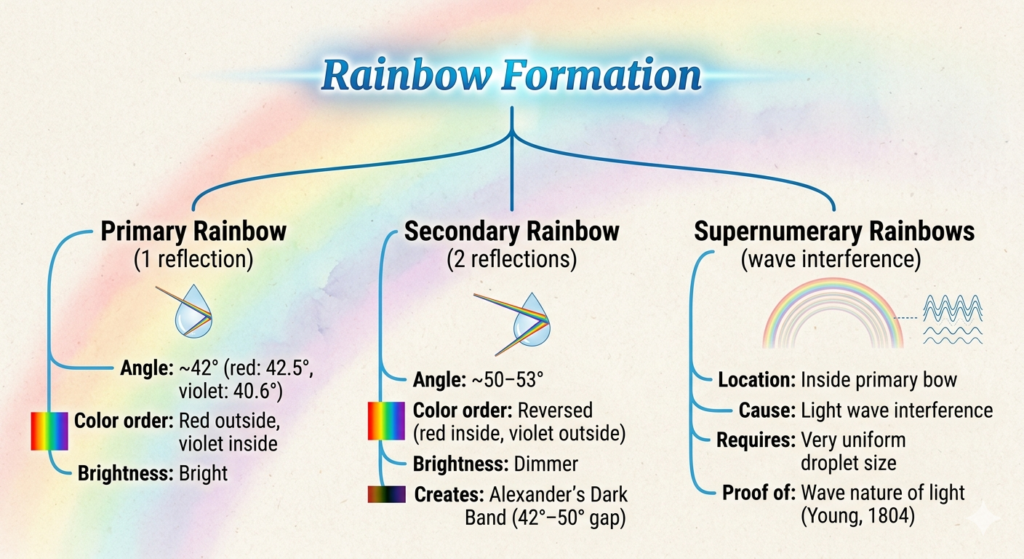
The physics of a rainbow is dictated by a specific constant. Light exits the drop at an angle of approximately 42° relative to the incoming sunlight.
- The Cone of Light: Because this 42° angle exists in 3D space around the line connecting your head to the sun (the anti-solar point), the raindrops that send light to your eyes form a cone. You see the circular edge of this cone as an arc.
- The Airplane View: From a high altitude, if there is rain both above and below you, the horizon doesn’t “cut off” the arc, and the rainbow appears as a perfect circle.
Advanced Rainbow Phenomena
| Feature | Scientific Explanation |
| Double Rainbow | Caused by two internal reflections inside the drop. The second reflection reverses the color order (Red on the inside) and reduces brightness. |
| Alexander’s Dark Band | The noticeably darker region between the primary and secondary bows where no light is redirected toward the observer. |
| Supernumerary Rainbows | Faint, pastel bands inside the primary bow caused by wave interference. These provided the first historical proof of the wave nature of light. |
Sunbeams: The Illusion of Convergence
Crepuscular Rays: Perspective Playing Tricks
Sunbeams, or crepuscular rays, are columns of sunlight made visible by scattering from dust, mist, or aerosols. In perfectly clean air, a beam of light is invisible; you only see the beam because particles reflect light sideways toward your eyes.
- The Illusion: While sunbeams appear to fan out like a handheld fan, the rays are actually parallel.
- The Rail Track Effect: This is a classic trick of perspective. Just as parallel railroad tracks appear to meet at a vanishing point on the horizon, parallel beams of light appear to radiate from the sun because they are originating from a point millions of miles away.
Anticrepuscular Rays: The Final Proof
If you turn 180° away from a sunset, you may see beams converging toward the opposite horizon. These are anticrepuscular rays. They are the exact same parallel beams passing over your head and appearing to meet at the “anti-solar point”. This phenomenon is the definitive proof that the fanning effect is entirely a matter of perspective.
The “Sunset in a Glass” Laboratory
You can prove Rayleigh scattering in your kitchen with a simple demonstration:
- Setup: Fill a clear glass with water and add 3-5 drops of milk.
- The Blue Beam: Shine a flashlight through the side. The beam inside the water looks blue because the milk particles scatter short wavelengths sideways into your eyes.
- The Red Sun: Look at the light hitting the wall behind the glass. It will look orange-red. This is because the “direct beam” has been stripped of its blue light, leaving only the long-wavelength “sunset” colors.
Comparison of Atmospheric Optics
| Process | Particles | Size Parameter | Wavelength Dependence | Visual Result |
| Rayleigh Scattering | N2, O2 Molecules | Much smaller than λ | Extremely Strong (1/λ⁴) | Blue sky; Red/Orange sunset |
| Mie Scattering | Dust, Aerosols, Clouds | Comparable to λ | Weak / Non-selective | White clouds; Hazy/Pale sky |
| Ozone Absorption | O3 Molecules | Molecular | High (UV & Violet) | Reduces violet intensity; UV shield |
| Refraction | Water Droplets | Macroscopic | Refractive Index (n) | Rainbows and Prism effects |
The Golden Rule of Sky Color: The color your eye receives is determined by the last particle the light interacted with before reaching you. Whether it is a blue sky, a red sunset, or a fanned-out sunbeam, you are observing a massive, living physics laboratory.
Beyond the Fading Sky: The Eternal Radiance of Satlok
The “sky wonders” of our world, while breathtaking, are not eternal. The blue horizons, the golden sunsets, and the 42-degree rainbows we admire are merely temporary mortal phenomena that are bound to a destructible Earth and governed by the laws of decay.
In contrast, Satlok is a self-luminous realm of indestructible light. It is an eternal world where the brightness of a single soul’s body has the illuminance that equals the radiance of 16 suns. Unlike our atmosphere, which requires sunlight to scatter off dust and molecules to become visible, Satlok is inherently effulgent, requiring no external source to shine.
The Land of Unending Happiness
To attain Satlok is to dwell in an ocean of happiness. While the landscape may appear familiar with mountains, greenery, and water, everything is made of imperishable substances. The mountains are made of diamonds and emeralds. In this realm, the cycle of birth and death is broken forever.
The Perishable vs. The Permanent
| Feature | Mortal Earth | Immortal Satlok |
| Light Source | External Sun (Perishable) | Self-Luminous (Eternal) |
| Stability | Temporary (Cycle of 84 Lakhs) | Permanent (No Birth or Death) |
To discover the deep spiritual truths regarding the Creation of Nature and how to escape the cycle of birth and death must download “Sant Rampal Ji Maharaj” app from the Google Play Store.
FAQ
Does the ocean’s reflection make the sky blue?
No. This is a common myth. The sky is blue due to Rayleigh scattering, the interaction of sunlight with gas molecules in the atmosphere. In reality, the ocean often looks blue because it is reflecting the sky and absorbing longer red wavelengths of light.
Why do sunsets turn red if the air hasn’t changed?
The molecules remain the same, but the distance the light travels increases. At sunset, sunlight passes through much more atmosphere than at noon. This “long path” scatters away almost all blue and green light, leaving only the long-wavelength reds and oranges to reach your eyes.
Are rainbows actual physical objects in the sky?
No. A rainbow is an optical phenomenon that exists only at a specific angle (42°) relative to the observer and the sun. Because it depends on your physical position, no two people ever see the exact same rainbow; as you move, the “arc” moves with you.
Why do sunbeams look like they fan out?
This is a perspective illusion known as the “railway track effect”. Just as parallel train tracks appear to meet at a distance, sunbeams are actually parallel columns of light. They only appear to diverge because they are originating from a distant point.