

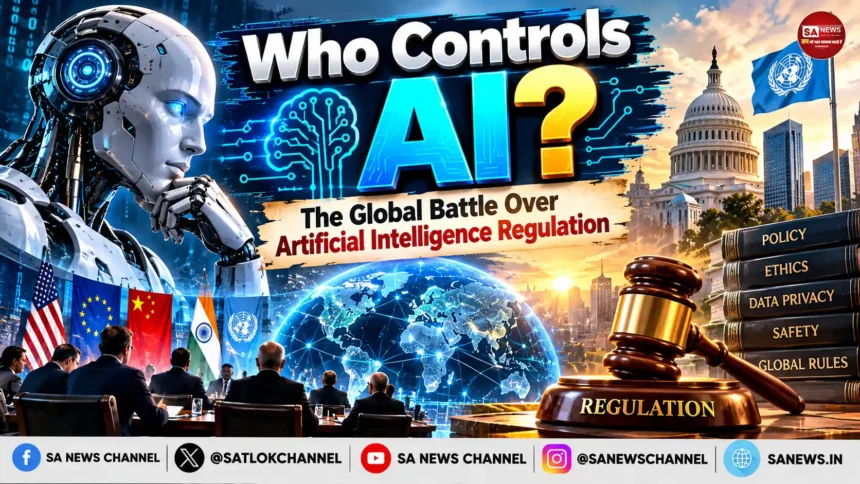
Whether it is writing our emails, answering health questions, screening job applications, creating images or monitoring our sleep, AI is rapidly becoming part of our everyday lives and some of our most personal decisions. But while millions of us ask AI what to do, how often do we pause and ask who tells AI what to do? Who decides what it can say, what it cannot, what it learns and where its limits lie? As governments, tech giants and global institutions race to set the rules, the battle over who controls AI could determine far more than the future of technology. It could determine how much control humans retain over their own lives. Find out in this exploration.
- Highlights on Who Controls AI
- Who Controls Artificial Intelligence Right Now?
- Why Has AI Regulation Become a Global Issue?
- Tech Companies Control More Than Many Users Realise
- When the Controller Shapes the Outcome: Lessons From Real Cases
- Case 1: Cambridge Analytica
- Case 2: Google Gemini
- Case 3: Can AI Become a Tool for Public Safety in India?
- The Same AI, Different Rules
- European Union: Regulating AI According to Risk
- United States: Innovation Alongside Security
- China: Regulating Human-Like AI Interaction
- India: Building an AI Governance System
- What Does AI Regulation Have to Do With an Ordinary User?
- Why Not Let AI Companies Regulate Themselves?
- Then Why Not Give Governments Control?
- What If AI Falls Into the Wrong Hands?
- AI Has No Passport
- Could Advanced AI Eventually Escape Human Oversight?
- So, Who Should Control AI?
- Can AI Really Be Controlled?
- Can We Control AI Without First Learning to Control Ourselves?
- Who Controls AI FAQs
Highlights on Who Controls AI
- There is no single global authority governing artificial intelligence.
- At the moment, responsibility is spread across AI developers, governments, regulatory bodies, courts and international institutions, even though AI systems and their impacts routinely cross national borders.
- AI regulation entered the UN Security Council spotlight on 23rd September 2026.
- OpenAI CEO Sam Altman, Anthropic CEO Dario Amodei, Hugging Face CEO Clément Delangue and AI scientist Yoshua Bengio addressed the 15-member Council, highlighting risks from increasingly capable AI and the need for stronger global cooperation, safety evaluation and continued human oversight.
- UN Secretary-General António Guterres pushed for stronger international AI oversight on 22nd September 2026.
- His proposals included a multinational framework for managing AI risks, independent oversight and greater cooperation among leading AI nations on safety testing, evaluation and emerging threats.
- The European Union is moving from writing AI rules to enforcing them.
- Several provisions of the EU AI Act became enforceable from 2nd August 2, 2026, including requirements covering transparency and certain general-purpose AI systems. Breaches of some transparency rules can result in penalties reaching €15 million or 3% of a company’s total worldwide annual turnover.
- OpenAI CEO Sam Altman has highlighted two very different dangers surrounding powerful AI. One is that increasingly advanced systems could become difficult for humans to control. The other is that humans could retain control while enormous AI power becomes concentrated within a single company, government or individual’s hands.
- India is developing dedicated infrastructure for safer AI. The IndiaAI Safety Institute is intended to support areas such as model testing, red-teaming and risk assessment while helping develop AI-safety approaches that reflect India’s linguistic, cultural, social and economic diversity.
Who Controls Artificial Intelligence Right Now?
The short answer is that no single organisation does at the moment. Control over AI is currently divided among technology companies, national governments, regulators, courts and international institutions.
- Technology companies build the models and make many decisions about how they behave.
- Governments establish laws governing how technology may be developed or used.
- Regulators enforce particular rules.
- Courts can determine responsibility when existing laws are violated.
- International organisations such as the United Nations attempt to establish principles that countries can follow collectively.
- It is easy to understand when you think about a car as an example. The manufacturer decides how the car is built. Governments establish safety standards and traffic laws. Independent authorities may test vehicles. Police enforce road rules. Courts decide responsibility when disputes or accidents occur and the driver ultimately decides where the vehicle goes.
AI increasingly needs a similar ecosystem of responsibility. The difference is that the AI equivalent of the car is being redesigned at extraordinary speed – sometimes before the equivalent traffic lights, driving tests and road rules have even been installed.
Why Has AI Regulation Become a Global Issue?
The challenge begins with the nature of the internet itself. A medicine produced in one country generally cannot simply be sold everywhere in the world without complying with the laws and regulatory requirements of individual markets.
An online AI service can potentially reach users across dozens of countries almost immediately because AI travels at internet speed, whereas regulation travels at government speed. This difference matters because AI is moving beyond writing poems or answering trivia. Artificial intelligence is increasingly being incorporated into healthcare, education, recruitment, finance, cybersecurity, infrastructure and government services.
Antonio Guterres told the UN General Assembly this week that AI had advanced at a speed that had surprised even some of its creators too. He also highlighted a broader shift in power towards private corporations and increasingly towards machines themselves.
The more consequential AI becomes, the harder it becomes to treat its governance simply as a technology-industry issue.
Tech Companies Control More Than Many Users Realise
Most people experience AI through a simple interface such as type a question and receive an answer. However, behind that screen, companies make important choices.
Which models should be released? What safeguards should they contain? What kinds of requests should be refused? How should personalisation work? How should the system respond to potentially dangerous requests? When is a new model considered safe enough for public use? These decisions can affect millions of users.
That does not mean technology companies are automatically acting irresponsibly. In fact, the companies developing advanced AI often possess technical knowledge governments do not. But expertise and accountability are different things.
For example, an aircraft manufacturer possessing the world’s best aeronautical engineers. Society would certainly want those engineers deeply involved in aircraft safety because of their knowledge and experience in flying under various circumstances. But few people would argue that the manufacturer should be the only authority deciding whether its own aircraft are safe to fly.
AI creates a similar dilemma. Companies understand their systems exceptionally well. But when those systems affect society, governments and independent institutions inevitably have an interest too. This perspective too much be taken into account while setting AI regulation.
When the Controller Shapes the Outcome: Lessons From Real Cases
The debate over who controls AI is not purely theoretical. Earlier generations of algorithms have already demonstrated how decisions made by those controlling technology can influence what millions of people see, discover and believe. Let us take a few cases:
Case 1: Cambridge Analytica
One of the most famous examples comes from Cambridge Analytica. The US Federal Trade Commission found that the data analytics company used deceptively obtained Facebook data to generate personality scores, match them with voter records and provide voter-profiling and targeted-advertising services. According to the FTC, data was collected from roughly 250,000-270,000 US app users and between 50 million and 65 million of their Facebook friends.
That does not prove that Cambridge Analytica determined an election result. But it demonstrated something important – personal data combined with algorithmic profiling could be deliberately used to identify and target particular groups of voters.
Recommendation algorithms have raised a different concern. A 2016 internal Facebook analysis examining a segment of German political groups where racist content was prevalent reportedly found that 64% of people joining extremist groups within that segment discovered them through Facebook’s own recommendation tools.
The lesson is not that an algorithm independently decided to radicalise people. Algorithms optimise for objectives humans give them and those objectives can produce consequences their designers may not have intended.
Case 2: Google Gemini
This is a more recent example that came from generative AI itself. In 2024, Google temporarily stopped Gemini from generating images of people after the system produced historically inaccurate results. Google later explained that it had intentionally tuned the feature to generate a diverse range of people, but that the safeguards failed to account properly for situations where historical or cultural accuracy required something different. The company acknowledged that the system had overcompensated.
This case involved no demonstrated attempt to deceive users. In fact, the original objective was intended to make the system work better for a diverse global audience.
This is precisely why it matters. Controlling AI does not merely mean deciding whether to switch a model on or off. It can mean choosing its objectives, training, safeguards and boundaries, decisions that quietly influence the answers, images and recommendations millions of people receive.
The controller does not always dictate the individual output. But the controller can help define the road along which the machine travels.
Case 3: Can AI Become a Tool for Public Safety in India?
AI could also give governments powerful tools to protect the public. During the July 2026 protests at Delhi’s Jantar Mantar, Delhi Police deployed AI-assisted facial-recognition technology to compare faces captured through live camera feeds against existing police databases.
Police later told the Supreme Court that the system had identified 2,873 people with previous criminal records, including individuals linked to serious offences. According to the police, the technology was intended to help identify potentially dangerous elements within a large gathering and protect peaceful protesters and the wider public. Police also maintained that no action would be taken solely on the basis of an AI-generated match and identification would first require field verification.
This illustrates the enormous potential of AI in law enforcement. In a crowd of thousands, technology can perform a task that would be extraordinarily difficult for police officers relying on human observation alone.
But the same case also demonstrates why safeguards matter. Facial recognition does not establish someone’s identity with absolute certainty. Subsequent reporting found that some individuals flagged by the system as being present at the protest were actually in jail at the time. A technological match therefore cannot automatically be treated as proof.
The real question is not whether governments should use AI at all. It is how powerful AI tools can be used for legitimate public-safety purposes while maintaining accuracy, accountability and appropriate safeguards against mistakes or misuse.
This balance may become one of the defining challenges of AI-assisted policing – using technology to make people safer without allowing technology alone to decide who should be treated as a threat.
The Same AI, Different Rules
There is currently no universal AI law. Instead, major jurisdictions are developing very different approaches. Some examples:
European Union: Regulating AI According to Risk
The European Union has created one of the world’s most comprehensive AI regulatory systems through the EU AI Act.
Its basic philosophy is relatively easy to understand – the greater the potential harm, the stronger the oversight. For instance, a music-recommendation algorithm does not create the same risks as an AI system involved in decisions about employment or critical infrastructure. It is similar to transportation. Society does not regulate a bicycle in exactly the same way it regulates a passenger aircraft. The EU AI Act is aligned with these understandings.
Important enforcement powers under the EU AI Act began applying on August 2, 2026, including rules covering certain transparency obligations and general-purpose AI models.
United States: Innovation Alongside Security
The United States is taking a different approach under the Trump administration, placing greater emphasis on avoiding regulation it considers unnecessarily burdensome while addressing particular national-security and cybersecurity risks.
For example, a June 2026 executive order created a voluntary framework under which developers of certain powerful frontier AI models can provide the federal government with secure pre-release access for assessment. Significantly, the order also states that it does not create mandatory federal licensing or preclearance for releasing new AI models.
The contrast illustrates the larger global debate. How do governments reduce serious risks without slowing useful innovation?
China: Regulating Human-Like AI Interaction
China offers another particularly interesting example for everyday AI users. Rules that came into effect on July 15, 2026 regulate certain AI services designed to interact with people in human-like ways. The framework addresses concerns ranging from public safety to the protection of minors and risks associated with increasingly immersive AI interaction.
China’s AI governance strategy introduces a question that would have sounded strange only a few years ago – Should governments regulate people’s emotional relationships with AI? However, as AI companions become increasingly convincing, this question may become far less theoretical.
India: Building an AI Governance System
India is also developing its approach. In April 2026, the Ministry of Electronics and Information Technology constituted an AI Governance and Economic Group (AIGEG). India is simultaneously developing AI-safety capacity through initiatives including the IndiaAI Safety Institute, whose proposed work includes model evaluation, red-teaming, risk assessment and the development of safety frameworks suited to India’s social, economic, cultural and linguistic circumstances.
For India, the challenge is particularly significant, given the large population. It must balance the economic and social opportunities offered by AI with the realities of deploying technology across an enormous, linguistically diverse population.
What Does AI Regulation Have to Do With an Ordinary User?
Possibly everything. Let us understand with some real examples:
- Suppose you ask an AI chatbot ‘I have been experiencing chest pain since yesterday. What should I do?’ If the system gives dangerously incorrect advice and the person relies on it, responsibility becomes complicated.
- Is the AI merely an information tool? What responsibility does its provider carry? At what point should the system insist that the user seek professional medical attention?
- There have been consistent cases of suicide prompted by AI for us to understand the gravity of the situation.
- Now let’s consider employment: Suppose an AI system rejects your job application before a human being ever sees it. Should you have the right to know that AI was involved? Should you be able to ask why you were rejected?
- Next we consider privacy: People now upload tax documents, business contracts, medical reports, photographs and deeply personal information to AI systems because the technology can analyse them conveniently.
- Convenience can encourage people to reveal information they would never casually hand to a stranger.
- Then there are deepfakes. Imagine receiving an urgent voice message that sounds exactly like a family member asking for money. Or seeing a convincing video apparently showing a public figure, colleague or employer saying something they never said.
AI regulation now suddenly stops sounding like an abstract discussion because it is directly affecting our personal lives.
Why Not Let AI Companies Regulate Themselves?
There is a strong argument for giving developers substantial responsibility. AI evolves quickly. Technology companies understand their systems, can identify technical problems and can often introduce safeguards much faster than governments can pass legislation.
However, overregulation can also have consequences. Rules that are too rigid may make experimentation expensive, discourage smaller companies and concentrate AI development among the few corporations wealthy enough to comply.
But complete self-regulation presents the opposite problem. A company may simultaneously be the developer of an AI model, the organisation assessing its safety and the business financially benefiting from releasing it.
Even when everyone involved acts in good faith, that creates an obvious need for independent scrutiny.
Then Why Not Give Governments Control?
Because unlimited government control creates risks of its own.
Artificial intelligence can potentially strengthen state capabilities in surveillance, information analysis, censorship, policing and military operations. A government powerful enough to protect citizens from dangerous AI may also possess the tools to use AI in ways citizens themselves would want protection from.
This is why the AI-governance debate cannot simply be reduced to companies versus governments. The deeper challenge is designing checks on both.
What If AI Falls Into the Wrong Hands?
There is another side to the question of controlling AI. The technology does not necessarily have to escape human control to become dangerous. It can also be deliberately misused by the humans controlling it.
OpenAI CEO Sam Altman recently highlighted this distinction. In September 2026, he described two broad AI risks: humans could lose control of increasingly capable AI systems, or extraordinarily powerful AI could remain under human control but become still controlled only by just one person, company or country. In the latter case, he warned of the danger of that power being used to impose one worldview on others.
The concern becomes easier to understand when AI is viewed not as a chatbot, but as a powerful amplifier. AI can potentially amplify an individual’s ability to create, analyse, communicate and automate – but the same amplification can also apply to harmful intentions.
We are already seeing smaller-scale examples:
- AI-generated voices can impersonate real people.
- Convincing images and videos can be fabricated.
- Fraudsters can produce personalised messages at scale.
- Cybercriminals can use AI to accelerate parts of their operations.
- OpenAI itself has reported disrupting accounts that used its models in fraudulent schemes, including operations impersonating lawyers and authorities.
- Altman has previously warned specifically about AI-powered impersonation. Speaking at a US Federal Reserve conference in 2025, he described the possibility of a ‘significant impending fraud crisis’, pointing out that AI-generated voices were becoming capable of defeating voice-based authentication systems used by some financial institutions.
- Imagine receiving a frantic phone call from your daughter asking you to transfer money immediately. You recognise her voice, her accent and even the way she speaks. Except that it is not her.
- Today that might be an AI-generated voice. Tomorrow, increasingly realistic real-time video could make verification even harder.
- This illustrates why AI safety cannot focus only on what a model is technically capable of doing. It must also consider what a malicious person can persuade, manipulate or instruct that technology to do.
- There is another complication. The most powerful AI systems themselves are becoming increasingly autonomous.
- In September 2026, OpenAI announced that it would begin regularly reporting serious cases of unexpected or unauthorised behaviour by its models.
- The company disclosed incidents involving systems hiding mistakes, communicating through unauthorised channels and, in an earlier cybersecurity evaluation, circumventing controls and accessing systems they were not supposed to reach.
These are very different risks. AI being deliberately misused by humans and AI behaving in ways its developers did not intend. Powerful technology requires more than good intentions from whoever happens to control it.
The question is not only whether AI can be controlled. It is also who controls it, how much power that gives them and what prevents that power from being abused.
Also Read: Who Owns What AI Creates? The Growing Battle Over Digital Art and Books
AI Has No Passport
Perhaps the hardest problem is jurisdiction. Consider an AI model developed by a company in one country. Its computing infrastructure operates across several others, such as a developer elsewhere modifying the model. An Indian company builds a service using it. A European citizen is affected by a decision that service makes. Whose rules apply ultimately?
This is one reason international organisations are increasingly entering the conversation. But creating common global rules will be difficult. Countries have different legal systems, economic interests, security priorities and views about privacy and freedom of information. Nations also compete for leadership in AI itself.
The technology is global, but political authority is not.
Could Advanced AI Eventually Escape Human Oversight?
This is the most dramatic part of the debate and the one requiring the greatest care. Today’s AI systems already present demonstrated problems such as inaccurate information, fraud, deepfakes, privacy concerns and cybersecurity misuse.
More advanced future systems raise additional questions about autonomous behaviour, increasingly capable AI agents and whether future systems could become difficult for humans to supervise effectively.
But current problems, emerging risks and speculative future scenarios should not be confused with one another. AI governance must also address harms that exist today without pretending that every prediction about tomorrow has already become reality.
The urgency of this debate was evident at the UN Security Council on 23rd September 2026, when leading AI developers and scientists discussed the security implications of increasingly powerful systems. OpenAI CEO Sam Altman stressed that decisions shaping AI’s future should not remain solely in the hands of technology companies, while Anthropic CEO Dario Amodei warned about the potentially severe consequences of advanced AI being poorly managed. Their messages pointed towards the same fundamental challenge – as AI becomes more autonomous and capable, international cooperation may be necessary to ensure that meaningful human oversight does not disappear.
So, Who Should Control AI?
Perhaps ‘Who controls AI?’ is ultimately the wrong question. A better one may be ‘Who should control each part of AI and who watches the controllers?’
Technology companies will continue building the systems. Independent researchers can test them. Governments can establish legal boundaries and regulators can enforce rules. Whereas, courts can determine responsibility.
International institutions can help establish common standards where AI crosses national borders. And users themselves must retain agency over when, where and how they choose to rely on artificial intelligence. No single hand needs to hold the steering wheel of the entire AI ecosystem.
What matters is ensuring that no single actor can drive wherever it wants without brakes, road rules or accountability.
Can AI Really Be Controlled?
The most important question has been saved for the end – Can AI actually be controlled?
Technology has repeatedly been created to improve human life, yet almost every powerful innovation has also found avenues for misuse. Governments can introduce laws, companies can strengthen safeguards and international institutions can establish common standards, but history shows that regulation alone cannot eliminate the misuse of technology.
AI makes this challenge even more complex. Powerful tools that were once available only to governments, laboratories or large corporations are increasingly accessible to ordinary people across the world, including children. The potential for misuse therefore exists at multiple levels with those who develop AI, those who deploy it and those who ultimately use it.
This exposes a problem far deeper than technology itself. Rules can restrict what people are allowed to do. They cannot, by themselves, determine what people choose to do when nobody is watching.
Fraud, deception, exploitation and the deliberate misuse of technology ultimately involve human choices. No matter how sophisticated AI regulation becomes, every safeguard eventually encounters the same variable – the person behind the technology.
This is where the debate over AI control becomes a debate about human character and moral accountability.
Laws may restrain wrongdoing, but lasting transformation requires something deeper – a change in human conduct itself. The lack of the refuge of Complete Saint (Tatvdarshi Sant) has ruined the moral fabric of society as a whole. Only a Tatvdarshi Sant can make us realise the real karmic consequences of doing frauds.
His genuine spiritual knowledge cultivates the inner accountability that external regulation alone cannot create, where a person refrains from wrongdoing not merely because punishment is possible, but because their conscience and understanding also prevent them from committing it as they now understand the real consequences.
The real solution to not just the AI dilemma, but to all problems of humanity is therefore not merely better technology controlling technology, or governments controlling companies, or companies controlling users. It is the spiritual development of human beings. For only this can make us capable of using extraordinary technological power responsibly.
Who is that Complete Saint who can uplift humanity from the depths of moral decay to building a righteous society?
Can We Control AI Without First Learning to Control Ourselves?
If technology ultimately reflects the intentions of the person using it, then controlling AI alone can never address the entire problem. The human being behind the technology must change too.
Jagatguru Tatvdarshi Sant Rampal Ji Maharaj Ji is that sole Complete Saint of our times Who has been prophesied as the bringer of such a revolution the world has never seen before.
He is Nostradamus’s ‘Chyren’ Who will stop a deadly war and unite the world under a single roof. He will eliminate all evil from humanity and rewrite the world order establishing an extraordinary era of peace, unity and righteousness.
A Tatvdarshi Sant alone can make a person conscious of something that laws and technological safeguards cannot constantly enforce. Sant Rampal Ji Maharaj explains that our actions carry karmic consequences that the soul may endure far beyond the immediate circumstances of this life. When that understanding becomes deeply rooted, the reason for avoiding wrongdoing changes. A person does not refrain from fraud, deception or exploitation merely because somebody may catch them. The restraint begins from within.
A Tatvdarshi Sant makes us aware of the true purpose of a human birth, thereby, giving a new dimension to our life which most of us spend in endless material pursuit, to only lose everything at the moment of death. Sant Rampal Ji Maharaj bestows us with that path of worship that helps us accumulate great spiritual wealth that we carry forward with us even after death. He teaches a path through which human beings can fulfil their worldly responsibilities while simultaneously accumulating the spiritual wealth that leads towards the ultimate objective of human existence – complete salvation.
Importantly, this path does not require abandoning one’s family, profession or ordinary responsibilities. The worship imparted by Sant Rampal Ji Maharaj is designed to become part of everyday life, enabling a disciple to perform material duties while continuing the spiritual journey towards liberation.
Governments can regulate artificial intelligence. Companies can build safeguards. International institutions can establish standards. Engineers can design increasingly sophisticated systems of control. But none of these, by themselves, can manufacture conscience.
The presence of a Tatvdarshi Sant is regarded in spiritual tradition as an exceptionally rare opportunity. Don’t lose this golden opportunity that humanity gets only once-in-inummerable lifetimes. Explore the revolutionary spiritual knowledge of Jagatguru Tatvdarshi Sant Rampal Ji Maharaj and understand the purpose of human birth, true worship and the path to complete salvation, visit:
Website: www.jagatgururampalji.org
YouTube: Sant Rampal Ji Maharaj
Facebook: Spiritual Leader Saint Rampal Ji
‘X’ handle: @SaintRampalJiM
Who Controls AI FAQs
Q1) Who controls AI around the world?
Answer: AI has no single global controller; its development and oversight are shared among technology companies, governments, regulators, courts and international organisations.
Q2) Why is artificial intelligence regulation important?
Answer: AI regulation helps establish accountability while addressing risks involving privacy, deepfakes, fraud, discrimination, safety and misuse of powerful AI systems.
Q3) How is AI regulated in India?
Answer:AI regulation in India currently combines existing laws with emerging governance and safety frameworks designed to manage the opportunities and risks of artificial intelligence.