

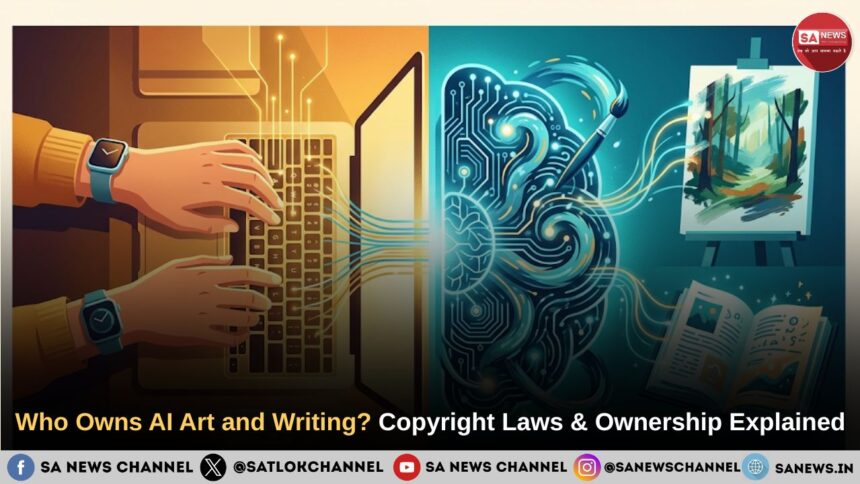
You type a single sentence into an app, tap a button, and in five seconds, you are staring at a beautiful painting. Ask it for a bedtime story, and it hands you an entire book. It feels like magic. But the moment you want to sell that picture or put your name on that book, things get messy fast.
- Who actually owns it?
- Owning the File vs. Owning the Rights
- Who Gets Called the Author?
- Why the Author and the Owner Are Rarely the Same Person
- Platform Rules vs. The Law: Permission Is Not Copyright
- A World Divided: United States vs. India
- Why Prompting Isn’t Truly Creating: The Line Between Direction and Authorship
- Spiritual Copyright: Why Unauthorized Mantras Hold No Power
Who actually owns it?
Is it yours because you came up with the idea and typed the words? Is it the tech company’s because they built the app and fed it millions of examples? Is it the software engineer’s because they wrote the underlying code? Or does it belong to nobody at all?
Think of it like walking into a bakery and ordering a custom cake. You choose the flavor and tell the baker what words to pipe on top in frosting, but you do not bake the cake yourself. Does telling someone or something what to make mean you made it?
For hundreds of years, our legal systems relied on a simple standard: only a living, breathing human being could be an author or an artist. A machine could not hold rights any more than a paintbrush or a camera could. But paintbrushes do not make their own choices. Artificial intelligence does. Now, courts and legal systems worldwide are racing to solve a riddle arriving on every desk: if the software performs the hard work, is there anyone left who can truly claim, “I created this”?
Owning the File vs. Owning the Rights
Holding a physical item is straightforward. If you buy a coffee mug, that mug belongs to you, and nobody can walk into your kitchen and take it without your permission. Digital creation changes that certainty completely.
When an artificial intelligence tool creates an illustration in five seconds, saving the file to your desktop only proves that you possess those specific digital bytes. That simple gap is where modern property rules begin to break down.
Possessing a digital file is basic ownership, but holding its copyright is an entirely different legal power. Copyright does not care who holds the file on a hard drive. Instead, it controls who has the exclusive legal right to sell, duplicate, license, or adapt the creative expression itself. For example, buying a printed paperback book gives you possession of paper and ink, but it gives you zero legal right to print ten thousand copies and sell them outside a train station.
This brings us to the difference between the maker and the legal author:
- Physical Creation is the raw mechanical process of rendering, such as a human hand moving a brush or a computer chip calculating colored pixels.
- Legal Authorship belongs to the recognized human mind that made the deliberate, creative choices behind those strokes.
Because computer programs lack legal personhood, an AI engine cannot sign contracts, hold bank accounts, or sue someone in court. It can physically generate a picture, but current law blocks it from ever holding a copyright.
The tech company providing the software does not automatically own the finished output either. When you buy a hammer from a hardware store, the manufacturer does not gain any ownership over the wooden table you build with it. A software company’s terms of service might give you permission to use the images, but a private corporate agreement cannot invent a legal copyright where the law says none exists.
If a user only typed an everyday sentence into a box, and the computer algorithm generated all the lighting, lines, and composition, the law recognizes no human author at all. In that scenario, the work goes directly into the public domain, meaning anyone on the internet can copy, share, or sell it without asking for permission.
Who Gets Called the Author?
When an AI tool creates a finished project, several parties might try to claim credit:
- The AI System: Disqualified immediately because machines do not possess legal rights.
- The AI Developer: Wrote the computer code and trained the models, but had no idea what a user would create at two in the morning.
- The AI Company: Sells the monthly subscription, acting as a digital toolmaker rather than an artist.
- The AI User: Typed the instructions, but often acted like a customer ordering a product rather than an artist making expressive choices.
- The Employer or Publisher: Paid the project bills, but can only claim ownership after an actual human worker creates something protected by law.
Why the Author and the Owner Are Rarely the Same Person
Many people assume that the person who creates a piece of work automatically owns its commercial rights forever. In reality, the author and the owner are often two completely different entities.
The author is the creative person who conceives the idea and brings it to life. The owner is the individual or business entity that controls the financial rights to sell and profit from it.
Consider an animator working at an Indian film studio. Under standard copyright law, that animator is the flesh-and-blood author who drew the scene. However, under Section 17 of the Indian Copyright Act, when an employee creates original work as part of their regular job, the employer becomes the very first copyright owner. (Most other jurisdictions, including the US, apply a comparable “work made for hire” rule, though the statutory language differs.) The animator receives their agreed salary, while the studio receives the exclusive right to sell cinema tickets and toys.
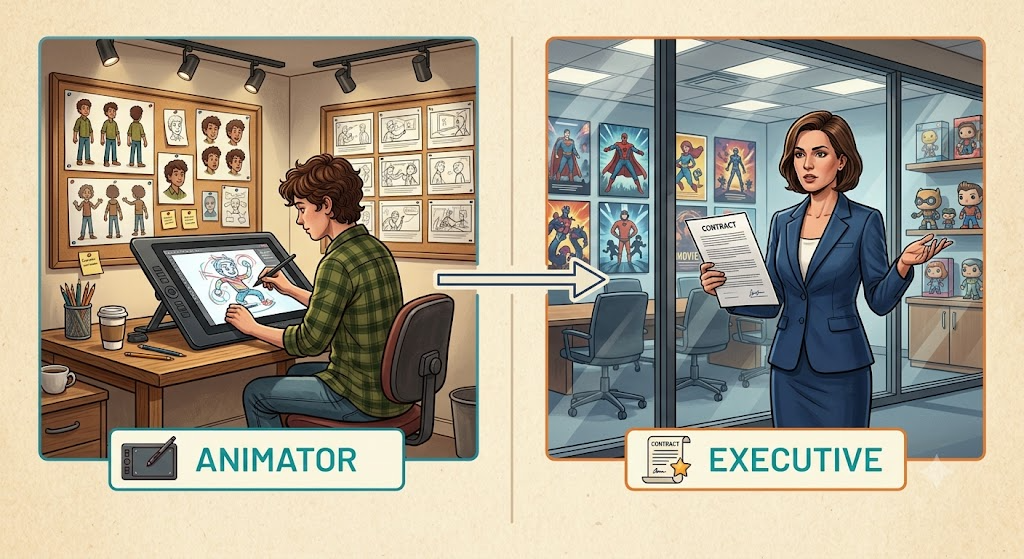
When applied to artificial intelligence, this principle brings complete clarity. Before an individual or a company can argue over who owns an AI asset, the law demands proof that an eligible human authored it in the first place.
Platform Rules vs. The Law: Permission Is Not Copyright
A common point of confusion is assuming that paying for an AI service grants exclusive ownership over the output.
Terms of service govern contract rights, not statutory property rights. While providers often assign commercial usage rights to the user, private corporate terms cannot invent copyright protection where public law refuses it. As the EU IP Helpdesk notes, your legal standing depends on both platform contracts and intellectual property statutes. There is a fundamental difference between having permission to use an image commercially and having the legal right to prevent others from duplicating it.
A World Divided: United States vs. India
Different jurisdictions take starkly different legal routes when deciding who qualifies as an author:
- United States: The U.S. Copyright Office maintains a strict human authorship requirement, a standard reaffirmed in its 2025 AI report. Purely machine-generated outputs cannot be copyrighted, and submitting detailed prompts does not make someone an author. An AI system may serve as a creative tool, but legal protection applies only to the human elements, such as creative arrangements, deliberate selections, or substantial manual edits.
- India: Indian law offers a unique alternative. Under Section 2(d)(vi) of the Copyright Act, the author of a computer-generated work is defined as “the person who causes the work to be created”. This connects authorship directly to human initiative. Once that human author is established, Section 17 governs whether ownership belongs to the creator or transfers to an employer.
Yet uncertainty remains. While global patent and copyright systems rejected non-human inventors and authors like DABUS, the Indian Copyright Office once granted a registration listing an AI named RAGHAV as a co-author, only to later issue a notice seeking its withdrawal, a dispute that remains unresolved.
Why Prompting Isn’t Truly Creating: The Line Between Direction and Authorship
Is a prompt enough to prove someone caused a work, or does the machine remain the true creator?
Across major legal systems, the consensus is clear: typing a prompt is not enough to make you the legal creator. Giving a machine instructions works just like hiring an artist or a contractor. You provide the broad idea, but the algorithm makes the countless creative choices required to generate the final words, colors, and brushstrokes. Because copyright law protects the execution of an idea rather than the idea itself, simple prompting does not meet the legal test for authorship.
Even in countries with computer-generated work provisions, authorities do not hand exclusive ownership rights to someone who merely presses a button. True copyright protection requires visible, separable human craft. If you rewrite the dialogue, rearrange the composition, or paint new layers over an image, those specific human contributions are yours to protect.
Without that manual, human-driven creative effort, the legal reality is settled: the machine’s raw output belongs to no one, falling straight into the public domain for the entire world to use.
Spiritual Copyright: Why Unauthorized Mantras Hold No Power
Just as copyright law protects original creations and stops others from profiting without permission, a universal spiritual law governs sacred devotion. According to Sant Rampal Ji Maharaj Ji, a spiritual teacher cannot simply borrow or copy sacred mantras from an authorized master to give to disciples. Without explicit authority, divine lineage, and direct permission, recited mantras remain mere imitations, completely devoid of spiritual power. To understand the spiritual science of authentic initiation and learn why copied mantras fail, read Gyan Ganga.
Frequently Asked Questions (FAQ)
Can an AI system legally own its creations?
No. Current laws globally require an author to be a legal person. Because algorithms lack legal personhood, they cannot hold property, sign contracts, or register copyrights.
If I write a long prompt, do I automatically own the copyright?
In most jurisdictions, no. Courts and copyright offices view descriptive prompts as instructions. The prompt provides the idea, but the machine creates the tangible expression.
What happens to an AI image if no human author is recognized?
The output immediately enters the public domain. While you keep the downloaded file on your drive, anyone else is legally free to copy, modify, and commercialize that exact image.
Does buying an AI subscription grant me copyright ownership?
No. A subscription provides access to the software under the provider’s terms of service. A private company contract cannot grant statutory copyright ownership if the work itself fails the legal test for human authorship.
How does India handle computer-generated material differently?
Under Section 2(d)(vi) of the Indian Copyright Act, authorship of a computer-generated work is assigned to “the person who causes the work to be created.” This links authorship directly to human initiative, though the user must still demonstrate more than basic, hands-off automation.