

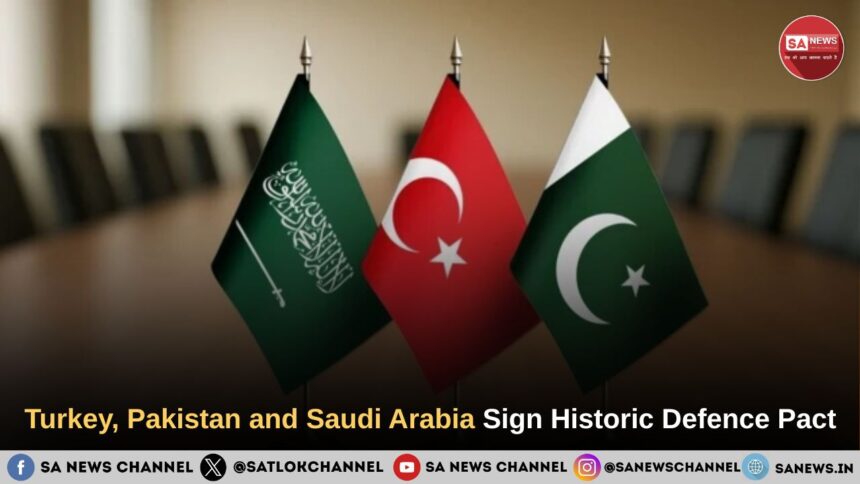
Turkey, Pakistan and Saudi Arabia signed the Mecca Joint Defence Agreement, a historic deal, according to which an attack on one of the states will be considered an attack on all three. Turkish Foreign Minister Hakan Fidan noted that the agreement has similarities with the NATO collective defence clause, but it is neither Muslim NATO nor an alternative to NATO or other international alliances.
- But what exactly does this agreement entail?
- Why Did The Treaty Of Mecca Emerge: Saudi Arabia, Pakistan, Turkey’s Strategic Goals
- Mecca Pact vs NATO: What Is Similar and What Is Different?
- Operational Realities: Command, Military Capability and the Nuclear Question
- Regional Geopolitics: The Turkish Triangle
- Strategic Consequences for India, Iran and Israel
- U.S.-Policy Implications
- Could This Become a Larger Islamic Defence Alliance?
- What’s Ahead For This New Security Framework?
- Conclusion
- FAQs
The agreement was signed in Mecca on August 7, 2026, by the Crown Prince of Saudi Arabia Mohammed bin Salman, Turkish President Recep Tayyip Erdogan, and Pakistan Prime Minister Shehzad Sharif.
The strategic importance of this accord lies in the fact that it unites three states with extensive but different Great Power resources: the oil and financial assets of Saudi Arabia, the military and NATO-related defence industry of Turkey, and Pakistan’s nuclear arsenal.
But what exactly does this agreement entail?
Collective Security and Mutual Assured Destruction: The Mecca Agreement and NATO’s Article 5 Compared
The most critical feature of the Mecca agreement is that it establishes a collective security provision similar to NATO’s Article 5. It means that Turkey, Saudi Arabia and Pakistan will treat an armed attack against任何一个 of them as an attack against all three. Nevertheless, Fidan stressed that the agreement does not seek to create an alternative to NATO. It may seem surprising, but although the alliance’s military spending is substantial, its Article 5 does not stipulate that an attack on one of the allies will be met with a military response from the others. It only obliges NATO members to consult and assist each other in consequence of the attack.
Thus, while the Mecca agreement echoes NATO’s Article 5, it does not duplicate it, as it leaves the response to attacks open. Moreover, it should be borne in mind that the new treaty needs to develop its institutional infrastructure: the foreign ministers’ committee and the Saudi secretariat will have to discuss other aspects of practical cooperation. But does anybody really need it?
Why Did The Treaty Of Mecca Emerge: Saudi Arabia, Pakistan, Turkey’s Strategic Goals
Saudi Arabia, Pakistan, and Turkey have different but credible strategic interests in concluding this treaty. For Saudi Arabia and Pakistan, it is another step towards collective security, while for Turkey, it is a chance to promote its defence industry.
Collective security is in demand in today’s great power competition against the background of which NATO is undergoing a crisis. For Saudi Arabia, the agreement contributes to the strategy of economic and military independence from Washington with which Riyadh has been pursuing with increased vigor in recent years. For Pakistan, partnerships with Saudi Arabia and Turkey create strategic depth, which is a critical factor in its balancing act between China, India, Russia, and the United States. As for Turkey, despite its NATO membership, the new agreement allows it to participate in another collective security structure, which enhances its strategic position. Not least because, according to the treaty, Turkey, Saudi Arabia, and Pakistan will treat attacks on任何一个 of them as attacks on all three.
The Mecca agreement supplements and develops the Pakistan-Saudi Strategic Mutual Defence Agreement of September 2025, according to which either party also considers an attack on one as an attack on both.
Mecca Pact vs NATO: What Is Similar and What Is Different?
| Feature | Mecca Joint Defence Agreement | NATO |
| Members | Türkiye, Pakistan, Saudi Arabia | 32 NATO members |
| Collective defence | Attack on one treated as attack on all | Article 5 |
| Headquarters/structure | New structure being developed | Established institutional system |
| Military integration | Still developing | Highly integrated |
| Nuclear dimension | Pakistan is nuclear-armed | US, UK and France have nuclear weapons |
| Existing alliance commitments | Complements existing arrangements | Formal multilateral alliance |
| Geographic focus | Middle East and South Asia | North Atlantic and wider Euro-Atlantic security |
The comparison is useful, but calling the pact “Muslim NATO” should be treated as a description rather than its official name.
Operational Realities: Command, Military Capability and the Nuclear Question
The most pressing matter concerns not the formulation of the agreement per se but rather the implications of its enforcement in the context of military crisis-management.
NATO has a long-standing history of consultation, joint planning, military compatibility, command structures and exercises.
By contrast, the Mecca pact is a relatively recent phenomenon and the involved parties must now decide upon the precise intelligence, logistical, air-defense and operational mechanisms of collaboration.
The next item of discussion concerns the nuclear question.
Although Pakistan is a nuclear power, the very public language of theSaudi-organized agreement does not necessarily imply an out-right nuclear-sharing treaty. Several analysts have speculated that Pakistan’s status as a nuclear weapons state may serve as an indirect guarantor of Saudi security, but it is crucial to distinguish between Pakistan’s nuclear status as a deterrent and any formal treaty obligations, if any, regarding nuclear sharing.
Regional Geopolitics: The Turkish Triangle
Turkey’s anomalous position as a NATO member which simultaneously participates in a Russian-led Collective Security Treaty Organization (CSTO) makes it the single most intriguing regional actor. Turkey has reaffirmed its commitment to NATO’s Collective Defense doctrine, most recently during the 2026 Ankara Summit, where it once again declared its support for Article 5. With this in mind, it becomes evident that Turkey pursues a policy of strategic hedging, seeking to balance its regional ambitions with its NATO obligations.
Turkish officials have repeatedly asserted that the Mecca agreement is not directed against any third party, including Iran, which is strategically located in the Middle East.
Strategic Consequences for India, Iran and Israel
The agreement’s indirect effects on regional geopolitics are no less significant, despite the Saudi-French-US declaration of its allegedly non-targeted nature. In terms of South Asian geopolitics, it is Pakistan’s inclusion in the agreement which carries the gravest implications for regional stability. If hostilities were to erupt between Pakistan and India, the new collective-security pledge would complicate matters immeasurably.
Meanwhile, Iran finds itself on the receiving end of yet another regional military alliance, albeit one which Ankara has officially stated to be unrelated to Tehran.
Israel, for its part, is concerned with security challenges posed by enhanced defense-cooperation between Pakistan, Turkey and Saudi Arabia, which are all located in its geographical vicinity.
U.S.-Policy Implications
The agreement’s indirect effects on regional geopolitics are no less significant, despite theSaudi-French-US declaration of its allegedly non-targeted nature. In terms of South Asian geopolitics, it is Pakistan’s inclusion in the agreement which carries the gravest implications for regional stability. If hostilities were to erupt between Pakistan and India, the new collective-security pledge would complicate matters immeasurably.
Meanwhile, Iran finds itself on the receiving end of yet another regional military alliance, albeit one which Ankara has officially stated to be unrelated to Tehran.
Israel, for its part, is concerned with security challenges posed by enhanced defense-cooperation between Pakistan, Turkey and Saudi Arabia, which are all located in its geographical vicinity.
Lastly, U.S. foreign policy considerations are also impacted by the agreement, since Saudi Arabia is a key American ally, Turkey is a NATO-member and Pakistan enjoys excellent relations with the U.S. This suggests that despite the public rhetoric of strategic autonomy, none of the three countries are willing to sever their ties with Washington.
Could This Become a Larger Islamic Defence Alliance?
Possibly, but it is too early to call the Mecca pact a fully-fledged Islamic military alliance.
Turkish President Recep Tayyip Erdogan has suggested that the framework could grow to include other powers, including Egypt.
If other regional heavyweights were to join, then the alliance’s security significance would increase substantially.
But at the same time, differences in strategic goals, command structures, foreign policy priorities, and rules of engagement between its backers would add layers of complexity to its functioning.
An alliance is easy to declare;
the more challenging task lies in its implementation.
What’s Ahead For This New Security Framework?
In the immediate term, much will depend on how the agreements on the joint defence are actually implemented.
The key questions regard the framework’s institutional design: how the foreign ministers’ committee will operate; what resources the Saudi-based secretariat will have; how the parties will plan and execute collective military operations; whether intelligence-sharing agreements will be concluded; whether other countries will join; how the pact will respond to attacks on any one of the members; and how the alliance will fit into the larger strategic context, including NATO and other military pacts.
Conclusion
In summary, the Mecca Joint Defence Agreement represents a significant shift in Türkiye-Pakistan-Saudi security relations. Similar to NATO’s Article 5, the agreement’s collective defence language is most notable: in a sense, it is reminiscent of a Muslim NATO, although it is still too early to speculate about Islamic military alliances. Rather, this agreement reflects broader geopolitical trends, as Middle Eastern and South Asian powers seek to build strategic partnerships while maintaining a multi-vector foreign policy. Therefore, the future of the Mecca Pact will depend to a large extent on military cooperation and intelligence sharing, as well as possible expansion and response to external pressures, including attacks on any of the signatories. Thus, this alliance is significant not only in itself but also as a sign of the times.
FAQs
What is the Mecca Joint Defence Agreement?
It is a defence agreement signed by Türkiye, Pakistan and Saudi Arabia that treats an armed attack against one member as an attack against all three.
Is this officially called “Muslim NATO”?
No. “Muslim NATO” is an informal description used to explain the pact’s collective-defence concept. It is not the official name of the agreement.
Is the Mecca pact the same as NATO Article 5?
It has a similar collective-defence principle, but the two arrangements are not identical. NATO has a much larger membership, established institutions and decades of military integration.
Does the agreement include Pakistan’s nuclear weapons?
The publicly available information does not establish a formal nuclear-sharing arrangement. Pakistan is nuclear-armed, but that does not automatically mean the pact provides a nuclear guarantee to the other members.
Is the pact directed against Iran?
Turkish Foreign Minister Hakan Fidan has said the agreement is not directed against Iran or any other country.
Could other countries join?
Yes, the framework could potentially expand. Turkish President Erdoğan has discussed possible future expansion, with Egypt among the countries mentioned.