

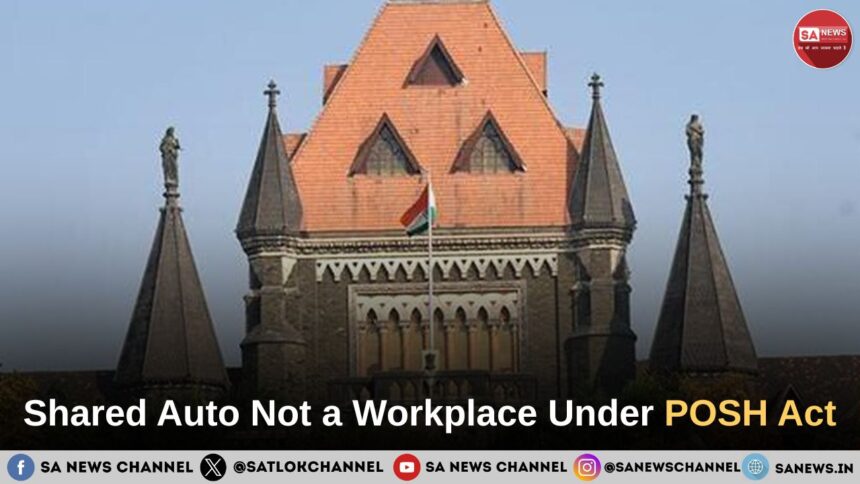
In a significant judgment that could influence workplace harassment cases across India, the Bombay High Court has ruled that a shared auto-rickshaw used for a daily commute does not qualify as a workplace under the Prevention of Sexual Harassment (POSH) Act unless the transportation is provided by the employer.
The ruling came in the case of Siddhesh Pradeep Satpute v. State Bank of India (SBI) and has provided important clarity on the scope of the POSH Act workplace definition and the jurisdiction of Internal Complaints Committees (ICCs).
What Was the Case About?
The dispute arose on March 24, 2023, when an SBI employee was travelling from Kurla railway station to Mumbai’s Bandra-Kurla Complex in a shared auto-rickshaw. A female commuter alleged that he had engaged in inappropriate physical contact during the journey.
The employee denied the allegation, claiming any contact occurred due to overcrowding in the vehicle. The matter escalated when a police complaint was filed, leading to criminal proceedings.
Separately, the woman’s employer forwarded the complaint to SBI’s Internal Complaints Committee. The ICC found the employee guilty of sexual harassment and recommended disciplinary action.
The employee subsequently challenged the decision before the Bombay High Court.
What is a Workplace Under the POSH Act?
A key issue before the court was whether a public shared auto-rickshaw could be considered a workplace under Section 2(o)(v) of the POSH Act.
The provision states that a workplace includes:
“Any place visited by the employee arising out of or during the course of employment including transportation provided by the employer.”
The court held that employer-provided transportation is specifically covered under the law. However, public transport or self-funded travel does not automatically become a workplace simply because an employee is travelling to work.
Bombay High Court Ruling
A Division Bench comprising Justices Firdosh P. Pooniwalla and Suman Shyam ruled that the Internal Complaints Committee lacked jurisdiction because the incident allegedly occurred in a public shared auto-rickshaw not controlled, arranged, or funded by either employer.
As a result, the court quashed the ICC’s order.
Importantly, the judges clarified that the ruling does not determine whether harassment occurred. The criminal case may continue independently under applicable laws.
Also Read: Bombay High Court: Aadhaar, PAN, Voter ID Not Enough to Prove Citizenship
Workplace Coverage Under the POSH Act
| Location or Transport Type | Covered Under POSH Act |
| Office premises | Yes |
| Client locations | Yes |
| Employer-provided cabs | Yes |
| Official business travel | Yes |
| Public buses or trains | No |
| Shared auto-rickshaws | No |
| Personal vehicles | No |
Why This Judgment Matters
The ruling establishes an important precedent for employers and Internal Complaints Committees.
Key takeaways include:
- ICCs must first determine whether an incident occurred within a legally recognized workplace.
- Jurisdiction cannot be assumed merely because employees are travelling to work.
- Employers must ensure POSH investigations remain within statutory limits.
- Criminal remedies remain available for misconduct occurring outside workplace boundaries.
POSH Act in India: Key Facts
According to the Ministry of Women and Child Development, the POSH Act was enacted in 2013 to provide protection against sexual harassment at workplaces and establish grievance redressal mechanisms.
Authority Source: POSH Act
For the full text of the POSH Act, readers may refer to official government resources.
Seeking True Safety Beyond Legal Jurisdictions
The Bombay High Court’s clarification that a shared auto-rickshaw does not qualify as a “workplace” under the POSH Act highlights a profound reality: human laws, definitions, and protective frameworks will always have boundaries and limitations. While society continuously strives to define and create safe spaces, it makes us wonder: can external regulations ever grant us absolute security and peace of mind in an unpredictable world?
When earthly jurisdictions fall short or leave gaps, where do we turn for ultimate protection? True safety cannot be found merely in shifting legal definitions, but in anchoring our souls to the supreme spiritual shelter. Sant Rampal Ji Maharaj provides that ultimate refuge through true spiritual knowledge. By understanding our eternal nature and connecting with the Supreme Power, we transcend the vulnerabilities of this temporary world, finding a permanent sanctuary of inner peace and divine protection that no worldly limitation can ever restrict.
Website: www.jagatgururampalji.org
YouTube: Sant Rampal Ji Maharaj
Facebook: Spiritual Leader Saint Rampal Ji
‘X’ handle: @SaintRampalJiM
FAQs on Bombay High Court Decision
What constitutes a workplace under the POSH Act?
A workplace includes offices, branches, client locations, and transportation provided by the employer while performing work-related duties.
Can ICC investigate harassment during public transport commutes?
No. Based on the Bombay High Court ruling, public transport not provided by the employer falls outside ICC jurisdiction.
Does the ruling prevent legal action against harassment?
No. Victims may still pursue remedies through criminal law and law enforcement agencies.