


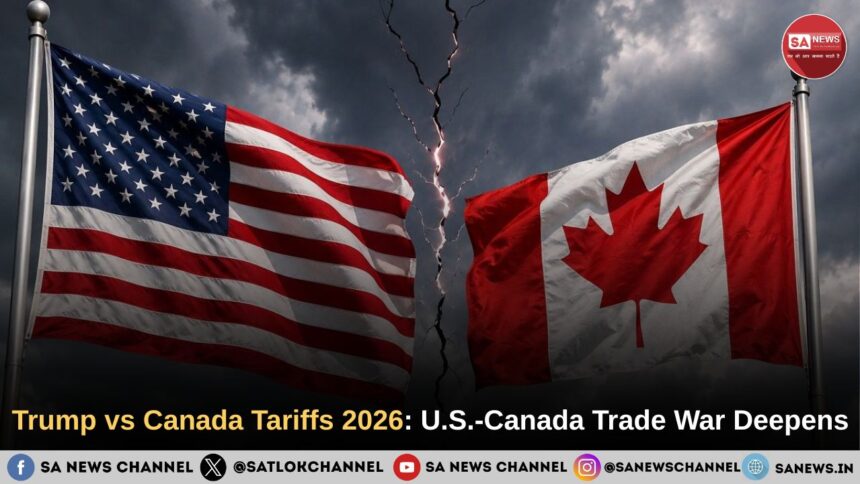
Trade relations between the United States and its northern neighbor Canada are deteriorating once again as negotiations broke down. US President Donald Trump responded to the news that Canada would impose retaliatory tariffs on American goods by criticizing Canada on August 23, 2026. The dispute has the potential to disrupt businesses, farmers, workers, and consumers, and damage the United States-Mexico-Canada Agreement (USMCA) trade deal that governs trade between the nations.
- Background of Trade Dispute between the US and Canada
- Canada Responds with Retaliatory Tariffs
- Effects of Tariffs on Businesses and Consumers
- Impact on the USMCA Trade Agreement
- Effects of Trade Dispute on the US and Canada
- Summary of US and Canada Trade Relations after Tariff Escalation
- From Trade Conflict to Peaceful Cooperation
- Frequently Asked Questions (FAQ)
- Conclusion: Trump Canada Tariff Dispute
Background of Trade Dispute between the US and Canada
The Trump administration and Prime Minister Justin Trudeau failed to reach an agreement on tariffs and other issues relating to automobiles, steel, market access, and trade practices in Canada. Canada’s prime minister stated that it would not accept “unilateral measures” that would hurt the country’s economy or national interests.
President Trump countered with his theory that Canada is trying to be “the 51st state,” enjoying the benefits of being part of the US without joining it. Canada dismissed the claim, stating that it values its sovereignty.
The US announced that it would impose 50% tariffs on about $20 billion worth of Canadian imports as of August 22, 2026. The list of products subjected to tariffs includes wine, hockey equipment, cement, food, electronics, and other goods. Transportation equipment and some other products are excluded. The tariffs are significant because firms in both countries are dependent on each other for parts and supplies. Goods produced in one nation are often used to make other products in the other country.
Canada Responds with Retaliatory Tariffs
Canada announced that it would impose tariffs on a list of American imports on a dollar-for-dollar basis as of September 8, 2026. The targeted products are steel, dairy products, electronics, home appliances, agricultural equipment, and paper products. The prime minister stated that the tariffs would protect Canadian jobs and businesses. However, the retaliatory measures could hurt Canadian firms that buy American products.
Effects of Tariffs on Businesses and Consumers
Firms that are unable to pass on the costs of tariffs to consumers may experience reduced profits, have to seek alternative suppliers, or reduce prices. These impacts are likely to affect automakers, farmers, manufacturers, steel producers, and electronics makers in both countries. Consumers may also suffer from reduced choice and higher prices for the affected products. Canadian consumers may pay higher prices for some American products, while American consumers may pay more for Canadian goods subjected to tariffs by the Trump administration. In addition, farmers and food producers may be negatively impacted by retaliatory measures.
Impact on the USMCA Trade Agreement
The dispute has raised concerns about the future of the USMCA trade agreement, which is critical for trade between the US and Canada. The agreement is essential for the economies of the US, Canada, and Mexico, which are highly integrated, particularly in automobile manufacturing, farming, and the energy sector. Producers and consumers in all three countries are likely to be affected by prolonged trade tensions. Even if the agreement remains in force, businesses may be reluctant to make long-term commitments due to the uncertainty of tariffs.
Effects of Trade Dispute on the US and Canada
President Trump asserts that the retaliatory tariffs imposed by Canada are detrimental to the American economy and businesses. The President’s administration views the measures as an attempt by Canada to “exploit” the US. On the other hand, Canada contends that it has to safeguard its economic and national interests while diversifying its export markets and reducing its reliance on the US. Despite the tensions, the economic interdependence between the two countries is likely to encourage Trump’s administration to reopen negotiations and ease tariffs.
Summary of US and Canada Trade Relations after Tariff Escalation
The Trump administration and Canada are involved in a trade dispute that has resulted in tariffs on billions of dollars worth of goods. The following are some of the key implications of the trade measures:
• Businesses in both countries may suffer from reduced profit margins, disrupted supply chains, and reduced competition.
• Consumers may face higher prices and fewer options when purchasing certain products.
• The dispute could undermine the USMCA trade agreement, which promotes free trade between the US and Canada.
• Canada is likely to benefit from efforts to diversify its export markets.
From Trade Conflict to Peaceful Cooperation
Just as both countries can protect their economic interests while continuing negotiations, individuals should also learn to handle differences without turning others into enemies. His teachings encourage people to rise above hatred, ego, anger, and discrimination and develop universal brotherhood.
This message is also reflected in humanitarian initiatives such as the Annapurna Mission, de-addiction campaigns, blood donation, dowry-free marriages, and other welfare activities aimed at helping people without discrimination.
According to this perspective, lasting peace begins when people recognize humanity above differences and develop compassion toward others. True spiritual knowledge further teaches the importance of understanding the Supreme God and the purpose of human life.
Frequently Asked Questions (FAQ)
Why did Trump impose tariffs on Canada?
The Trump administration views retaliatory measures by Canada as a means of exploiting the US and undermining its businesses and economy.
When will Canada’s tariffs take effect?
Canada announced that it will impose tariffs on American imports as of September 8, 2026.
Will consumers be affected by trade tensions?
Yes. Tariffs may lead to higher prices for certain goods and reduced competition.
Will trade relations between the US and Canada be permanently damaged?
It is too early to tell. However, both countries are highly integrated economically and politically, and trade relations are likely to recover.
Conclusion: Trump Canada Tariff Dispute
The Trump administration and Canada are locked in a trade dispute that has resulted in tariffs on billions of dollars worth of goods. The effects of the trade measures will be felt by businesses and consumers in both countries. The central question is whether Trump’s administration will continue to impose tariffs or reopen negotiations and ease some of the restrictions. The outcome of the dispute will have significant implications for trade relations between the US and Canada, as well as North American trade and the USMCA trade agreement.