


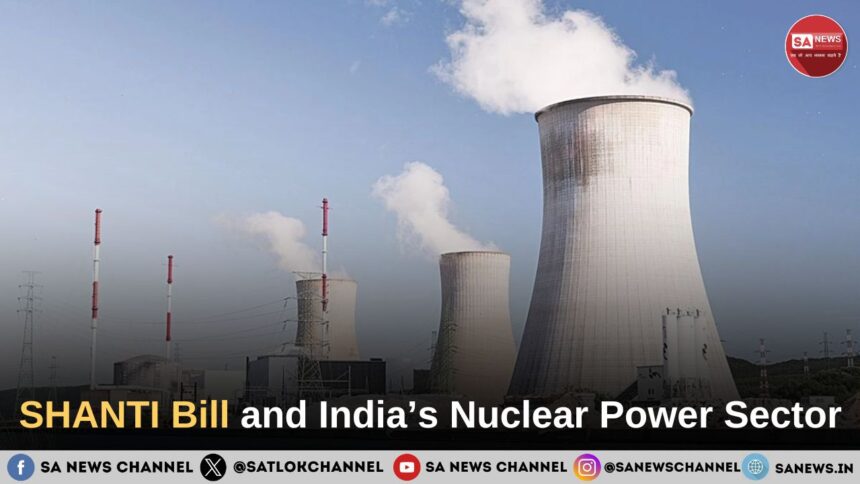
India’s nuclear power sector has traditionally remained under strict government control, guided primarily by the Atomic Energy Act, 1962, and related safety and liability laws. However, with rising energy demand, climate commitments, and the need for advanced technology, policymakers have been exploring ways to modernize the sector without compromising national security or safety.
In this context, the SHANTI Bill (Strategic Holistic Advancement for Nuclear Technology & Investment Bill) has been introduced as a policy reform initiative to bring greater clarity and coherence to India’s nuclear energy framework.

Image: partnership
What is the SHANTI Bill?
The SHANTI Bill is designed to streamline legal, regulatory, and investment mechanisms in the nuclear energy sector. Its primary objective is to create a structured environment that allows limited and regulated private participation, while keeping ownership and strategic control with the government.
The bill seeks to:
- Clarify accountability and responsibility in nuclear projects
- Encourage investment through transparent rules
- Align domestic nuclear regulations with international safety practices
- Strengthen long-term energy security
Scope of Private Participation Under the SHANTI Bill
Under the proposed SHANTI framework, private companies would not take ownership of nuclear reactors, but could participate in clearly defined areas such as:
- Nuclear technology development
- Infrastructure construction and engineering services
- Equipment manufacturing and supply chains
- Project financing and investment partnerships
This approach aims to mobilize large-scale capital, accelerate project timelines, and improve efficiency through advanced technology and management expertise.
Economic and Technical Advantages
If implemented effectively, the SHANTI Bill could:
- Attract domestic and international investment
- Improve access to modern nuclear technology
- Reduce project delays and cost overruns
- Support skilled employment and industrial growth
Image: stock market sector
Private-sector efficiency combined with public-sector oversight may enhance India’s capacity to meet its growing electricity demand.
Nuclear Energy, Clean Power, and Energy Security
Nuclear energy plays an important role in India’s transition toward a low-carbon energy mix. While it is not free from challenges, nuclear power produces electricity with minimal direct carbon emissions, making it a valuable complement to renewable sources such as solar and wind.
By diversifying energy sources, the SHANTI Bill aims to strengthen energy security and reduce dependence on fossil fuels.
Safety, Regulation, and Public Concerns
Experts emphasize that any expansion of private involvement must be accompanied by:
- Strong regulatory oversight
- Strict adherence to safety standards
- Clear liability mechanisms
- Environmental and risk management safeguards
The government has reiterated that nuclear safety, environmental protection, and national interest will remain non-negotiable priorities
Energy Development from a Spiritual Perspective
Sant Rampal Ji Maharajalways emphasizes that material progress must be guided by ethical and spiritual values. According to his teachings, technological advancement without moral responsibility can lead to exploitation and imbalance.
He stresses that when policymakers and business leaders act with spiritual awareness, discipline, and compassion, development can serve humanity rather than harm it.
FAQs: SHANTI Bill and Nuclear Power in India
Q1. What is the SHANTI Bill?
Ans: The SHANTI Bill is a proposed policy framework aimed at enabling regulated private participation in India’s nuclear energy sector while maintaining government control.
Q2. Does the SHANTI Bill allow private ownership of nuclear plants?
Ans: No. Ownership and strategic control remain with the government; private participation is limited to specific supporting roles.
Q3. What is the main objective of the SHANTI Bill?
Ans: To attract investment, improve efficiency, and strengthen energy security under strict safety regulations.
Q4. Why is nuclear energy considered important for India?
Ans: Nuclear energy provides stable, low-carbon power that supports growing energy demand and climate goals.