

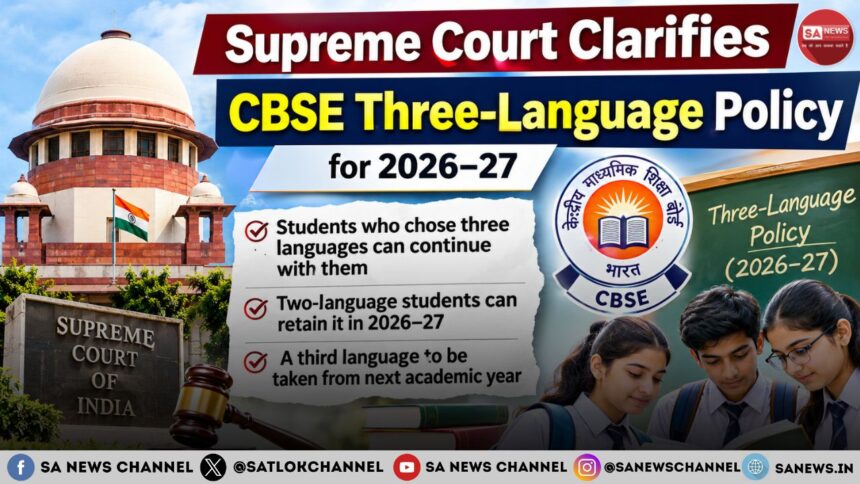
The Supreme Court has clarified how CBSE students may retain language choices during the transition to its three-language framework. Students who chose three can continue with them. Those studying two may retain that arrangement in 2026–27 and take a third language the following academic year, according to the court’s oral observations.
Supreme Court’s Clarification
On November 25, 2026, a bench of Chief Justice of India Surya Kant and Justices Joymalya Bagchi and V. Mohana clarified the position while hearing petitions against CBSE’s three-language formula.
Justice Bagchi said Class VI students who chose three languages could continue; those who had not chosen a third should not be forced. The CJI said two-language students could retain that arrangement in 2026–27, subject to taking a third the following academic year. Schools should not push three-language students back to two.
Why CBSE Approached the Court
CBSE sought clarification of the Supreme Court’s September 28, 2026 directions, saying some students had already selected three-language combinations. The September order extended to the current Class VI batch transitional relief available to Classes VII, VIII and IX.
Also Read: CBSE Class 12 Date Sheet 2027: Full Exam Schedule for Science, Commerce and Humanities
CBSE told the court Class VI had about 23.44 lakh students; 4,186 retained two languages, while over 93 per cent opted for three, the board submitted.
Policy Background
The framework is linked to the National Education Policy (NEP) 2020 and National Curriculum Framework for School Education (NCF-SE) 2023. CBSE Circular No. Acad-17/2026 (April 9) directed schools to introduce R3 in Class VI in 2026–27.
Circular No. Acad-33/2026 (May 15) provided for three languages in Class IX from July 1, including at least two native Indian languages. Circular No. Acad-49/2026 (July 10) detailed implementation, relaxations, assessment and exemptions.
Class-Wise Arrangements in 2026–27
Class X: The current batch remains under the earlier two-language system; no third language is required.
Class IX: Three languages are prescribed, at least two being Bhartiya Bhashas. Students already studying two non-native languages may continue with them as a one-time relaxation but must add one Bhartiya Bhasha as R3.
Classes VII and VIII: Students who have started two non-native languages must add one Bhartiya Bhasha and continue that combination through Class X.
Class VI: CBSE provides for three languages, two Bhartiya Bhashas. The Supreme Court’s oral clarification says students who chose three may continue; those who did not should not be forced during the transition.
Assessment and Exemptions
CBSE’s July circular provides internal school assessment, without a separate Class X board examination, for R3 in current Classes VII, VIII and IX. It says current and later Class VI batches would take the R3 board examination in Class X. However, the September 28 court order extended transitional relief to current Class VI; the November 25 oral clarification is not a written amendment to the circular.
Exemptions cover Children with Special Needs under the Rights of Persons with Disabilities Act, 2016; CBSE schools outside India; and foreign students returning to India. The circular also addresses inter-state migration and flexible teacher support.
What Parents and Schools Should Check
Parents should verify the language combination recorded by the school and ask which transitional provision applies, including how R3 will be assessed. Schools should follow CBSE circulars and court directions without unnecessary mid-session changes.
FAQs on CBSE Three-Language Policy
1.What did the Supreme Court clarify?
Students who chose three languages may continue; schools should not force them back to two.
2.Can two-language students continue in 2026–27?
Yes. They may continue this year and take a third language next academic year.
3.Does the current Class X batch need a third language?
No. CBSE retains the two-language system for this batch.
4.Will Classes VII–IX transition batches have a separate R3 board exam?
No. CBSE provides internal school assessment for these batches.
5.Why did CBSE approach the Supreme Court?
It sought clarification because some students had already selected three languages.