

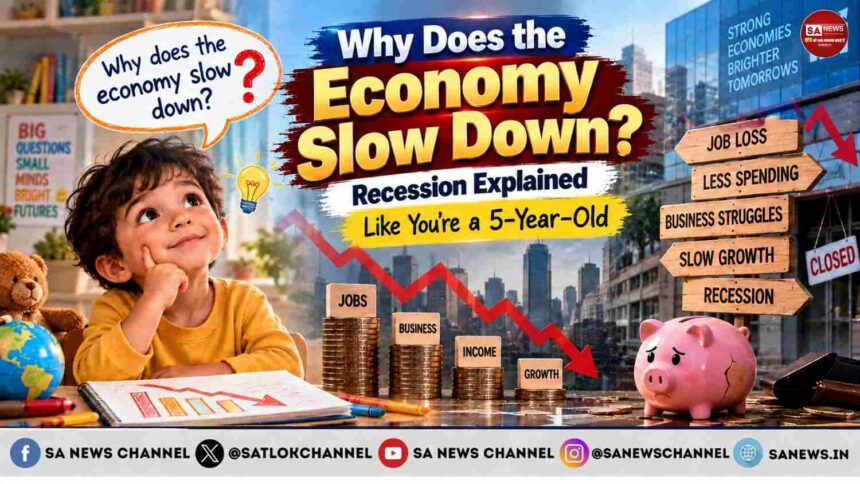
Oracle is cutting jobs. Other big companies announce layoffs. News headlines start talking about slowing economies. Does that mean a recession is coming? Not necessarily. A company can lay off thousands of workers without the whole economy being in recession. So what would have to happen for us to call something a recession? This article saves you from GDP charts, central banks and complicated economic language momentarily by visiting a tiny place called Happy Town, enabling us to understand recession and its implications in simple words.
- Recession Explained: Highlights
- What Is a Recession? Explained Like You’re 5
- What Is Demand and Why Does It Matter in a Recession?
- Why Can Everyone Saving Money Become a Problem?
- Why Does Unemployment Rise During a Recession?
- If Oracle Is Laying Off Workers, Are We Already in a Recession?
- What Is GDP and What Does It Have to Do With Recession?
- How Do Economists Know a Recession Is Really Happening?
- What Is the Difference Between an Economic Slowdown and a Recession?
- What Is the Difference Between Inflation and Recession?
- What Causes a Recession?
- What Is Investment in an Economy?
- Is a Recession Coming in 2026?
- What is the Road to Economic Recovery From a Recession?
- How Long Does a Recession Last?
- Can India Become the Golden Bird Again?
- FAQs: What is Recession?
Recession Explained: Highlights
- A recession happens when economic activity falls significantly across a large part of an economy for more than a very brief period.
- Layoffs alone do not mean recession because individual companies can cut jobs for many different reasons.
- Demand simply means how much people want and are able to buy.
- GDP is like a giant scoreboard measuring the value of goods and services produced by an economy.
- Unemployment can rise when businesses sell less and therefore need fewer workers.
- One person’s spending becomes another person’s income, which explains why widespread reductions in spending can reinforce an economic downturn.
- Inflation and recession are different: inflation means prices are broadly rising; recession means economic activity is broadly shrinking.
What Is a Recession? Explained Like You’re 5
A recession is what happens when lots of people and businesses across an economy start buying, selling, earning and producing less than before, and the decline becomes significant and widespread.
But even that sounds complicated. So let us enter Happy Town as an example. Happy Town has 100 families. It has a bakery, toy shop, clothes shop, restaurant, bank and small factory. Every day, people go to work. They earn money. Then they use some of that money to buy things from other people.
Riya’s mother buys a INR 200 cake from the bakery. The baker uses part of that INR 200 to pay Ravi, who works for him. Ravi uses some of his salary to buy a shirt. The clothes-shop owner uses some of her earnings to eat at the restaurant. The restaurant buys bread from the bakery. The money keeps travelling around Happy Town.
Here is the first big idea – Your spending becomes somebody else’s income. And somebody else’s spending can become yours.
Then Something Changes
One day, people in Happy Town become nervous about money. Riya’s mother thinks maybe she should not buy that INR 200 cake this week, she might need the money later. That is perfectly sensible. But 50 other families also have the same thought. Suddenly, the bakery sells far fewer cakes. This is where the situation changes
The baker earns less. So he tells Ravi, ‘I’m sorry. I don’t need you for six days this week anymore. I can only give you four.’ Now Ravi earns less. So Ravi decides not to buy the new shirt he wanted. The clothes shop loses a sale subsequently. Its owner orders fewer clothes from the factory. The factory receives fewer orders and decides it does not need to hire two new workers after all.
Those workers become nervous about finding jobs, so they spend less too. And this goes on like a cascading effect.
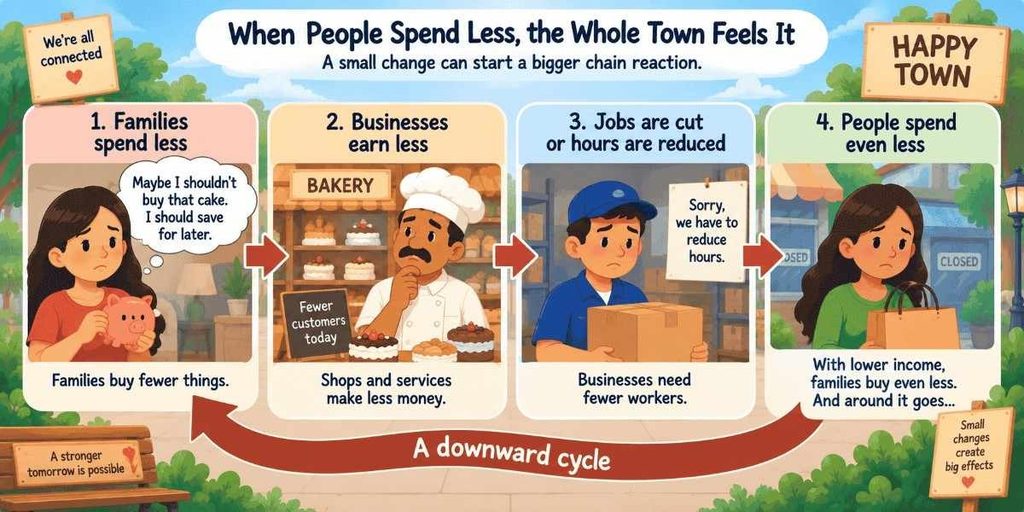
People spend less, therefore businesses earn less, businesses cut costs, people earn less and people spend even less. This downward chain reaction is the basic idea behind a recession.
In the real world, economists use a more precise definition. The NBER (National Bureau of Economic Research) describes recession as a significant decline in economic activity that spreads across the economy and lasts more than a few months, while considering its depth, diffusion and duration.
When lots of Happy Town starts slowing down together, something bigger than one struggling shop may be happening.
What Is Demand and Why Does It Matter in a Recession?
A very simplistic definition of demand is how much of something people want and are able to buy. Let us revisit Happy Town.
Suppose Happy Town’s bakery normally sells 100 cakes every day. Then families become worried and buy only 60. The baker has not forgotten how to bake neither has Happy Town run out of flour.
People simply are not buying as many cakes. Demand for cakes has fallen.
Now imagine the same thing happens to clothes, restaurant meals, furniture, cars, holidays and hundreds of other things. Businesses receive less money as a result of this. When businesses consistently sell less, they may produce less, postpone expansion, stop hiring or reduce workers.
This is why falling demand can help turn people’s worries about the economy into actual economic weakness.
Why Can Everyone Saving Money Become a Problem?
Saving money is sensible for an individual family and something we are taught within the fabric of Indian society. But a sudden economy-wide fall in spending can reduce other people’s incomes.
This sounds strange definitely, but here we need to think from the perspective of a country’s economy.
Surely saving is good. For example Riya’s family from Happy Town, it absolutely can be for their long term benefit. Suppose they normally spend INR 10,000 and decide to save another INR 2,000 for emergencies. That may make their household financially safer.
But now imagine almost every family in Happy Town becomes frightened simultaneously and stops buying cakes, clothes and other commodities. As a result, restaurants remain empty, businesses may cancel expansion.
Each family may be making a sensible personal decision. But collectively, businesses receive much less income. They may then cut jobs or wages, which gives families even more reason to save and spend less. Neither is wrong in such scenarios, it is, however, an absurd cycle
Economists associate this idea with the paradox of thrift – what can be prudent for one household can have very different effects when large numbers of households sharply reduce spending at the same time.
Saving is not bad, of course. The recession problem appears when spending and economic activity fall sharply across much of the economy.
Why Does Unemployment Rise During a Recession?
Unemployment can rise during a recession because businesses selling fewer goods and services may need fewer workers.
Now, we return to our baker. When he sold 100 cakes a day, he needed five employees. Now he sells only 60. He might first stop hiring. Then he may reduce overtime and then working hours. If sales remain low, he may eventually let someone go.
That worker now loses income and becomes more careful with money. So the worker stops eating at the restaurant. Subsequently, the restaurant earns less as it loses one customer. And perhaps the restaurant cuts someone’s hours too. Notice the loop?
Fewer sales can lead to fewer jobs, while fewer jobs can lead to even fewer sales.
This is why economists pay close attention to employment during downturns.
If Oracle Is Laying Off Workers, Are We Already in a Recession?
Layoffs at one company do not prove that an economy is in recession. This is where Happy Town becomes especially useful to understand.
Imagine only the toy shop cuts five jobs. Why? Perhaps it bought machines that can perform some tasks automatically or perhaps it closed one department. Maybe it is also spending more money building an online business.
Meanwhile, the bakery is packed, the restaurant has queues and the clothes shop is hiring. The factory is producing more than last year. Happy Town is not in recession just because the toy shop changed its workforce. The same principle applies to Oracle.
Oracle’s current restructuring includes job cuts, but the company is simultaneously making huge investments in AI infrastructure. Its first-quarter FY2027 capital expenditure reached USD 28.5 billion while revenue increased 30% year-on-year to USD 19.3 billion. Layoff news does induce fear among the working class.
That does not tell us whether Oracle’s individual employment decisions are good or bad. It tells us a simple reality – layoffs and recession are not synonyms.
One company cutting jobs tells us something about that company. A recession requires evidence that economic weakness has spread much more broadly.
What Is GDP and What Does It Have to Do With Recession?
GDP measures the value of final goods and services produced within an economy over a particular period.
But let us translate that with our ongoing example. Imagine Happy Town has a giant notebook. Someone records the value of the cakes baked, clothes produced, restaurant meals served, furniture made, haircuts given and many other final goods and services produced in the town. Then they add everything together. Think of that giant total as Happy Town’s economic scoreboard.
A real country’s version is called Gross Domestic Product or GDP.
Now suppose Happy Town produces substantially less this year than before. Whether it is cakes, clothes, restaurant meals, factory output, etc. The town’s economic scoreboard can fall.
Economists pay close attention to real GDP, which adjusts for price changes, because higher prices alone shouldn’t make us think an economy produces more actual goods and services.
Two consecutive quarters of falling real GDP are often called a recession in everyday discussion. But this is a rule of thumb, not a universal official definition. The IMF notes that GDP alone can provide too narrow a picture, while the NBER uses multiple measures when dating U.S. recessions.
How Do Economists Know a Recession Is Really Happening?
Economists look for significant weakness across multiple parts of an economy rather than declaring recession because of one company, industry or statistic.
One measurement is not enough to provide the necessary understanding. So economists ask are businesses producing less, people losing jobs, incomes weakening, people buying less, factories producing less? Is real GDP shrinking?
When many of those indicators point downward together, the evidence becomes much stronger.
The NBER, for example, considers measures including employment, personal income, consumer spending, sales and industrial production when assessing U.S. business cycles.
A recession is an economy-wide story, not a single bad headline.
What Is the Difference Between an Economic Slowdown and a Recession?
An economic slowdown means the economy is still growing, but more slowly; a recession means economic activity has actually contracted significantly and broadly.
Suppose Happy Town produced INR 100 worth of goods and services, then INR 110, then INR 115. It is still producing more each time. But its growth has slowed.
Now suppose output starts falling meaningfully across the town. This is where we differentiate. It would be like a car going from 80 km/h to 40 km/h, which means the car has slowed down. Going backwards means its direction has actually changed.
An economic slowdown and recession are therefore not interchangeable terms.
What Is the Difference Between Inflation and Recession?
Inflation means prices are broadly rising, while recession means overall economic activity is significantly declining.
Let us go back to the cake example. Yesterday, Riya’s cake cost INR 200. Today, people still want plenty of cake, but it costs INR 250. This is inflation.
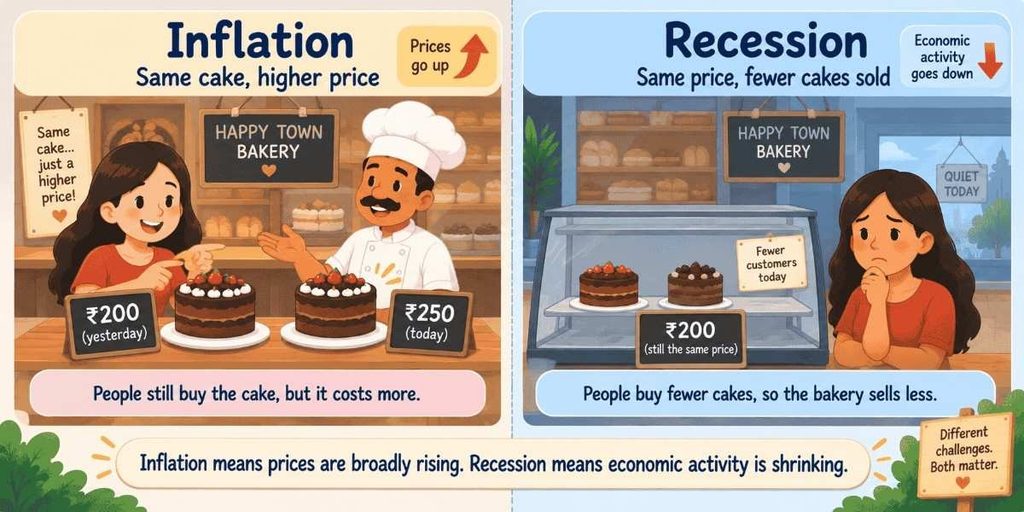
Now imagine the cake still costs around INR 200, but families stop buying it. The bakery produces fewer cakes and reduces workers’ hours. This looks more like a recession.
The easiest distinction is:
- Inflation = things cost more.
- Recession = the economy does less.
High inflation and weak economic growth can sometimes happen together. When stagnation and high inflation coexist, economists commonly use the term stagflation.
What Causes a Recession?
A recession can begin for many different reasons, but the important part is that the original problem eventually spreads through the economy.
Now, consider several things that could upset Happy Town.
Interest rates become expensive
Riya’s parents want to borrow INR 5 lakh. The bank will lend them the money, but borrowing now costs much more. Because of this, they postpone their purchase.
The baker also decides not to borrow money for a new oven. The factory postpones buying a machine. Interest is essentially the price you pay for borrowing money. When interest rates rise substantially, borrowing can become less attractive, reducing spending and business investment.
Banks become afraid to lend
Now we move to a situation where Happy Town Bank suffers huge losses and becomes nervous. Even people who want loans struggle to get them.
Businesses postpone projects. Families postpone major purchases. Eventually, credit dries up and therefore, a serious financial crisis can spread into the wider economy.
Something unexpected hits the town
The covid-19 pandemic is the biggest live example we have. A pandemic could close shops and a war could disrupt energy supplies. An asset bubble could burst.
What follows is that consumers could suddenly lose confidence.
Different shocks can start recessions; the defining feature is that economic weakness becomes broad and significant.
What Is Investment in an Economy?
Economic investment includes spending that increases the ability to produce goods and services in the future.
This is not just somebody buying shares or objects like an oven. Investment in an economy looks like a factory building another production line, a clothes shop opens another branch or a company builds a warehouse. These are forms of business investment.
Now imagine businesses become worried about the future. The factory could cancel its machine or the clothes shop could cancel its new branch. This would mean less work for the people who would have built, transported, installed and operated those things.
This is why falling investment can amplify an economic downturn. The IMF notes that investment typically falls much more sharply than consumption during recessions.
Is a Recession Coming in 2026?
India is not currently projected to enter recession, although economic risks remain.
The OECD’s June 2026 outlook projects India’s real GDP to grow 6.3% in FY2026–27 and 6.4% in FY2027–28. However, the OECD also expects higher inflation to weigh on private consumption, investment to slow amid higher oil and gas prices and employment growth and labour-force participation to weaken.
So the present picture is more nuanced than simply big companies announcing layoffs signalling a recession coming. Current forecasts still point to Indian economic growth, not contraction. But economists continue watching the clouds.
And Happy Town gives us the perfect analogy: One shop having trouble does not mean the town is in recession. You start worrying about recession when trouble spreads across the town.
What is the Road to Economic Recovery From a Recession?
An economy begins recovering when economic activity starts growing again.
Let us return to Happy Town one final time. Families gradually feel safer about their jobs. Riya’s mother buys the cake again. The baker starts selling more and he restores Ravi’s working hours. Now, Ravi has more income, so he finally buys that shirt. The clothes shop receives more customers and it increases its factory order. The factory needs another worker. The downward circle has started turning upward. This is recovery in its simplest form.
Sometimes central banks can support this process by lowering interest rates, making borrowing cheaper. Governments can also use spending or tax measures to support economic activity. But neither tool is magic.
The appropriate response depends on what caused the recession and recovery can take time. Economic recovery occurs when activity begins expanding again, typically alongside improvements in production, spending, investment, employment or income.
How Long Does a Recession Last?
A recession has no fixed duration because different economic shocks create different downturns.
For example, the U.S. pandemic recession lasted only from February to April 2020. Despite being extraordinarily brief, the NBER classified it as a recession because the decline in employment and production was exceptionally deep and widespread.
More broadly, IMF research notes that recessions in its historical sample typically lasted about a year, although individual episodes varied considerably.
Importantly, a recession ending does not mean everyone immediately feels better. A business may still struggle and someone who lost a job may still be searching. Families may still be rebuilding savings. An economy can therefore begin recovering before every household experiences that recovery.
But what about recovery from social setbacks? Are economic and the moral fabric of society interconnected?
Can India Become the Golden Bird Again?
We began this article with a tiny imaginary place called Happy Town. And by now, one thing should be clear – an economy is ultimately made up of people and the choices they make every day.
What families earn matters. What they spend on matters more. Whether they are drowning in unnecessary debt matters. Whether businesses and households feel secure enough to plan for tomorrow matters.
This is where Jagatguru Tatvdarshi Sant Rampal Ji Maharaj presents a remarkably different roadmap for rebuilding India, not by beginning with complicated economic formulas, but by beginning with the human being.
Consider a family that previously spent a substantial part of its income on alcohol, cigarettes, tobacco or other intoxicants. If that addiction disappears, the money does not disappear with it. It can remain with the household and be redirected towards food, healthcare, children’s education, better housing, savings or other genuine needs. Now multiply that change across millions of households. This will positively boost the economy and the individual families too.
The same principle is applied to another major source of financial pressure – extravagant weddings and dowry. Under Sant Rampal Ji Maharaj’s teachings, marriages are conducted through the simple 17-minute Ramaini ceremony without dowry or unnecessary pomp and expenditure. The roadmap argues that eliminating these customs can protect families from exhausting lifelong savings, selling assets or entering years of debt merely to conduct a marriage.
This is an important economic idea hiding inside a social reform. You do not strengthen a family only by helping it earn more. You can also strengthen it by stopping money from being needlessly destroyed. Before writing off the ideas, bear to read it completely.
But the roadmap does not stop here. Sant Rampal Ji Maharaj describes a social order built around ‘Serve and Unity’, i.e. service and universal brotherhood, in which responsibility is treated as service rather than an opportunity for personal gain. It envisages public responsibilities being entrusted to honest subject experts, while corruption, social division, addiction, dowry and wasteful display are progressively removed from society.
Alongside this is the Annapurna Muhim, through which assistance is directed towards people facing material hardship. The broader principle is again simple that resources should serve human welfare rather than vanity, addiction or practices that leave families poorer. This is what actually makes an economy and society genuinely strong.
Happy Town Analogy
Imagine Happy Town again, but this time its families are not losing large portions of their income to addiction. Parents are not borrowing enormous sums for dowry and extravagant weddings. More household resources can instead reach education, health, nutrition, housing and productive needs. People are encouraged to live simply, help one another and regard service as a collective social responsibility, not personal merely accumulation.
Happy Town has not merely become richer on paper. Its people have changed what they consider worth spending their lives and money on. This is the distinction that will matter eventually.
GDP, recession and inflation can tell us about the economy, but none of those numbers, by themselves, can answer what kind of society we are trying to build with all that economic activity?
Sant Rampal Ji Maharaj’s roadmap for making India the ‘Golden Bird’ once again places that question at its centre. Discover how India’s GDP calculation would transform unbelievably if Sant Rampal Ji Maharaj’s roadmap is really put into action, in the following video. It also reveals few more important calculations with exact analysis that is bound to leave any economist in awe for its futuristic and inclusive strategy:
After all, an economy is not some giant machine operating somewhere above our heads. It is millions of human lives connected together. Change what happens inside those lives and you begin changing the economy they collectively create.
Learn more about Jagatguru Tatvdarshi Sant Rampal Ji Maharaj’s path breaking spiritual knowledge by visiting:
Website: www.jagatgururampalji.org
YouTube: Sant Rampal Ji Maharaj
Facebook: Spiritual Leader Saint Rampal Ji
‘X’ handle: @SaintRampalJiM
FAQs: What is Recession?
Q1) What is a recession in simple terms?
Answer: A recession is a broad decline in economic activity when spending, production, income, and employment weaken across an economy.
Q2) What is the difference between a recession and an economic slowdown?
Answer: A slowdown means the economy is still growing at a slower pace, while a recession involves a significant decline in overall economic activity.