

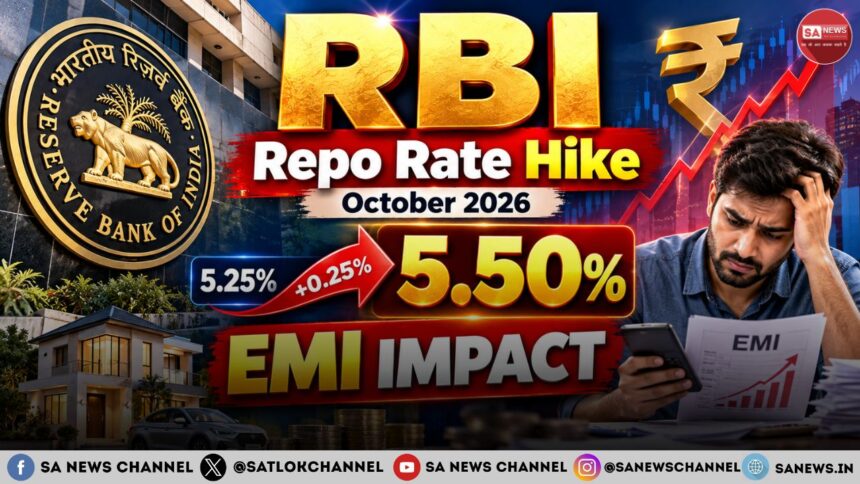
RBI Repo Rate Hike October 2026: Borrowing money in India could become more expensive. In a significant policy reversal, the Reserve Bank of India (RBI) raised its repo rate from 5.25% to 5.50% on 7th October 2026, announcing its first interest rate increase since February 2023. What will this move translate into for the common citizen in his daily life? Read on to understand why the RBI raised interest rates and how this decision could affect your finances.
- Highlights: RBI’s October 2026 Monetary Policy
- RBI Raises Repo Rate to 5.50%: What Changed?
- Why Did the RBI Increase the Repo Rate?
- India’s GDP and Inflation Outlook: What Does the RBI Expect?
- Understanding the Repo Rate: Why It Matters to Your Finances
- Repo Rate Hike: What Could Change in Your Monthly Home Loan Repayments?
- Will Fixed Deposit Rates Increase Too?
- Could the RBI Raise Interest Rates Again?
- A Turning Point for India’s Monetary Policy?
- Can Financial Stability Alone Guarantee Peace and Happiness in Human Life?
Highlights: RBI’s October 2026 Monetary Policy
- New repo rate: 5.50%, following a 25-basis-point increase.
- MPC decision: All six members supported the rate hike.
- Policy stance: Shifted from neutral to calibrated tightening.
- Inflation forecast: 5.2% for FY2026-27.
- GDP growth forecast: 7.1% for FY2026-27.
- Next MPC meeting: 2-4 December 2026.
RBI Raises Repo Rate to 5.50%: What Changed?
The RBI’s Monetary Policy Committee, headed by Governor Sanjay Malhotra, concluded its three-day meeting on 7th October 2026 with a unanimous decision to increase borrowing costs.
The announcement is particularly significant because the central bank had reduced interest rates by 125 basis points during 2025 before keeping them unchanged through several meetings in 2026.
The October decision signals a departure from that earlier approach. The MPC also adopted a calibrated tightening stance. Unlike the rate increase, this decision was not unanimous as two members preferred maintaining the neutral stance.
According to the RBI, the revised stance means interest rate cuts are unlikely in the immediate future. Depending on economic conditions, policymakers may either maintain the current rate or increase it further.
A quick glance at the changes brought in the Monetary Policy revision:
| RBI Policy Indicator | October 2026 |
| Current repo rate | 5.50% |
| Previous repo rate | 5.25% |
| Rate increase | 25 basis points |
| Standing Deposit Facility | 5.25% |
| Marginal Standing Facility | 5.75% |
The move comes at a time when India’s economy continues to expand, but rising food prices, expensive energy and global uncertainty threaten to push inflation higher.
For several Indians, the announcement raises immediate questions. Will home loan EMIs increase? Could fixed deposits become more rewarding? And why is the RBI tightening monetary policy when economic growth remains strong? Let’s find out.
Why Did the RBI Increase the Repo Rate?
The primary reason behind the October 2026 repo rate hike is the growing risk of persistent inflation.
India’s retail inflation climbed from approximately 4.5% in July to 4.8% in August 2026.
Three developments have made the inflation outlook particularly challenging.
- Food prices are becoming a concern: An inadequate southwest monsoon and El Niño conditions have created uncertainty around agricultural production. Price increases in commodities such as onions and sugar have added pressure to household budgets.
- Global energy prices remain unpredictable: Continuing tensions in West Asia have unsettled international crude oil markets.
- For an oil-importing economy such as India, expensive crude can increase transportation, manufacturing and distribution costs, potentially affecting prices across multiple industries.
- Inflation is spreading beyond essential goods: The RBI has also observed indications of broader price pressures.
- This matters because inflation becomes more difficult to contain when businesses begin adjusting prices across a wider range of products and services.
Raising interest rates is one way to discourage excessive borrowing and spending, although its effects take time to emerge.
India’s GDP and Inflation Outlook: What Does the RBI Expect?
Interestingly, the RBI increased interest rates despite projecting stronger economic growth.
Its October assessment forecasts 7.1% real GDP growth for FY2026-27, supported by domestic consumption, investment and services activity.
However, the inflation picture is less comfortable.
| Economic indicator | RBI forecast |
| FY2026-27 GDP growth | 7.1% |
| FY2026-27 CPI inflation | 5.2% |
| FY2026-27 core inflation | 4.4% |
| Q3 inflation | 6.0% |
| Q4 inflation | 5.7% |
These numbers reveal the challenge facing policymakers. India’s economy is growing, but unchecked price increases could gradually erode consumers’ purchasing power.
Data References:
- MoSPI (Official Consumer Price Index Database)
- Ministry of Statistics (July 2026 CPI Inflation Report)
Understanding the Repo Rate: Why It Matters to Your Finances
The repo rate is the interest rate at which commercial banks can obtain short-term funds from the RBI against eligible securities.
When this rate rises, funding through the RBI’s repo facility becomes more expensive. Banks may respond by adjusting their lending rates, which can affect everything from housing loans to business financing.
However, an increase in the repo rate does not automatically mean every bank loan becomes costlier overnight.
Repo Rate Hike: What Could Change in Your Monthly Home Loan Repayments?
We will illustrate through an example. Consider someone with an INR 30 lakh outstanding home loan, 20 years remaining and an annual interest rate of 8.50%.
If the lender passes on the entire 0.25-percentage-point increase, the interest rate could rise to 8.75%.
Calculation example:
| Loan Details | Before | After |
| Interest rate | 8.50% | 8.75% |
| Loan outstanding | INR 30 lakh | INR 30 lakh |
| Remaining tenure | 20 years | 20 years |
| Approximate EMI | INR 26,035 | INR 26,511 |
That represents an additional monthly repayment of approximately INR 477, assuming the tenure remains unchanged. Actual increases depend on the loan’s interest-rate benchmark, reset schedule and lender’s conditions.
Will Fixed Deposit Rates Increase Too?
Higher policy rates can create opportunities for savers. Banks seeking additional deposits may introduce more attractive FD interest rates. However, such changes depend on individual banks’ funding requirements and competitive strategies.
Existing fixed deposits generally continue earning their originally agreed rates until maturity. Therefore, savers should compare current offers rather than assume that every bank will immediately raise deposit returns.
Could the RBI Raise Interest Rates Again?
Further repo rate increases remain possible, but the RBI has not committed to a predetermined series of hikes. Its next decision will depend on inflation, economic activity, international energy prices and the extent to which rising costs influence broader pricing behaviour.
The next MPC meeting is scheduled for 2-4 December 2026.
A Turning Point for India’s Monetary Policy?
The October repo rate increase represents more than a change of 25 basis points. It marks a shift in the RBI’s priorities as policymakers respond to renewed inflation risks.
For borrowers, the coming months may bring higher financing costs. For savers, changing deposit rates could present new opportunities. The bigger question is whether inflation will ease sufficiently to prevent another increase.
For now, India’s monetary policy has entered a more cautious phase, making the RBI’s next decision particularly important.
Can Financial Stability Alone Guarantee Peace and Happiness in Human Life?
Interest rates fluctuate, inflation rises and falls, and economic conditions remain unpredictable. While financial planning is essential, can material wealth alone guarantee lasting peace, happiness and security? After all, even the greatest fortunes cannot protect us from every uncertainty of life.
Jagatguru Tatvdarshi Sant Rampal Ji Maharaj explains through our sacred scriptures that the true purpose of human life extends far beyond accumulating worldly wealth. His spiritual knowledge offers a deeper understanding of why human life is precious, why worldly comforts are temporary, and how true devotion, according to the sacred scriptures, can lead the soul towards permanent happiness and liberation.
Learn more about how authentic worship bestowed by a Tatvdarshi Sant (Complete Saint) can transform one’s life completely, by visiting:
- Website: www.jagatgururampalji.org
- YouTube: Sant Rampal Ji Maharaj
- Facebook: Spiritual Leader Saint Rampal Ji
- ‘X’ handle: @SaintRampalJiM