

Sukhpura is a small village located within the Bhiwani district of Haryana, India. For several decades, this agrarian community has faced significant infrastructural challenges related to water management and distribution.
- The Institutional Appeal to Satlok Ashram Shri Dhanana Dham
- Rapid Implementation of Technical Survey and Google Mapping
- Over-Night Logistic Mobilization and Material Allocation
- Statements from Local Representatives and Villagers
- Previous Philanthropic Frameworks in Neighboring Sectors
- Technical Execution and Operational Guidelines
- Technical Parameters of the Sukhpura Water Project
- Permanent Structural Resolution for Sukhpura Livestock and Agriculture
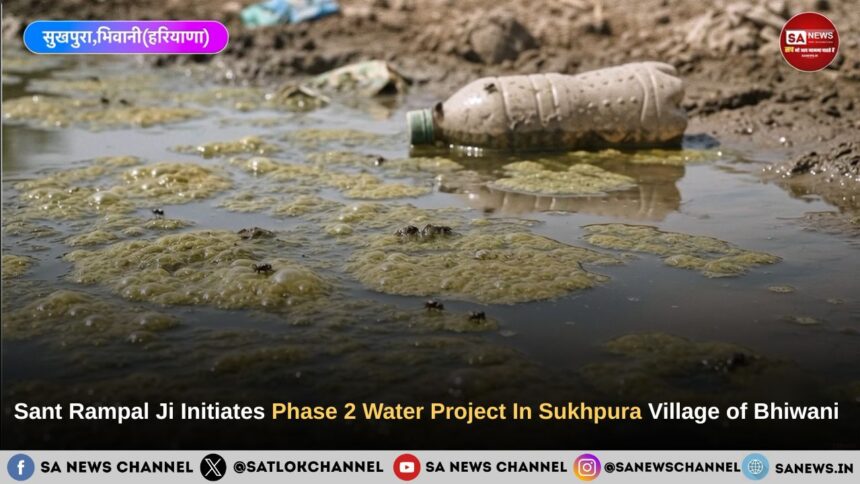
The primary water source for local livestock is the village pond, locally referred to as the Johad. While the Jui Feeder Canal flows in close proximity to the village boundary, the lack of an established pipeline network prevented the redirection of clean canal water into the pond. Consequently, the village suffered from a dual crisis: a lack of fresh water influx and an inability to drain highly contaminated water out of the reservoir.
This long-standing issue severely impacted local livestock farmers, agriculture, and general animal husbandry, which form the economic backbone of the region.
The Institutional Appeal to Satlok Ashram Shri Dhanana Dham
Having exhausted administrative channels due to limited regional resources and the small population size of the village, the leadership of Sukhpura sought alternative assistance. A formal delegation from the Gram Panchayat, consisting of approximately 10 to 20 village representatives, including the incumbent village headman (Sarpanch) Anup Singh, traveled to the Satlok Ashram Shri Dhanana Dham.
The delegation submitted a formal letter on their official panchayat letterhead directly to Jagatguru Tatvdarshi Sant Rampal Ji Maharaj, requesting immediate infrastructural support to link the Jui Feeder Canal with the village pond.
Rapid Implementation of Technical Survey and Google Mapping
Upon receiving the formal request from the Sukhpura Gram Panchayat, Sant Rampal Ji Maharaj immediately ordered an expert technical survey team to mobilize and assess the site conditions.
The deployment occurred with such rapidity that the technical survey team arrived at Sukhpura village before the panchayat delegation had completed their return journey from the ashram.
The evaluation team utilized a multi-layered technical approach to map out the pipeline route, which included:
- Drone-based aerial photography and topographical analysis to assess the elevation changes between the Jui Feeder Canal and the village pond.
- Google Mapping coordinates to plot the precise path across private and public lands.
- Ground-level physical inspections and linear measurements conducted in the presence of the village council.
The survey verified that the linear distance between the Jui Feeder Canal and the village pond measured approximately 700 meters across 12 acres of land, necessitating exactly 2400 linear feet of piping.
The technical team concluded that an 8-inch diameter pipeline alongside a 10 Horsepower (HP) electric motor would be required to facilitate both the input of clean canal water and the outward drainage of stagnant waste water.
Over-Night Logistic Mobilization and Material Allocation
Following the submission of the technical field report, Sant Rampal Ji Maharaj immediately sanctioned the release of all necessary engineering hardware and installation equipment.
The logistical operation was completed overnight, with heavy transport vehicles arriving at Sukhpura village between 4:00 AM and 5:00 AM the following morning.
Sant Rampal Ji Maharaj directly provided the following materials to the Sukhpura Gram Panchayat:
- 83 individual pieces of heavy-duty 8-inch diameter underground pipes totaling 2400 feet.
- Industrial-grade Fevicol SR adhesive solution for secure pipe joint bonding.
- High-pressure directional pipeline bends and joints (Handi bands).
- Heavy-duty mechanical nuts and bolts for flange connections.
- Specialized air release valves to prevent vacuum blockages inside the pipeline.
The rapid arrival of these materials surprised the local population, who noted that standard public sector procedures for similar scale infrastructure pipelines typically require weeks or months of administrative processing.
Statements from Local Representatives and Villagers
Upon the arrival of the transport convoy, the residents of Sukhpura assembled at the village boundary to receive the technical teams and the cargo. The welcoming proceedings included traditional drum performances (Dhol-Nagada), flower garlands, and the recital of the Mangalacharan prayer.
Sarpanch Anup Singh stated that the village had experienced severe drinking water shortages for their livestock, forcing farmers to source water from fields on a temporary basis. He confirmed that the entire inventory of 83 pipes had been safely received and officially handed over to the panchayat’s custody.
Another resident, Sunil, stated that the speed of execution was unprecedented in his personal experience, referencing traditional adages regarding spiritual benevolence. A local resident named Krishna reported being awakened at 5:00 AM by the arrival of the transport truck asking for directions to the village temple, expressing absolute satisfaction with the prompt delivery.
An elderly resident (Tau) added that the water crisis had remained unresolved since the year 1995, and this project establishes a permanent solution for the entire village.
Previous Philanthropic Frameworks in Neighboring Sectors
During the public interactions, both the village representatives and the visiting technical coordinators referenced previous large-scale regional relief work conducted by the organization. During past severe flood events in the Bhiwani and Jhajjar regions, adjacent villages such as Badpad and Bahni Bhairon faced extreme waterlogging that threatened to destroy entire seasonal wheat crops.
During that environmental crisis, Sant Rampal Ji Maharaj directly provided high-capacity dewatering pumps, heavy motors, and extensive pipeline networks to drain millions of gallons of standing water out of agricultural lands.
Local farmers noted that these interventions saved the agricultural economy of multiple districts, ensuring that the regional wheat output remained stable when absolute crop failure seemed imminent.
Technical Execution and Operational Guidelines
The operational transfer of the infrastructure equipment was conducted under strict technical directives. The service coordinators informed the Sukhpura Gram Panchayat that the installation must follow a sequential protocol to ensure long-term structural integrity.
Technical Parameters of the Sukhpura Water Project
| Metric / Component | Technical Specification / Detail |
| Total Pipeline Length | 2400 Linear Feet (700 Meters) |
| Area Covered | 12 Acres of regional terrain |
| Pipe Dimension | 8-Inch Diameter Heavy-Duty |
| Total Pipe Units Delivered | 83 Pieces |
| Adhesive and Sealants | Fevicol SR Compound with heavy-duty Nut-Bolt systems |
| Structural Fittings | High-Pressure Handi Bends and Air Valves |
| Pumping Component | 10 HP Electric Motor (Pending underground installation) |
| Estimated Installation Time | 2 to 3 Days using local tractor units and labor |
| Project Genesis Date | June 19, 2026 |
The village council has deployed tractor units to begin digging trenches for the underground pipeline. The community expects to complete the manual assembly and earth-filling process within two to three days, after which the technical team will conduct a final inspection to deliver and mount the 10 HP motor.
Permanent Structural Resolution for Sukhpura Livestock and Agriculture
The successful deployment of the 2400-foot pipeline marks the structural resolution of a thirty-one-year-old water management failure in Sukhpura village. By creating a controllable, bidirectional flow mechanism between the Jui Feeder Canal and the village pond, the community has secured an enduring water supply for thousands of cattle and agricultural plots.
The speed of this intervention emphasizes how direct civic mobilization and organized philanthropic governance can rapidly bypass bureaucratic stagnation to deliver vital public utilities directly to rural populations.