


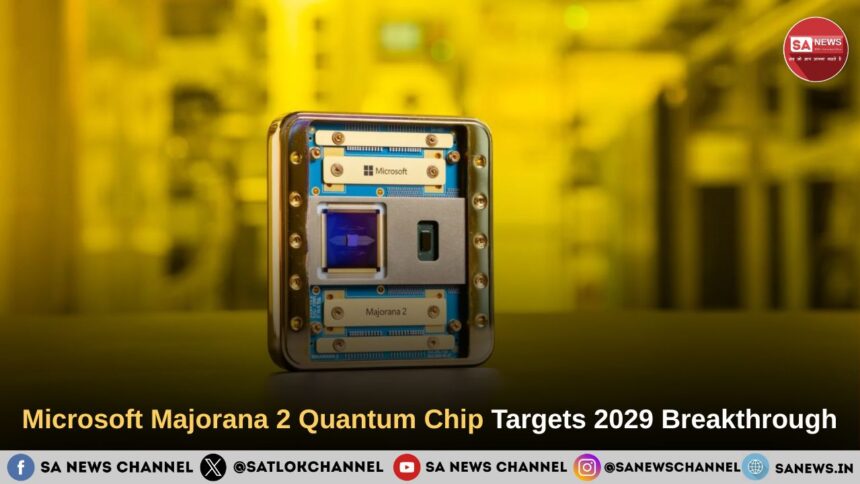
San Francisco, June 2, 2026: Microsoft has unveiled Majorana 2, the latest generation of its topological quantum computing technology, during its annual Build 2026 conference in San Francisco. The company says the new platform represents a significant engineering breakthrough, delivering topological qubits that are approximately 1,000 times more reliable than those demonstrated in Majorana 1, which was introduced in early 2025.
- Dramatic Reliability Gains
- New Lead-Based Superconductor Powers the Upgrade
- Agentic AI Played a Central Role
- Commercial Quantum Computing Timeline Moved Forward
- Building on the Foundation of Majorana 1
- Excitement Across Multiple Industries
- Skepticism Remains Strong
- Microsoft Defends Its Progress
- A Distinct Path in the Quantum Race
- What Comes Next?
The announcement marks a major milestone in Microsoft’s long-term effort to build a scalable quantum computer based on Majorana quasiparticles, an approach that differs fundamentally from the superconducting, trapped-ion, and photonic architectures pursued by many competitors.
Dramatic Reliability Gains
According to Microsoft, the most notable achievement in Majorana 2 is the dramatic improvement in qubit stability. The company reports that the new topological qubits now exhibit an average lifetime of around 20 seconds, with some qubits remaining stable for up to one minute under test conditions.
This represents a substantial improvement over the millisecond-scale lifetimes associated with earlier demonstrations. At the same time, quantum operations reportedly continue to run on a microsecond timescale, allowing for meaningful computational activity within the extended coherence window.
Microsoft argues that this combination of longer-lived qubits and fast operations significantly strengthens the case for topological quantum computing as a practical path toward large-scale quantum systems.
New Lead-Based Superconductor Powers the Upgrade
A key factor behind the performance gains is a major materials redesign. Microsoft has shifted from an aluminum-based superconducting material used in earlier devices to a lead-based superconductor.
The company says this change has effectively doubled the topological gap, a crucial parameter that helps protect quantum information from environmental noise and operational errors. A larger topological gap theoretically provides stronger intrinsic error resistance, one of the central promises of the topological quantum computing approach.
The company describes this development in detail while highlighting Microsoft’s broader research efforts. Microsoft also released a technical preprint on June 2 as researchers continue evaluating the findings.
By improving the physical protection of quantum states, Microsoft hopes to reduce the amount of error correction required in future quantum systems.
Agentic AI Played a Central Role
Microsoft also revealed that the development of Majorana 2 was heavily supported by Microsoft Discovery, the company’s agentic AI platform for scientific research and materials innovation.
According to Microsoft, the AI system assisted researchers in identifying and optimizing materials configurations that could improve device performance. The company describes this as a notable example of artificial intelligence accelerating scientific discovery and engineering development.
The announcement highlights Microsoft’s broader strategy of combining advances in AI and quantum computing to shorten research cycles and tackle complex scientific challenges.
Commercial Quantum Computing Timeline Moved Forward
Perhaps the most ambitious aspect of the announcement is Microsoft’s updated roadmap.
The company now says it is targeting a scalable, commercially useful quantum computer by 2029, effectively cutting its previous timeline in half. Microsoft believes that inherently more stable topological qubits could enable practical quantum systems with significantly reduced error-correction overhead compared with other architectures.
The long-term vision remains the same: a quantum platform capable of scaling to extremely large numbers of qubits while maintaining operational reliability.
Building on the Foundation of Majorana 1
Majorana 2 follows the debut of Majorana 1 in early 2025, which served as Microsoft’s first major demonstration of a topological qubit architecture designed with large-scale scalability in mind.
Majorana 1 introduced the company’s vision of eventually integrating millions of qubits on a single chip, a goal that remains central to Microsoft’s quantum strategy. Majorana 2 is being presented as the next step toward turning that vision into a practical engineering reality.
Excitement Across Multiple Industries
The announcement has generated considerable interest among researchers, technology leaders, and industry observers. If Microsoft’s claims hold up under broader scrutiny, the technology could have far-reaching implications for fields such as:
- Chemistry and molecular simulation
- Advanced materials science
- Complex optimization problems
- Cryptography and cybersecurity
- Drug discovery and industrial research
Large-scale fault-tolerant quantum computers are widely expected to unlock computational capabilities that are beyond the reach of classical systems.
Skepticism Remains Strong
Despite the excitement, the announcement has also been met with substantial skepticism from parts of the scientific community.
Critics point to Microsoft’s history of ambitious quantum computing claims, particularly previous debates surrounding evidence for Majorana quasiparticles and questions about independent validation. Some physicists argue that the latest results require additional peer-reviewed analysis and reproducible experimental verification before definitive conclusions can be drawn.
Many researchers are calling for more publicly available data, independent benchmarks, and external replication of Microsoft’s findings.
Microsoft Defends Its Progress
Microsoft maintains that its engineering progress is real and measurable. The company says the results are supported by extensive internal testing and data shared with partners, including defense-related organizations.
Company officials have framed Majorana 2 not merely as a scientific experiment but as evidence of a transition toward scalable quantum engineering. Microsoft argues that the latest advances demonstrate meaningful progress toward practical quantum systems rather than isolated laboratory achievements.
A Distinct Path in the Quantum Race
Microsoft’s topological approach continues to stand apart from competing strategies pursued by major industry players such as IBM and Google, which primarily focus on superconducting qubits, as well as organizations developing trapped-ion and photonic quantum technologies.
Supporters argue that topological qubits could offer superior intrinsic stability, while critics note that the approach presents unique fabrication, measurement, and verification challenges.
As the global quantum computing race intensifies, companies across the sector are advancing increasingly aggressive development timelines.
What Comes Next?
For now, Majorana 2 represents one of the most closely watched developments in quantum computing. The coming months will be crucial as researchers examine Microsoft’s technical preprint, released on June 2, and await further peer-reviewed publications and independent assessments.
Whether Majorana 2 proves to be a transformative breakthrough or another step in a longer journey, its performance claims are likely to remain a focal point of discussion throughout the quantum computing community.
Observers will be watching closely for independent benchmarks, peer-reviewed validation, and additional technical disclosures that can determine whether Microsoft’s accelerated path toward a commercially useful quantum computer by 2029 is achievable.