

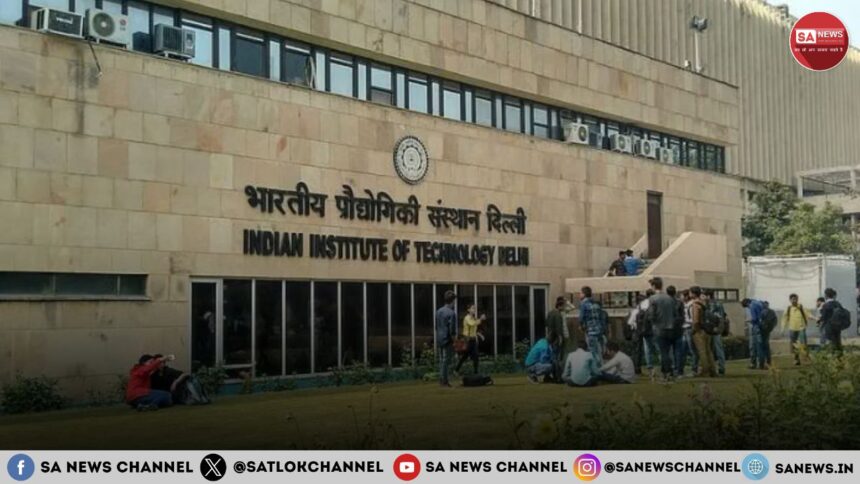
Multiple Indian Institutes of Technology (IITs) will introduce 6,000 specialized seats across undergraduate, postgraduate, and doctoral levels starting in the 2027 academic cycle. Developed in partnership with the Bhupat and Jyoti Mehta Family Foundation, this phased eight-to-ten-year expansion targets robotics, physical artificial intelligence, and space technology.
- Complete IIT 2027 Seat Matrix Across BTech, Master’s, and PhD
- Why Half of the Seat Matrix Targets Master’s and PhD Research
- Interdisciplinary Curriculum Merging Hardware and Physical AI
- Engineering Designed for Indian Operating Realities
- Paid Industry-Residency Semester and Capstone Execution
- Dedicated IIT School for Space Science and Aerospace Training
- Faculty Recruitment and Admission Roadmap for 2027 Aspirants
- What Is More Important Before Checking This Seat Matrix
- Frequently Asked Questions (FAQs) on IIT 6000 Deep-Tech Seats 2027
To support the new academic schools and teaching laboratories, participating IITs will also recruit more than 120 dedicated faculty members. Rather than treating AI purely as digital software, the initiative focuses on embodied intelligence—systems that perceive, reason, and act reliably in real-world physical environments.
Complete IIT 2027 Seat Matrix Across BTech, Master’s, and PhD
A defining feature of the proposed IIT 2027 seat matrix is its equal split between undergraduate intake (3,000 seats) and advanced postgraduate or doctoral research capacity (3,000 seats).
| Engineering Vertical | BTech Seats | Master’s (MTech/MS) Seats | PhD Seats | Total Seats |
| Robotics and Physical AI | 2,500 | 1,200 | 1,300 | 5,000 |
| Space Engineering and Technology | 500 | 300 | 200 | 1,000 |
| Total IIT Expansion | 3,000 | 1,500 | 1,500 | 6,000 |
Why Half of the Seat Matrix Targets Master’s and PhD Research
Allocating 1,500 master’s seats and 1,500 PhD positions is designed to build a self-sustaining research pipeline alongside industry-ready BTech graduates.
High-end robotics and aerospace systems require long-horizon hardware experimentation rather than short software sprints. By scaling doctoral and postgraduate intake simultaneously, partner IITs aim to generate original intellectual property, deep-tech startups, and future academic leaders.
Interdisciplinary Curriculum Merging Hardware and Physical AI
Traditional engineering programs often keep mechanical design, electrical control systems, and computer science in separate departments. The upcoming IIT degrees dissolve those silos by combining software intelligence directly with physical mechanics, sensors, and actuators.
Students in the Robotics and Physical AI tracks will train on foundation models for physical control, digital twins, humanoid and legged locomotion, soft robotics, and multi-agent swarm architectures.
Engineering Designed for Indian Operating Realities
Unlike generic global syllabi built around idealized lab environments, coursework under this initiative explicitly addresses domestic engineering constraints.
Students will design autonomous systems built to withstand high ambient temperatures, heavy dust exposure, erratic power grids, and strict unit-cost ceilings. Hardware builds will target real-world deployment across Indian agriculture, rural healthcare delivery, national defense, and micro, small, and medium enterprises (MSMEs).
Paid Industry-Residency Semester and Capstone Execution
To bridge the gap between campus laboratories and commercial manufacturing, the academic structure prioritizes hands-on execution over purely theoretical exams.
Learners will complete industry-backed capstone builds alongside a structured, paid industry-residency semester at participating institutions. This gives students direct exposure to commercial production workflows and field testing before graduation.\
Dedicated IIT School for Space Science and Aerospace Training
The 1,000-seat space technology vertical arrives at a critical phase for India’s growing public and private space ecosystem. Participating IITs will offer specialized lab training in satellite navigation, orbital robotics, spacecraft propulsion systems, and human spaceflight technologies.
As a cornerstone of this roadmap, a dedicated School of Space Science and Technology is proposed at one of the partner IITs. This builds on the Mehta Family Foundation’s ongoing partnership with six IITs since 2019, which has already launched eight schools and centers in data science, AI, biomedical engineering, and sustainability with over 4,000 enrolled students.
Faculty Recruitment and Admission Roadmap for 2027 Aspirants
Onboarding more than 120 dedicated faculty members across participating campuses will maintain strong research supervision ratios for incoming master’s and PhD scholars.
For aspirants targeting the 2027 academic session, the full 6,000-seat matrix will roll out in phases over an eight-to-ten-year window rather than opening in a single year. Individual IITs will release separate official notifications detailing campus-wise seat distributions, fee structures, and selection criteria—via JEE Advanced for BTech and GATE or institute-level tests and interviews for postgraduate and doctoral admissions—closer to the 2027 cycle.
What Is More Important Before Checking This Seat Matrix
While technical and scientific education empowers human innovation in fields like robotics, artificial intelligence, and space exploration, true spiritual education, Satgyan, is equally vital and the need of the hour to understand the Supreme God and the ultimate purpose of human life. Acquiring education enables us to read and verify our own sacred scriptures directly rather than relying on hearsay, allowing us to recognize the true path of worship. As it has been proved by Jagatguru Tatvdarshi Sant Rampal Ji Maharaj from the holy Vedas, Quran Sharif, Bible, and Guru Granth Sahib that Supreme God Kabir Saheb Ji is the ultimate creator of the entire universe, why not go to His refuge and take initiation (Naam Diksha)? Readers can explore these foundational scriptural truths in detail through the sacred book Gyan Ganga, the free PDF of which is available to download by clicking this link: [Download Gyan Ganga PDF].
Frequently Asked Questions (FAQs) on IIT 6000 Deep-Tech Seats 2027
Q1: Which institutions are introducing these 6,000 new seats in 2027?
Multiple Indian Institutes of Technology (IITs) are introducing these 6,000 seats in partnership with the Bhupat and Jyoti Mehta Family Foundation, with the first student cohorts starting in the 2027 academic session.
Q2: Will all 6,000 IIT seats be added in a single year in 2027?
No. While the inaugural batch begins in 2027, the full 6,000-seat matrix across BTech, master’s, and PhD programs will be rolled out in phases over an eight-to-ten-year period.
Q3: What is the exact IIT seat matrix across BTech, Master’s, and PhD levels?
Overall, the seat matrix allocates 3,000 seats to BTech, 1,500 seats to master’s programs, and 1,500 seats to PhD research. Specifically, Robotics and Physical AI gets 2,500 BTech, 1,200 master’s, and 1,300 PhD seats, while Space Engineering gets 500 BTech, 300 master’s, and 200 PhD seats.
Q4: What will the new IIT Space Engineering and Technology courses cover?
The 1,000 space technology seats will focus on satellite navigation, spacecraft propulsion, orbital robotics, and human spaceflight, alongside a planned School of Space Science and Technology at one of the participating IITs.
Q5: Have participating IITs announced the campus-wise seat matrix and entrance criteria?
Not yet. Individual IITs will release official admission notifications, campus-wise seat matrix distributions, and entrance score requirements (such as JEE Advanced or GATE criteria) ahead of the 2027 admission cycle.