


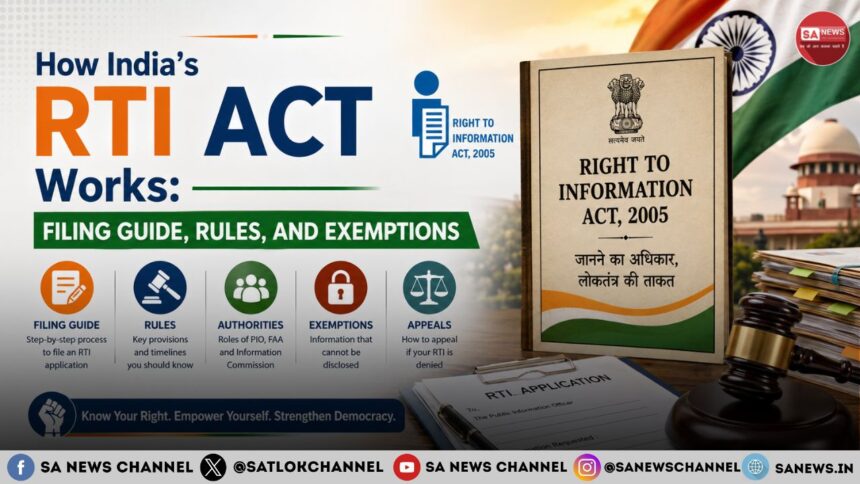
Have you ever wondered what actually happens behind the closed doors of a government office when a local road project stalls for months, or a welfare pension suddenly vanishes into thin air? For decades, the inner workings of Indian governance were hidden behind a wall of administrative secrecy. That dynamic shifted radically in 2005.
- Who Holds the Power and Who Must Answer?
- What You Can and Cannot Access?
- Procedural Safeguards and the Personal Data Clash
- Step-by-Step Guide: How to File and Pursue Your RTI
- Step 1: Ask for Records, Not Opinions
- Step 2: Choose Your Filing Route
- Step 3: Know the Clock and the Cost
- Step 4: File a First Appeal if Refused or Ignored
- Step 5: File a Second Appeal with the Information Commission
- Step 6: Be Realistic About Timelines
- Step 7: Avoid the Common Traps
- Practical Applications: RTI as a Civic Tool
- 1. Solving Local Issues (Roads, Sanitation, Public Services)
- 2. Tracking Welfare Schemes and Pension Applications
- 3. RTI for Students and Job Seekers
- Protecting Your Privacy and Safety
- From RTI to Aatmgyan: Uncovering the Ultimate Truth of Existence
Born out of a grassroots movement in rural Rajasthan where villagers demanded to see daily wage registers to expose widespread local fraud, the Right to Information (RTI) Act turned arbitrary bureaucratic secrecy on its head. Rooted in Article 19(1)(a) of the Indian Constitution, which guarantees our fundamental freedom of speech and expression, the law rests on a straightforward premise: a healthy democracy requires informed citizens who possess the statutory power to audit official records.
Who Holds the Power and Who Must Answer?
Can any organization or business file an RTI application? The short answer is no. Under Section 3 of the Act, this administrative key is placed solely in the hands of individual Indian citizens.
While corporate entities, foreign nationals, and NGOs cannot submit applications in their institutional names, any individual Indian national can step forward and file on their own behalf.
What makes this right so potent is its complete lack of entry barriers:
- Zero Justification Needed: Under Section 6(2), you are never required to explain to a bureaucrat why you want a document, nor do you need to disclose any personal details beyond name and contact address.
- Equal Financial Access: Age, formal schooling, and financial status pose no barrier to entry. If you fall under the Below Poverty Line (BPL) category, you are entirely exempt from paying application, photocopying, or document extraction fees.
Which Offices Are Legally Bound to Respond?
From an administrative standpoint, the law applies strictly to designated “Public Authorities” as defined under Section 2(h). Here is how the legal scope breaks down across different tiers of authority:
| Category | Representative Examples |
| Constitutional & Judicial Bodies | Supreme Court, High Courts, Election Commission of India, UPSC |
| Statutory Authorities | Reserve Bank of India (RBI), SEBI, National Human Rights Commission (NHRC) |
| Executive Institutions | NITI Aayog, Central Information Commission (CIC) |
| Substantially Funded Entities | NGOs, educational institutions, or private bodies heavily financed by government funds |
What about private corporations? Purely private companies lie outside the direct scope of the RTI Act.
However, an effective workaround exists: if a government regulator such as SEBI or the Registrar of Companies holds the statutory power to collect specific data from a private entity, you can formally request that information directly through the relevant regulatory body.
Proactive Disclosure Under Section 4
Why go through the effort of drafting a formal application if the information is already public? Section 4(1)(b) places a mandatory duty on every public authority to proactively publish 17 specific categories of operational data.
This includes detailed budget allocations, subsidy distribution schemes, and official staff duties. Public offices are required to keep these details updated online, minimising the need for citizens to file formal requests in the first place.
What You Can and Cannot Access?
How much power does a simple sheet of paper actually hold over a massive bureaucratic machine? Having managed RTI processing day in and day out, I can assure you that the scope of what citizens can request is far broader than most people realise.
The Right to Information Act does not just allow you to read administrative text on a screen. It gives you the legal right to inspect physical records, examine ongoing infrastructure projects firsthand, and even take certified physical samples of materials used in government projects.
Here is a breakdown of what is accessible versus where the legal boundaries lie:
| Category | What You Can Access via RTI | The Legal Boundary / Exemption |
| Financial & Contracts | Departmental budgets, sanctioned allocations, grant distributions, audit reports, utilization certificates, vendor bids, selection criteria, and signed public contracts. | Section 8(1)(d): Commercial confidence, trade secrets, or intellectual property where disclosure harms competitive positions of third parties. |
| Official Documents | File notes, actual officer reasoning recorded on active files, internal communications, policy drafts, certified logbook copies, internal notifications, and administrative circulars. | Section 8(1)(e) & 8(1)(b)/(c): Fiduciary data (bank client details, lawyer-client records) and information barred by court orders or breaching parliamentary privilege. |
| Physical Verification | The legal right to physically inspect ongoing site work (e.g., municipal road construction) and take certified physical samples of raw materials for independent testing. | Section 8(1)(g) & 8(1)(h): Details that endanger physical safety, reveal confidential informants, or hamper active criminal investigations. |
National Security, Cabinet Records, and Intelligence Agencies
Under Sections 8(1)(a) and 8(1)(f), records remain strictly protected if disclosure threatens India’s sovereignty, defence, strategic economic interests, or diplomatic relations with foreign states.
What about specialised intelligence and security agencies? Under Section 24, premier organisations listed under the Second Schedule (such as the Intelligence Bureau, RAW, and Enforcement Directorate) are broadly exempt from standard RTI inquiries entirely.
The Critical Catch
If your inquiry directly involves allegations of corruption or human rights violations within these exempted agencies, the blanket immunity vanishes. The agency is legally required to respond.
When it comes to Cabinet deliberations under Section 8(1)(i), discussions among Ministers, Secretaries, and advisors remain confidential while a policy decision is under active consideration. However, the underlying background papers and officer notes may become accessible once the decision is complete and the exemption no longer applies, subject to other applicable exemptions.
Procedural Safeguards and the Personal Data Clash
When an application hits a Public Information Officer’s desk, we cannot simply issue a blanket rejection just because sensitive details are involved. The law enforces three essential procedural safeguards:
- Reasoned Orders: A PIO cannot issue a vague or arbitrary refusal. Every denial requires a formal, written order explicitly citing the specific sub-clause of Section 8 and explaining why it applies.
- Severability (Section 10): If a document contains a mix of sensitive and public data, the PIO cannot reject the entire file. We are required to sever or redact the exempt portions and disclose the remaining non-exempt information.
- Public Interest Override (Section 8(2)): Even if requested data falls under a Section 8 exemption or the Official Secrets Act, a public authority retains the discretion to release it if the overall public interest in disclosure outweighs the harm to protected interests.
The Changing Landscape of Personal Privacy
The boundary between transparency and individual privacy has become considerably more contested. Section 8(1)(j) historically protected personal information that lacked connection to public activity, unless the disclosure served a larger public interest.
However, the Digital Personal Data Protection (DPDP) Act, 2023, which received presidential assent on 11 August 2023 subsequently altered this balance.
When the Central Government notified several DPDP provisions on 13 November 2025, Section 44(3) directly amended Section 8(1)(j) of the RTI Act. Critics argue that the amended wording narrows the scope for disclosing personal information in the public interest, though the constitutional implications remain under judicial review.
PIOs sit right at the center of this tension, deciding case by case whether a request falls within an exemption or survives on public interest grounds. Since the 2023 amendment narrowed the room for that judgment call, some PIOs now default to withholding personal information outright rather than weighing competing interests, which shifts more disputes toward the appeal process.
Prior to the amendment, if a Central Public Information Officer (CPIO), State Public Information Officer (SPIO), or appellate authority determined that disclosure served a larger public interest, the information could still be released. That determination is now harder to invoke, placing greater pressure on the First and Second Appeals process to correct over-broad refusals.
In response, three writ petitions currently pending before the Supreme Court filed by Venkatesh Nayak, The Reporters Collective Trust, and the National Campaign for People’s Right to Information (NCPRI) are directly challenging whether the amended Section 8(1)(j) has undermined this constitutional balance. Recognizing the major legal questions involved, the Supreme Court referred the matter to a larger bench in February 2026.
Step-by-Step Guide: How to File and Pursue Your RTI
Ready to draft your application? Following a structured, realistic process prevents unnecessary rejections and administrative delays.
Step 1: Ask for Records, Not Opinions
This is where most applications fail. PIOs must hand over existing documents, not explanations, interpretations, or justifications. “Avoid questions that begin with ‘why’ or ask ‘who is responsible.'”
Instead, request certified copies of work orders, file notes, inspection reports, or agreements. Anchor each request with a file number, project name, or date range, and list points separately (1, 2, 3) in plain, neutral language.
Step 2: Choose Your Filing Route
Confirm first whether the target department falls under the Union or a State government:
- Central Authorities: File through rtionline.gov.in with online payment via net banking, card, or UPI. You get an instant registration number and acknowledgement.
- State Authorities: Use the relevant state’s dedicated portal (such as Maharashtra, Delhi, Karnataka, etc.). Because some states still lack functional online portals, check online availability first.
- Offline Filing: Send by Speed Post or Registered Post to the CPIO or SPIO. Keep the receipt, since the 30-day clock starts from the date of receipt by the office, not posting.
- Hand Delivery: Submit at the counter and insist on a stamped receiving copy featuring the date.
- The Post Office Route: Under Section 5(2), designated Assistant Public Information Officers (APIOs) at post offices nationwide accept RTI applications for any department and must forward them to the correct PIO within 5 days, free of charge.
Step 3: Know the Clock and the Cost
Timelines and fee structures are strictly codified under the law:
- Standard Requests: 30 days from receipt.
- Life or Liberty Matters: 48 hours.
- Transferred Requests: 35 days (30 days plus a 5-day transfer allowance under Section 6(3)).
- Third-Party Information: Up to 40 days.
- Fees: ₹10 at the central level; states vary, typically ₹10 to ₹50. BPL cardholders are exempt with valid proof.
- Additional Charges: Photocopying around ₹2 per page, inspection often free for the first hour then charged hourly, and higher rates for CDs, floppy disks, or maps.
- Payment Methods: UPI, net banking, or card online; Indian Postal Order, Demand Draft, banker’s cheque, or cash offline.
- No-Response Penalty: If the PIO misses the deadline, the information must be given free, and the PIO may face penalty proceedings under Section 20.
Step 4: File a First Appeal if Refused or Ignored
If you get no response within 30 days, or an unsatisfactory or partial answer, file a First Appeal with the First Appellate Authority (FAA) of the same public authority within 30 days of the deadline or the reply (extendable to 45 days with recorded reasons).
State clearly what information was sought, what was denied or withheld, and why you are dissatisfied. The FAA is required to decide within 30 days, extendable to 45 days for reasons recorded in writing.
Step 5: File a Second Appeal with the Information Commission
If the FAA’s order goes against you, if the FAA misses its own deadline, or if the PIO’s reply remains evasive even after the First Appeal, you can escalate to an independent commission:
- Where to File: Central Information Commission (CIC) for Union public authorities, or the relevant State Information Commission for state authorities.
- Deadline: Within 90 days of receiving the FAA’s decision, or 90 days after the FAA’s deadline lapses if no decision was issued. The Commission can condone delay if you show sufficient cause.
- How to File Online: Online filing for Second Appeals and Complaints before the CIC is available through the Commission’s portal at dss.cic.gov.in, using a registered email ID or mobile number to log in. If you filed your First Appeal online, the portal can auto-retrieve your application and appeal details using the First Appeal registration number, email ID, and filing date.
- What to Include: Clearly state the information you sought, what wasn’t provided, your specific grounds for dissatisfaction, and a specific prayer (the relief you are asking for). If you are seeking compensation, include specific grounds and details of the loss or detriment you suffered.
- Commission Powers: The Commission can direct the authority to provide the information, and under Section 19, it holds powers to impose penalties on the PIO for unjustified delay or refusal, and award compensation to you for loss or detriment suffered.
- After the Second Appeal: This is the last administrative remedy; anything beyond it means filing a writ petition in the High Court under Article 226.
Step 6: Be Realistic About Timelines
Information Commissions are heavily backlogged nationwide, so a Second Appeal is not a fast fix. Karnataka’s Commission alone received 30,821 Second Appeals in 2024-25, up from 17,204 in 2020-21, and still disposed of only about half that year’s caseload.
Waiting periods of six months to several years are common depending on the state, so treat the Second Appeal as a serious escalation, not a quick remedy, and keep pursuing your First Appeal rights fully before relying on it.
Step 7: Avoid the Common Traps
File with the correct (state vs. central) portal, keep one subject per application, include full contact details, and retain every receipt and acknowledgement slip for later appeals.
Practical Applications: RTI as a Civic Tool
How can you use this legislation to solve everyday issues in your community? Here are four practical domains where requesting administrative records delivers real-world results:
1. Solving Local Issues (Roads, Sanitation, Public Services)
Municipal apathy often thrives in the absence of a paper trail. When a resident files an RTI asking for the sanctioned budget, work order date, contractor name, and inspection log for a stalled road repair, the civic body can no longer hide behind vague assurances.
Ask for the tender document, the measurement book entries, and the completion certificate rather than a general update, since these are records the department is bound to produce. This same approach works for garbage collection lapses, streetlight repairs, or water supply complaints: request the complaint register, the action taken report, and the official assigned to the case.
2. Tracking Welfare Schemes and Pension Applications
Delayed pensions, ration card rejections, or stalled scheme disbursements usually trace back to a file sitting untouched somewhere in the bureaucracy.
An RTI can ask for the current status of your application, the name of the official holding it, the date it was received, and the reason for delay if one has been recorded. For schemes like MGNREGA, disability pensions, or widow pensions, requesting the muster roll, payment order, or eligibility verification report often surfaces the exact point where the process stalled, giving you something concrete to follow up on.
3. RTI for Students and Job Seekers
Students who feel an exam result doesn’t reflect their performance have a legal route to verify it. Following the Supreme Court’s ruling in CBSE v. Aditya Bandopadhyay (2011), examination bodies must permit inspection or provide certified copies of evaluated answer sheets on request. You can also seek the model answer key, the marking scheme, and the cut-off or merit list used for a particular exam or admission cycle, which helps confirm whether marking was applied consistently.
Job seekers frequently face silence after clearing one stage of a recruitment process. An RTI can request the number of vacancies actually notified, the current stage of the selection process, the expected timeline for the next stage, or the reservation roster applied. For exams under scrutiny, you can also request the number of candidates who appeared, the number shortlisted, and the criteria used for shortlisting.
Protecting Your Privacy and Safety
The most frequent drafting error is asking a question that invites an opinion rather than a document. Phrases like “why was this delayed” or “who is responsible” give the PIO room to sidestep the request entirely. Reframe every query as a demand for a specific record: a certified copy, a register entry, or a dated file note. Keep each application focused on a single subject, since bundling unrelated topics is a common ground for rejection or partial replies, and number your points so nothing gets missed in the response.
RTI applicants have occasionally faced intimidation, particularly when exposing corruption at the local level. Where safety is a genuine concern, applicants can request that their personal details be withheld from any public disclosure log, though the PIO still requires your contact information to process the request itself.
Filing through a registered post or the online portal, rather than in person at a hostile office, creates a documented, time-stamped trail that is harder to dispute or suppress later.
Frequently Asked Questions
How do I file an RTI application online? For Central departments, use rtionline.gov.in and pay ₹10 via net banking, card, or UPI. For state authorities, use the relevant state portal.
What is the RTI fee for BPL applicants? BPL applicants are fully exempt from application, photocopying, and extraction fees, with valid proof (such as a BPL card).
What happens if an RTI application isn’t answered in 30 days? The information must be given free of charge, the PIO faces a potential penalty under Section 20, and you can file a First Appeal immediately.
Can RTI be filed anonymously? No – Section 3 reserves the right for Indian citizens, and a contact address is required. However, Section 6(2) means you don’t have to explain your reasons.
Is RTI applicable to private companies? No, but if a government regulator (like SEBI) has authority to collect that data from the private firm, you can file with the regulator instead.
What are the fees for document copies under RTI? Beyond the ₹10 application fee, expect ~₹2/page for copies. Inspection is free for the first hour, then hourly; higher rates apply for maps, CDs, or floppy disks.
How do I file a Second Appeal online? For Central authorities, use the CIC’s portal at dss.cic.gov.in with your registered mobile or email; First Appeal details can be auto-retrieved.
How long does a Second Appeal take? Backlogs mean resolution often takes six months to several years – Karnataka’s Commission alone received over 30,000 appeals in 2024–25 and cleared roughly half.
From RTI to Aatmgyan: Uncovering the Ultimate Truth of Existence
Just as the law grants us the Right to Information (RTI) to uncover the truth and hold the government accountable, the Supreme God has given humanity the inherent right to divine information. This is our right to know the absolute truth of our existence (Aatmagyan) and the true nature of God (Parmatmagyan).
Yet, humanity has been deceived. The god of this physical world has veiled our minds, stripping away our ability to easily comprehend this vital Aatmagyan. Because our spiritual awareness has been compromised, a true Satsang (spiritual discourse) acts as our designated “RTI Portal.” It is through this portal that we can bypass worldly illusions, file an appeal for the truth, and finally attain genuine Parmatmagyan.
To truly understand this profound reality, read the sacred book Gyan Ganga. For more information, visit: www.jagatgururampalji.org