


Money is undergoing its most radical transformation since the invention of paper currency. Across the globe, central banks and monetary authorities are actively exploring or piloting Central Bank Digital Currencies (CBDCs) to modernize traditional financial infrastructure. From India’s e-Rupee and China’s e-CNY to Europe’s ongoing digital euro initiatives, digital fiat money is moving from theoretical research into everyday retail transactions. As digital payments become the global default, understanding the shift toward central bank digital tokens, stablecoins, and cash-free economies is essential. Here is your comprehensive guide to how CBDCs work, why they matter, and what lies ahead for personal financial freedom.
- Understanding the Landscape: What Are Digital Currencies and CBDCs?
- The Two Core Models of CBDC Architecture
- Key Drivers Accelerating the Transition to Digital Fiat Money
- The Decline of Physical Cash
- Enhancing Financial Inclusion
- Streamlining Cross-Border Transactions
- Countering Unregulated Private Stablecoins
- Global Overview: How Different Nations Are Approaching CBDCs
- The Benefits and Promise of CBDCs
- Core Challenges, Risks, and Privacy Concerns
- The Convergence of Blockchain, DeFi, and Sovereign Currencies
- Connecting Financial Evolution with True Spiritual Wisdom
- FAQs on the Future of Digital Currencies and Central Bank Digital Currencies
Understanding the Landscape: What Are Digital Currencies and CBDCs?
To navigate the future of money, one must first distinguish between various forms of digital assets. While private cryptocurrencies like Bitcoin operate on decentralized networks without central oversight, a Central Bank Digital Currency (CBDC) is a sovereign, digital form of a country’s national fiat currency. Issued and backed directly by a central monetary authority-such as the Reserve Bank of India, the Federal Reserve, or the European Central Bank-a CBDC represents an official legal tender and direct liability of the issuing government.
Unlike commercial bank deposits, which are claimable against a private banking institution, a unit of CBDC is equivalent to holding physical banknote cash, but in a secure digital wallet on a smartphone or dedicated hardware device.
The Two Core Models of CBDC Architecture
Central banks approach digital currency implementation through two distinct structural frameworks:
Retail CBDC (rCBDC): Designed for direct everyday use by the general public, consumers, and local businesses. Retail CBDCs serve as digital cash for grocery purchases, peer-to-peer transfers, online shopping, and bill payments.
Wholesale CBDC (wCBDC): Restricted exclusively to commercial financial institutions, interbank settlement clearinghouses, and major international trade corridors. Wholesale models optimize interbank liquidity, streamline security settlements, and dramatically decrease cross-border transaction latency.
Key Drivers Accelerating the Transition to Digital Fiat Money
The global momentum behind central bank digital currencies is driven by several economic, technological, and societal shifts:
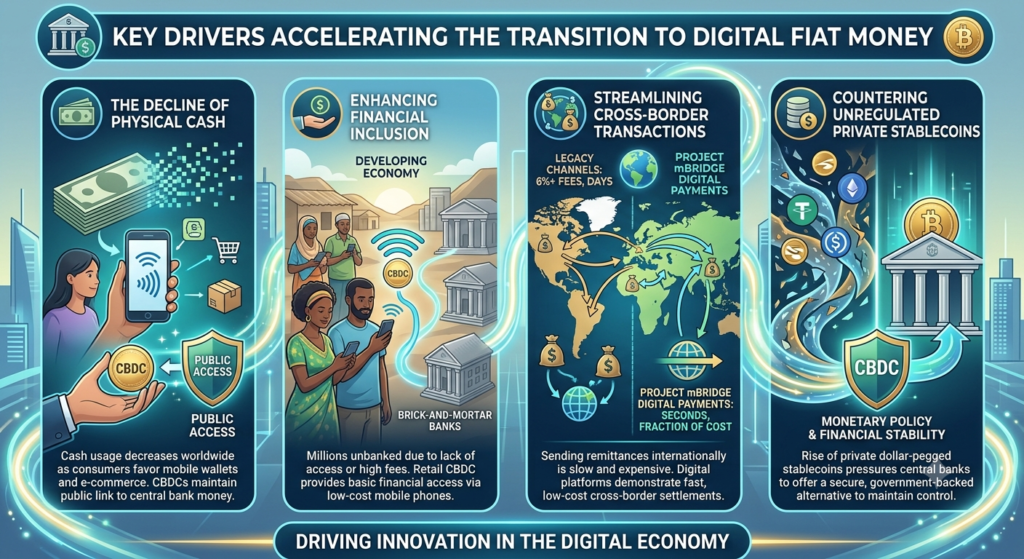
The Decline of Physical Cash
Worldwide cash usage has steadily decreased over the last decade. As consumers favor mobile payment wallets, tap-to-pay contactless cards, and e-commerce platforms, sovereign governments risk losing direct public connection to central bank money. CBDCs preserve public access to risk-free central bank money in a digital-first world.
Enhancing Financial Inclusion
In many developing economies, millions of individuals remain unbanked due to lack of brick-and-mortar branch access or steep account maintenance fees. A retail CBDC can offer basic financial access to any individual possessing a low-cost mobile phone, bypassing the administrative hurdles of traditional commercial bank accounts.
Streamlining Cross-Border Transactions
Sending remittances across international borders using legacy banking channels often incurs fees exceeding 6% and takes several business days. Projects like Project mBridge-which connects multiple central bank digital platforms-demonstrate that sovereign cross-border digital payments can settle in seconds at a fraction of the cost.
Countering Unregulated Private Stablecoins
The rapid rise of private dollar-pegged stablecoins (such as USDT and USDC) has pressured central banks to offer a secure, government-backed alternative. Monetary authorities fear that widespread reliance on private digital tokens could undermine domestic monetary policy execution and compromise national financial stability.
Global Overview: How Different Nations Are Approaching CBDCs
Different regions are charting their own paths regarding digital currency deployment:
China: The Pioneer in Scale
The People’s Bank of China (PBOC) leads large-economy adoption with its e-CNY (Digital Yuan) pilot. Spanning tens of major metropolitan hubs, the e-CNY is integrated into popular super-apps like WeChat and
Alipay, utilized for municipal transit, government worker payrolls, and cross-border trade settlements.
India: Expanding the e-Rupee
The Reserve Bank of India (RBI) continues expanding its Digital Rupee (e₹) pilot across retail and wholesale sectors. By introducing offline payment functionality, programmable disbursement for government schemes, and integration with existing UPI QR codes, India is testing how CBDCs can coexist alongside established instant payment rails.
Europe: The Digital Euro Strategy
The European Central Bank (ECB) is advancing through its preparation phase for the Digital Euro. European regulators emphasize consumer privacy for small-value offline transactions, strict wallet holding limits to prevent bank runs, and independence from non-European commercial payment networks.
The United States: Focus on Regulated Stablecoins
Unlike other major economic blocs, the United States has taken a cautious stance on issuing a retail Digital Dollar. Following legislative and policy shifts, US regulators are prioritizing a robust regulatory framework for private US dollar stablecoins and wholesale interbank innovations over a government-run retail CBDC.
The Benefits and Promise of CBDCs
The implementation of sovereign digital tokens offers several transformative advantages for economic systems:
Instant Settlement: Transactions settle in real time directly on the central bank ledger, eliminating settlement risk and clearing delays.
Programmable Payments: Governments can automate targeted fiscal disbursements, social welfare payments, and agricultural subsidies directly to eligible beneficiaries without intermediary leakages.
Lower Transaction Costs: Eliminating intermediary banking hops significantly reduces merchant payment processing fees and cross-border remittance costs.
Enhanced Transparency against Financial
Crime: Digital ledgers make tracking illicit money flows, tax evasion, and money laundering far more effective for regulatory bodies.
Core Challenges, Risks, and Privacy Concerns
Despite the clear efficiency gains, the global adoption of Central Bank Digital Currencies faces serious technical, structural, and societal hurdles:
Commercial Bank Disintermediation
If citizens transfer their savings directly into central bank digital wallets during times of economic panic, commercial banks could suffer sudden liquidity drains. If commercial deposits shrink, traditional banks have less capital to lend to home buyers and small businesses, potentially slowing broader economic growth.
Privacy versus Oversight
Physical bank cash offers absolute anonymity. In contrast, a fully centralized digital currency ledger gives government entities theoretical access to every citizen’s transaction history. Striking a delicate balance between anti-money laundering (AML) enforcement and protecting citizen financial privacy remains the most contentious debate surrounding retail CBDCs.
Cybersecurity Risks
Centralized digital currency infrastructure presents an extremely high-value target for state-sponsored cyberattacks, distributed denial-of-service (DDoS) attempts, and systemic software glitches. A major outage in a national CBDC system could stall an entire country’s commerce.
Also read: Important Security Alert! If you’re an Apple device user, beware
The Convergence of Blockchain, DeFi, and Sovereign Currencies
The future financial architecture will not be dominated by a single payment mechanism. Instead, we are entering a multi-asset financial ecosystem where blockchain technology, decentralized finance (DeFi), private stablecoins, and sovereign CBDCs coexist.
Interoperability protocols are being designed to allow seamless exchange between regulated commercial bank tokens, dollar-backed stablecoins, and official central bank digital assets. Through tokenization of real-world assets (RWA) and automated smart contracts, wholesale digital money will power next-generation global trade finance, stock
clearing, and corporate treasury management.
Connecting Financial Evolution with True Spiritual Wisdom
As humanity transitions from physical coins and paper notes to intangible digits on a computer screen, this monetary evolution offers a profound mirror to our mortal existence. For centuries, human beings have expended their precious lifespan, mental energy, and physical labor chasing material wealth-first in gold, then in paper, and now in digital bits. Yet, despite all technological advancement and financial innovation, material wealth remains fleeting and incapable of providing permanent peace, safety, or salvation.
In the Satsangs (spiritual discourses) of Sant Rampal Ji Maharaj, humanity is reminded of the fundamental truth revealed in the sacred scriptures (Vedas, Bhagavad Gita, Quran, and Guru Granth Sahib). Sant Rampal Ji Maharaj explains that worldly wealth-whether in the form of physical currency or advanced digital tokens-is tied purely to this temporary physical world. None of this monetary balance can accompany a soul beyond death.
Sant Rampal Ji Maharaj teaches that while honest labor (Haq-Halal earnings) is necessary for fulfilling basic family needs, engaging in relentless greed, corruption, and the blind pursuit of material accumulation leads only to bad karmic debts and future suffering. He advocates a life rooted in moral integrity, non-violence, freedom from addictions, and devotion to Supreme God Kabir (SatPurush) through a Tatvdarshi Saint.
Just as central banks are trying to create a secure, scam-free monetary standard through CBDCs, true spiritual worship (Sat-Bhakti) given by Sant Rampal Ji Maharaj provides the ultimate, imperishable spiritual currency (Naam Dhan). This spiritual wealth protects the soul from life’s afflictions and grants permanent liberation (Moksha) in Satlok-an eternal realm where no crisis, decay, or financial insecurity exists.
FAQs on the Future of Digital Currencies and Central Bank Digital Currencies
Q1: What is a CBDC, and how is it different from regular online banking?
A CBDC is direct digital money issued by a nation’s central bank, acting as a sovereign legal tender equivalent to paper cash. Regular online banking represents a digital balance held with a private commercial bank, which carries institutional credit risk, whereas a CBDC is a direct liability of the central government itself.
Q2: Will Central Bank Digital Currencies replace physical cash completely?
Most central banks, including the ECB and RBI, explicitly state that CBDCs are designed to complement physical cash rather than eliminate it immediately. Cash will remain available for vulnerable populations and those who prefer physical payment methods, though its overall usage will continue to decline naturally.
Q3: Is a CBDC the same as Bitcoin or cryptocurrency?
No, CBDCs and cryptocurrencies are fundamentally different. Bitcoin is a decentralized, private digital asset with volatile market pricing and no central backing. A CBDC is fully centralized, controlled by a government monetary authority, and pegged 1:1 to the national legal currency.
Q4: How do CBDCs impact personal privacy?
Privacy levels depend heavily on individual CBDC design. Most central banks are developing tiered privacy models-allowing high anonymity for small, routine daily payments while requiring identity verification for larger transactions to prevent tax fraud and money laundering.
Q5: What are the main benefits of CBDCs for ordinary citizens?
For everyday consumers, CBDCs provide faster, safer, and cheaper digital transactions without requiring commercial bank account fees. They also enable offline digital payment capabilities during network outages and ensure instant delivery of direct government welfare funds.