


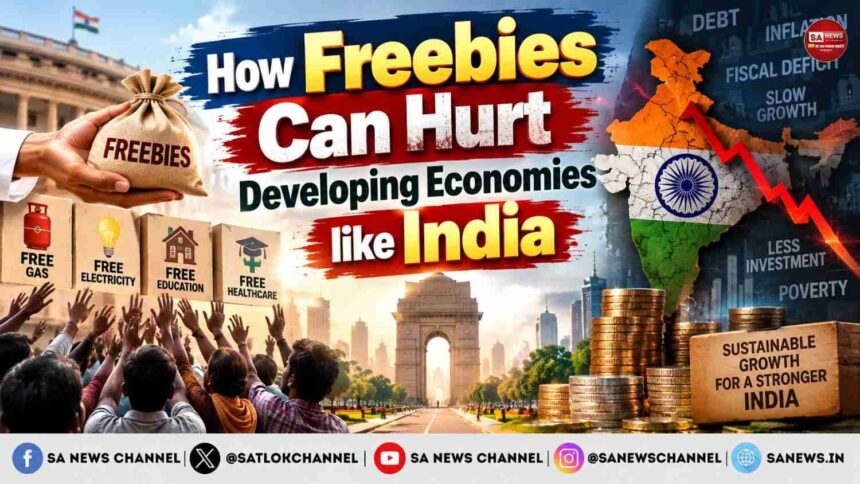
A free electricity connection, a monthly cash transfer, subsidised food, free public transport or a promise to waive a bill can make an immediate difference to a household. To someone struggling to pay for food, education or healthcare, such support need not be an abstract economic proposition. It can be a difference between getting by in a month and finding greater financial stress.
- The difference between welfare and freebies
- The hidden cost of “free”
- The pressure on state governments
- Debt is not free money
- Free electricity can create another problem
- The opportunity cost is the bigger issue
- But welfare spending can also strengthen the economy
- The danger of creating dependency
- India needs to think beyond the next election
- What India should focus on
- The real cost is measured in missed opportunities
- That is the balance India will have to maintain.
The problem arises when governments start treating perpetual giveaways as a substitute for economic development.
A public expenditure in a developing country like India has to serve multiple purposes. It has to support the poor, build roads and railways, improve schools and hospitals, create jobs, strengthen infrastructure and maintain public services. When a growing proportion of the budget goes towards on-going giveaways, governments have less leeway to invest in things that can boost productivity and incomes over years.
This is not to say that all subsidies are bad, though. India’s food-security programmes, scholarships, healthcare support and targeted assistance to vulnerable groups are important social instruments. The question is whether public expenditure is helping people become economically stronger or making them reliant on government support.
The difference between welfare and freebies
The terms “welfare” and “freebies” may seem synonymous but are not necessarily economically the same thing.
A government programme that is providing nutrition to children, better maternal healthcare, education support or temporary assistance to families facing extreme poverty can have long-term benefits. Better nutrition can be linked to better learning. Better education can be more employable. Healthcare can prevent families from being pushed into poverty.
A political promise to provide an infinite or perpetual benefit with little or no cost to the recipient, however, may have a very different economic impact, especially where there is no obvious funding source.
This is important because India is still investing heavily in its development. The country needs productive infrastructure, skilled workers, modern agriculture, reliable electricity, better urban services and stronger manufacturing and services sectors.
The Economic Survey 2025-26 mentions that revenue expenditure has moderated from 13.6% of GDP in FY22 to 10.9% in FY25. It also notes that rationalising discretionary spending — and particularly subsidies — can create fiscal space for more productive expenditure, and that major subsidies were at around 1.2% of GDP in FY25 and budgeted for 1.1% in FY26.
The problem is not simply how much a government spends. It is what a government’s spending achieves.
The hidden cost of “free”
Nothing is really ‘free’ where it is being paid for by the government.
The money will come ultimately from taxation, government revenues, borrowing, or a combination of the three. If a state government provides free electricity, the cost does not just vanish. It may show up as a subsidy in the budget, an unpaid bill to a power distribution company or as added borrowing.
The benefit today is clear to see, but the long-term cost is far less obvious.
A family may receive a benefit today while the cost is distributed across millions of taxpayers and future budgets.
It is a political incentive that can be challenging to ignore. A benefit received directly by a voter is easy to see. The opportunity cost of not building a road, school, irrigation system, or industrial facility is much harder to see.
That’s why governments can feel pressured to expand on popular schemes, even if the long-term fiscal consequences deserve closer scrutiny.
The pressure on state governments
The issue is important at the state level as many states are responsible for many essential services, including education, health, agriculture, transport and electricity distribution.
The Comptroller and Auditor General’s State Finances publication shows some significant variation in subsidy spend between states. In FY2022-23, Punjab spent around 17% of its total expenditure on subsidies while Gujarat, Andhra Pradesh and Rajasthan also spent over 10%.
These figures in themselves do not prove that the subsidy is good or bad. Different states have different structures and requirements. They demonstrate why recurrent subsidies are important to a state’s expenditure, however.
There is also the issue of governments having large fixed obligations.
Salaries, pensions and interest payments cannot be easily switched off when revenue falls. The more spending is committed to recurring expenditure, the less flexibility there is during an economic shock.
And borrowing today means repayment tomorrow.
Debt is not free money
Borrowing can be useful where it finances an asset that increases future economic capacity.
Suppose a government borrows money to construct a highway linking an agricultural region with major markets. The road may reduce transportation costs, increase farm incomes, attract businesses and generate additional tax revenue over time.
Borrowing to finance a permanent consumption benefit is different.
The benefit may disappear after the money is spent, but the debt remains.
This does not mean that governments should never borrow for social protection. During a crisis, borrowing can be necessary to protect households and prevent an economic downturn from accelerating.
The danger is where temporary support becomes a permanent political commitment without a sustainable revenue base.
Interest payments are a good illustration. According to the CAG’s state-finances analysis, several states were already spending over 10% of their total expenditure on interest payments in FY2022-23, including Haryana, Punjab, West Bengal, Kerala, Tamil Nadu, Rajasthan, Andhra Pradesh, Gujarat, Telangana and Karnataka.
Every rupee spent servicing old debt is a rupee that cannot simultaneously be spent on a new road, school or hospital.
Free electricity can create another problem
Electricity subsidies provide a good example of the trade-off.
Cheap or free power can help poor households and farmers. But if electricity is priced far below its economic cost for a large consumer group, it can encourage excessive consumption and undermine the finances of distribution companies.
Poorly targeted power subsidies can also make it hard for utilities to invest in modern grids, reduce transmission losses and improve service quality.
The result can be a strange cycle of governments subsidising electricity because the system is inefficient, but the financial weakness induced by poorly-designed subsidies can make the system even harder to improve.
A better approach would be to provide targeted support plus invest in efficiency, renewable energy, distribution infrastructure and reliable electricity supply.
The opportunity cost is the bigger issue
Perhaps the biggest economic cost of freebies is not the money directly spent on them.
It’s what the government cannot do with that money.
Imagine a state has ₹10,000 crore available for additional spending.
It could use a big chunk of it for recurring giveaways. Or it could invest in irrigation, industrial infrastructure, government schools, hospitals, urban transport and skill development.
The second option may not provide an immediate political dividend, but if those investments boost productivity, they can deliver benefits for decades.
A functioning industrial corridor can create jobs for years.
A good school can educate thousands of children.
An irrigation project can improve agricultural productivity across generations.
A modern hospital can prevent families from losing their savings to medical emergencies.
This is why economists often focus on the quality of expenditure rather than its size.
Also Read: Sant Rampal Ji Maharaj Came as ‘Deenanath’: Prosperity Returned to Fodar Village of Mathura
But welfare spending can also strengthen the economy
The debate becomes misleading if every welfare programme is labelled a wasteful freebie.
India has millions of households that remain vulnerable to economic shocks. Taking away support without creating alternatives could increase poverty and inequality.
The Economic Survey 2024-25 noted that government social-services expenditure rose from 23.3% of total expenditure in FY21 to 26.2% in FY25 Budget Estimates. It also highlighted the role of government welfare programmes in supporting consumption and income-generating activity among low-income households.
There is also evidence that better delivery can make welfare spending more efficient. The government has reported that Direct Benefit Transfer systems have helped reduce leakages and improve the delivery of subsidies and benefits.
This leads to a more useful question:
Not “should governments give anything for free?”
But “which support produces the greatest social and economic return for public money?”
The danger of creating dependency
Another concern is that permanent subsidies can sometimes change incentives.
If an individual receives temporary support while search for employment, the assistance can act as a safety net.
But if benefits become detached from economic circumstances and continue indefinitely, they may reduce the incentive to increase income in some situations. The impact varies greatly depending on the programme design, so it would be wrong to assume that every recipient becomes dependent.
The better approach is to design assistance around empowerment.
For example, support can be allied with education, skill development, healthcare, employment services, entrepreneurship or agricultural productivity.
The goal should be to help a household move from vulnerability to stability.
India needs to think beyond the next election
This is perhaps the hardest part of the debate.
Democratic governments operate under electoral pressure and political parties compete to provide programmes that voters find attractive. This is a normal part of democracy.
But public finance operates on a much longer timeline.
A government may make a promise today, implement it tomorrow and leave the repayment burden to governments several years later.
This is why the transparency of announcements of major subsidies or giveaways is key.
Whenever a major subsidy or giveaway is announced, citizens should be able to see its estimated annual cost, funding source, the number of beneficiaries, expected social benefits and long-term fiscal implications.
Such transparency would make the debate less emotional and more economic.
What India should focus on
India does not need to choose between economic growth and social protection. It needs to make them work together.
The priority should be targeted assistance for people who genuinely need it plus aggressive investment in areas that boost future earning capacity.
That means better government schools, stronger healthcare, skill development, affordable housing, reliable electricity, irrigation, logistics, transport, digital infrastructure and an environment in which businesses can create jobs.
A welfare programme that helps a child stay in school can be an investment. A programme that improves nutrition can be an investment. A temporary income-support programme during a crisis can be justified. But a system in which governments expand unfunded consumption promises can gradually reduce the money available for development.
The real cost is measured in missed opportunities
The biggest danger of excessive freebies is not that people receive benefits. It is that a country may become comfortable distributing a limited economic pie instead of expanding it.
India’s challenge is to get millions of people into higher-productivity jobs, raise household incomes, improve human capital and build infrastructure that can support a much larger economy.
This requires public money to be used carefully.
The answer is not to eliminate welfare. It is to distinguish between a safety net and a permanent fiscal burden.
A developing economy needs to protect people who cannot protect themselves while simultaneously creating conditions in which fewer people need government assistance in the future.
From Economic Security to Spiritual Security
The debate over freebies highlights an important economic question: should public resources only provide immediate relief, or should they also help people build long-term stability and self-reliance? Targeted welfare can protect vulnerable families, while education, healthcare, skills and infrastructure can strengthen their future earning capacity. A similar principle can be considered in spiritual life: temporary material benefits cannot address the deeper questions of human existence. According to the spiritual knowledge of Sant Rampal Ji Maharaj, true spiritual knowledge and scripturally supported devotion are important for understanding the soul’s ultimate purpose. His teachings also connect spirituality with helping those in need through humanitarian initiatives. To learn more about his spiritual teachings and humanitarian work, visit the Annapurna Muhim YouTube channel.
That is the balance India will have to maintain.
Freebies may provide an immediate benefit, and in some circumstances targeted subsidies are entirely justified. But when recurring giveaways consume resources that could otherwise build productive capacity, the bill does not disappear. It just moves into the future — through higher debt, weaker public services, fewer investments and fewer opportunities for the next generation.
The real measure of good economic policy is not how much a government gives away today, but whether the economy is stronger tomorrow because of what the government spent today.